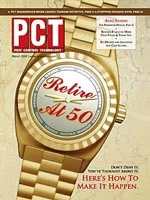
It’s finally the end of the day, and it hasn’t been one of your better ones. What with the customer who called for another retreat, the technician who asked for help on his paperwork — which was due last week, and the supplier who brought the wrong product, you can only dream of retirement...leisurely days filled with nothing but golf, travel and grandchildren. Or does your ideal retirement mean finally starting that venture you’ve always envisioned — a small (non-pest-related!) business, political or charitable volunteer work, or going back to school?
And, in that vision of yourself living out your retirement years, how old are you? 50? 58? 64? 73?
Whether your retirement dream is leisurely or active, early or in your later years, today’s retirement is not like that of your grandfather, and achieving a financially stable and fulfilling retirement means doing some pre-planning, both mentally and financially, say retirees and financial planners alike.
|
Ready to Retire? BY PAMELA JORDAN 1.) The most important thing you must do is determine what buyers are willing to pay and build your business with that in mind. Pay attention to the deals going on in the industry and in your area of the country. Know what buyers are looking for. Know which buyers want what you have to sell. The better your business matches the acquisition criteria of the buyer, the more they will be willing to pay, within the range of fair market value. 2.) Set goals. When do you want to sell? How much do you want to sell for? Review the tax consequences of a sale with a qualified CPA and make changes, if possible, to maximize your after-tax proceeds at sale. Give yourself time to get the business ready — start preparation long before you are ready to exit. 3.) Keep your eye on the goal but don’t etch it in stone. The economy, the market for acquisitions and the activity of buyers in our industry can make a big difference in your sale price. And always remember — sell when the market and your business are at their peak! 4.) Analyze your business on a regular basis with the critical eye of a buyer. Using an outside source — such as a business broker, your CPA or a comparison to industry operating surveys — can be helpful. (The National Pest Management Association or your state association can be a good source of industry data.) 5.) Look to sell when you can demonstrate at least three consecutive years of sustained growth, profit and solid customer retention. 6.) The more “repeatable” business the better, i.e., recurring customer accounts or routes and termite renewals. Repeatable total revenue of 75 percent or more is highly desirable. 7.) Refrain from putting into place compensation, benefit or bonus programs that drive the operating costs to a point that buyers would find it hard to continue them after the close of the deal. 8.) Pay down debt and limit long-term leases and obligations as your exit date draws near. Assets must be delivered to the buyer debt free or the purchase price will be reduced by the amount of debt or leases assumed by the buyer. Either way, it comes out of your pocket. 9.) Be sure to have valid and enforceable employee non-disclosure/non-solicitation agreements on all employees. Have them reviewed to be sure they are up to date with current law in your state(s) and if they are not transferable, it would be advisable to make that change long before you contemplate the sale. 10.) Resolve, or be sure there is insurance coverage in place to cover, any claims or litigation that exist at the time you plan to go to market with the business. Make sure you have in-surance in place that is written on an “occurrence” basis not “claims made.” Be sure your policy will cover claims that occurred after the sale date but during your ownership. The author is president of Acquisition Strategies, Tampa, Fla. She offers business valuation, sale preparation, consulting and brokering services for buyers and sellers exclusively in the pest and lawn care industries. She is also the author of the book “Level the Field,” which contains “everything you need to know to sell your most valuable asset for the most money at the right time.” Visit www.levelthefield.com for more information. |
In the 1950s the average life expectancy in the United States was 68 years. By 2002 that average had risen to age 77, according to the most recent report by the CDC’s National Center for Health Statistics. And once you’ve lived to be 65, you can expect to live another 18 years. When our grandfathers retired, many simply planned to spend their last few years in their easy chairs, enjoying the rest and relaxation they’d earned from their years of work. Today’s retirees tell an entirely different story.
MENTAL SHARPNESS. "For the last 30 years, we have been trained to go, go, go, produce, produce, produce," said Don Jamison of Jamison Consulting and a retired pest control company owner. "If you think you can live with that pace, then retire to the grandkids and travel, you better rethink your position. You better have something to focus on."
That "something," Jamison explained, can be anything from getting into politics to becoming a greeter at Wal-Mart. "You need something to do. Retirement is not going to fly for 99 percent of the population today."
In 1998, Jamison sold his company Jamison Pest Control to Terminix. Financially, he could have gone into full retirement at that time, but instead he chose to consult in the pest industry — racking up 60,000 air miles each year. "That’s not retirement!" he said. But after Sept. 11, Jamison added, the travel became oppressive and his consulting practice was not fun anymore. He decided, once again, that he was ready to move on. "I went into full retirement," he said, "and that’s when the pooh-pooh hit the fan."
It didn’t take Jamison long to get back into business. "I was just burned out. I’d had all I wanted," he said. So he started up a small lawn care business, which he still operates today, with four employees and its own new challenges. "I’m the secretary, I answer phones. I do computer entry," he said. "For me to sit down and learn (a software) program is like pulling a tooth — but it’s more fun than I’ve had in forever!"
Going back into business is not the only way to keep your mind — and body active. Chuck Steinmetz sold his company, All America Termite & Pest Control, to Sears, then continued to work for them, he said. When he did retire at age 58, "I had no desire to go back to day-to-day business." However, he added, "You have to have a plan for retirement. You can’t just stop working."
Steinmetz had been active on the board of the Orlando Science Center while he was still working, but upon his retirement, he increased his support, accepting the election as chairman of the board. Shortly thereafter, though, the Center’s CEO left, and Steinmetz became interim CEO. For that first year, he was back to working almost full time. Although he’d not intended to take on such a daily job, he said, "it was one of the most wonderful things I’ve ever been involved with."
Today, though Steinmetz still owns Middleton Pest Control, he acts as an absentee owner and he and his wife have settled into more of a leisurely — but active — retirement. "We decided to buy a place in Vale, Colo.," he said. "I decided to take golf lessons." And it wasn’t long before Steinmetz realized he greatly enjoyed the challenge of golf and became an avid, serious player. In addition, the couple travels extensively and collects art, exercises regularly, and Steinmetz serves on the board of Rollins College Business School, is an avid reader, does some consulting work and enjoys his grandkids. "I took them to the circus yesterday," he smiled.
"Each day is very busy. When I get up in the morning I can do anything I want to do. There’s nothing I have to do."
FINANCIAL STRENGTH. Steinmetz is enjoying his retirement primarily because he planned for it both mentally and financially. "You have to be able to fund it," he said. "If you depend only on Social Security, I think you’ll starve to death." Such planning, he said, begins far in advance. "You need to somehow develop the sources for a monthly income." And for this, he said, the pest control industry is a great place to spend a career.
"You can go into business with very little money. If you go out and knock on doors, you’ll get someone to buy your services," he said. And Steinmetz feels it is just such entrepreneurs who have built the industry’s success. "I encourage people to do that," he said. "It’s what makes the industry better."
But building and selling a business is not the only way to build your retirement funds. Rather, said Denny Zaverl, president of the financial planning firm Zaverl & Associates, it’s a matter of determining how much money you need to live the retirement you want, then putting your money in the right places to get you there.
The best definition of retirement, Zaverl believes, is "being able to do everything you want to do and nothing you don’t want to." So the question is: "How much money do you need to be able to do what you want?" Most people, he said, want to maintain a lifestyle similar to that they had while they were working. That is, if you traveled, golfed or had a boat prior to retirement, you’ll want to maintain these interests afterward as well. (See related story on page 36.)
Because of this, and ever-rising life expectancy rates, Zaverl said he does not see many people retiring in their early 50s. "I hear all this talk of the 50s thing, but I sure don’t see a lot of it," he said. "In my experience, it’s not easy to retire at 50, because the amount of money necessary to live out a normal life expectancy is fairly high."
|
How Much Do You Need To Retire? In its most recent report, the National Center for Health Statistics placed life expectancy for the United States at the age of 77.4, the highest in history. And, once you’ve lived to be 65, you can expect another 18 years as well. That means if you are to retire at the age of 50, you need to have a financial plan for living out the next 30 to 40 years. To put this into dollars: If you have investments making 5½ percent interest — a good average to plan on, said Denny Zaverl, Zaverl and Associates, and you would like to retire at 50 and live on $70,000/year ($5,700/month), you will need a $1 million portfolio to fund your remaining 30-year life expectancy. You will be living on the interest and a bit of the principle. To have an annual income of $35,000 for 30 years, you would need investments of $500,000 at 5½ percent. However, you also need to realize that these figures are in today’s dollars, Zaverl cautions. When you adjust for inflation, your money will be worth about half its value in about 20 years, which means the $70,000 you planned on will only be worth $35,000 when you are 70 years old; or the $35,000 worth $17,500. By the time you are 80 to 85, the inflation adjustment is not as critical, as your lifestyle will generally have changed enough to negate the effect, he said. In addition, if you are 50 years old, married and in good health, you can probably expect that either you or your spouse will live to the age of 90. “At 50,” Zaverl said, “I wouldn’t plan to die at 80!” However, this means that your money will need to stretch even further: If you have $1 million, you will need to live on $60,000 per year to make it stretch for 40 years. “Taking a realistic view of how much you would like to live on — in today’s dollars — is so important,” he said. “That’s the challenge of retiring early — today’s long lifestyle requirements.” |
Whether you are planning to retire at 50, 70 or somewhere in between, the real key is "getting yourself in a position to have ‘no-touchy money,’" Zaverl said. "No-touchy money" is his term for money which you are willing and able to invest long-term, at least 10 to 15 years — and not touch. From there it’s a simple plan of 1-2-3:
"Invest in things that you get tax deductions for first," starting with those which provide tax-deferred monies. Put as much as possible into 401(k)s, IRAs, profit-sharing, pensions and education funds, Zaverl said . Contributions to such plans are tax deductible and the invest-ment’s growth is tax-deferred. "Tax-free growth, in the long run, is even better than tax-deductible," he said.
Once you’ve maximized your tax-deductible investments, use after-tax savings vehicles such as section 529 plans, Roth IRAs and variable annuities for monies you don’t project needing in the next 10-15 years.
Finally, invest in the market. The younger you are, the more risk you can take; As you get closer to retirement, you should back off to lower risk investments. "You don’t want to be rolling the dice in Las Vegas with your retirement money," he said.
Above all, Zaverl says, the simplest way for someone to fund their retirement is to follow the simple maxim: "Pay yourself first." There have been a number of studies which prove that if you "...save 10 percent off the top — you’ll never have to worry about retirement. And that’s really true!" he said.
A GOOD INDUSTRY. While both Jamison and Steinmetz were able to retire early by selling their successful pest control businesses, it was not financial goals that drove their success. "You work for the intellectual stimulation it brings," said Steinmetz, who was trained as an entomologist. "The material side was not my goal. It was accomplishing certain things that had not been (accomplished)."
Jamison, who adds that he has "sincerely enjoyed the step down at 60 years," said he also misses the pest management industry and the people he met through the years. "You have to understand that this industry is different than most," he said. "Bug guys are earthy people. They’re upright and trustworthy."
And both men are proud to say they helped build the industry to what it is today. Steinmetz pioneered annual treatments and Jamison, in his role with the National Pest Control Association when it was a "fledgling" operation. "I’m really, really proud to that I’m an instigator, on the ground floor...and now it’s really making a difference in the industry."
THE LAST WORD. It wouldn’t be right to end an article about retiring at 50 on any other note than Jamison’s final caution. "If you’re going to retire at 50 or earlier, you need to have a pretty good plan or a terminal illness. For goodness sake, think about what you’re going to do besides golf and the grandkids."
The author is a freelance writer who frequently writes about the pest control industry. She can be reached via e-mail at llupo@giemedia.com.
|
FIVE YEARS LATER By: Don S. Jamison
When and why did I retire? The time and conditions wereright for me. My daughter wanted nothing to do with the perpetuation of the organization, I was 55 years old and took over the company when I was 20 years old and had done nothing else! And, I think I was just a little “burnt out” at that point.
I sold Jamison Pest Control to Terminix in 1998 and the day I sold to them, I was gone. Terminix wanted nothing to do with me, my culture or my concepts for or about the pest control business. They wanted my accounts and the competition that my company posed to them gone.
For two years following the sale, I consulted with smaller pest control companies and spoke for training programs, company meetings, local, state and national association meetings and conferences. I logged 60,000+ air miles each year and when Sept. 11 occurred, travel was just no fun anymore!
I cut speaking pretty much out of my schedule and I cut consulting back to a very few clients and moved into “real retirement.” I played a lot of golf and lowered my handicap to a single digit. I also found out that was just about the best my golf game would ever get because of my “type A personality!” I found that I wanted to enjoy my friends — having a beer and a cigar, laughing, telling jokes and visiting too much to get that serious about my game — it was just not worth it!
So now, I still hit the ball OK and score well enough every now and then to make me happy. I chaired some projects at my club, I played racquetball a couple of days a week, I was involved (marginally) in local politics and served on a couple of Boards (the Tennessee Department of Agriculture Pest Control Licensing Board [to which I was appointed by the governor]) and the Shelby County Civil Service Board (to which I was appointed by the Shelby County Mayor). In general, I was taking it easy and enjoying life at a slowed-down pace.
I decided after the third year of retirement that I was just not “sharpening my pencil” the way one should to stay sharp and fit. I needed something more than what I was doing but I did not want to get back into the grind...I wanted to work and enjoy what I was doing. I wanted to do things I wanted to do. I had a good buddy who owned a company who asked if I would take on some projects and/or come to work in his company. I agreed and I worked with him for almost a year, and for reasons that most owners and former owners could easily understand, the arrangement needed to come to a conclusion.
During that time, I made contact with a former employee and had lunch. That lunch led to some really interesting discussions. The young man was a true bright star at my former company and I valued him as a man and a friend.
Our friendship, past years and experiences, discussions, needs and desires all led to our forming a new lawn care company in Memphis called Jamison…Your Lawn Partner. After six years, the name “Jamison” still carries a good customer service connotation and after one year of his taking care of the outside sales and services and my taking care of the office and internal day to day management we now have 600+ customers.
It is a small company and I’m enjoying the day-to-day people side of business again, both from a customer and employee standpoint. I don’t have 100+ employees, several thousand customers or a dozen active lawsuits. It is just fun again.
Some of my golf buddies at the club have gotten after me lately because I’m not playing quite as much golf today. Some days I would just rather “play” with Jamison...Your Lawn Partner!
The young man of whom I spoke earlier is Pat O’Bryan. I originally hired him when he was 18 as a termite technician. As he grew with Jamison Pest Control, we funded his undergraduate degree. We continued to support his education as he grew to manager status until he earned a master’s degree in business. His skills and desires matched perfectly with my needs, skills and desires, the timing was perfect, and with a strong mutual respect and virtual father/son relationship in place, off we went, literally from scratch.
Yep, I’m retired and I’m having as much fun as I’ve ever had! But, I guess here I should define “retired” for someone who doesn’t know me personally: I’m “sharpening my pencil,” enjoying my golf, enjoying some travel and I’m still active in my local community. But most of all, I’m just a happy camper!
My best friend and golfing buddy of 20 years just retired this year after a full career as one of the premier ENT surgeons in Memphis at age 64. He is truly a happy with retirement. He quit with nothing planned for his coming years except travel, his mountain home, his kids and grandkids and enjoying life! After my last six years and knowing his personality, I would question his retiring without a pretty good plan for keeping his pencil sharp. Another of our golf buddies retired at 55 from the presidency of a publicly traded pharmaceutical company and today he is just beginning to miss not being picked up in a limo at the airport and traveling at the head of the entourage.
There are things retirees will miss — there are things I miss — but life changes (some good and some bad). I really miss seeing and visiting with the many friends I made in the pest control industry. I really miss not being in on the changing industry and not being at the center of it, but I sincerely don’t miss the lawsuits and other such problems. We all make choices and we suffer the problems and reap the benefits of our decisions. In the final analysis, I would offer that making a good plan for retirement is just as important as making a good business plan for the development of your business!
Don Jamison wrote a story for PCT in January 2000 called “Why I Sold.” Read the story online at www.pctonline.com/jamison. Contact him via e-mail at djamison@giemedia.com. |
Explore the March 2005 Issue
Check out more from this issue and find your next story to read.
Latest from Pest Control Technology
- Earn CEUs from Your State at Next Week’s Mosquito Control Virtual Conference
- Preserving Culture, Providing Opportunities Key in Hoffman’s Decision
- Winter Weather Could Decide How Bad Mosquito Season Gets
- Trent Frazer Discusses How Mosquitoes Survive Winter
- Barnes Exterminating Acquires Tennessee Pest Solutions
- Pest Index Up 9% YOY in January
- Arrow Exterminators Acquires Hoffman's Exterminating
- PMPs Plan Mera Peak Summit for Parkinson's





