Description
Some species of adult fruit flies have distinctive red eyes and the wings have two “breaks” in the leading edge (vein) nearest the body. The larvae are small (1/10 to 1/5 inch long) and distinctive because they have an extended, stalk-like breathing tube at the rear of the body. The pupae are brown and seed-like with two horn-like stalks at one end.
Biology
Each female can produce as many as 500 eggs that are laid onto the surface of fermenting fruits or vegetables or areas where moisture and yeast are abundant. The larvae complete development in five to six days and then they crawl to drier areas of the food or elsewhere to pupate. Development time (egg to adult) requires eight to 10 days. Because fruit flies frequent unsanitary areas, they could potentially carry disease-causing bacteria onto food products.
Habits
Fruit flies are common structural pests frequently associated with fermenting fruits or vegetables, fermenting liquid in the bottom of garbage cans, or a dirty mop. Recycling bins and their contents, as well as fruit and salad bars, are ideal habitats and have resulted in increased problems with this pest fly. Recently emerged adults are attracted to light.
Control
The best method for eliminating an infestation of fruit flies is to find and remove all actual breeding sources and all potential breeding sources. Finding these breeding sources is the difficult part and correct identification of the fly and knowledge of its habits are the keys to success. The regular cleaning of floor drains is crucial in preventing infestations. Bleach and hot water will not eliminate fly larvae breeding in a drain. Once breeding sources have been removed, a space treatment using a non-residual insecticide can be applied to kill the remaining adult flies. Avoid trying to control fruit fly infestations by applying space treatments before the breeding sources have been removed. New adult flies emerge from breeding sources beginning the next day. Be sure to turn off the air handling system prior to application. The application of any residual insecticides for fruit fly control is rarely, if ever, necessary.
UP CLOSE
•Fruit flies comprise several different species belonging to the genus Drosophila
•1/8-inch long, including the wings
•Small, tan-colored flies
•Key identifying character is its bright red eyes
•Breeds in and feeds on ripened fruit and vegetables and moist, decaying organic matter
•Eggs hatch within 30 hours
•Key to control is to find all breeding sources and remove them
•Larvae can survive only in moist decaying or fermenting organic matter (i.e., fruits or vegetables that are stored outside of a refrigerator or cooler)
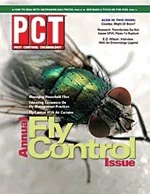
Explore the June 2004 Issue
Check out more from this issue and find your next story to read.