Naming an article after my column may appear to be an odd thing to do but perhaps not as odd as you may think. Many experts in our industry, both technical and managerial, have stated repeatedly that our pest management service industry is 95 percent communication and 5 percent pesticide application. I’m not certain of the percentages but I’m certain that it strongly favors communication and not application.
Customer communication is the cornerstone to your business’ success or failure. Knowledge and good communication skills are key elements in being able to effectively communicate with your customers.
The question is, who needs to be able to communicate effectively with your customers? In ALL companies the answer is pretty simple — every employee must be able to communicate effectively with your customers, e.g., owners, managers, technicians, quality assurance personnel, order takers, and salespeople.
MORE INFORMED CUSTOMERS. We live in an age when our customers may know more about their pest problem than we do; perhaps, for example, they have researched it on the Internet. How embarrassing it is to have a customer more technically competent than your salesperson, order taker, or more critically your technician. This is a confidence destroyer, not a builder.
Many companies invest a lot of time in technically training their employees. Some provide classroom training for weeks or months, followed by a period of field training, and then remedial training as needed. Unfortunately, however, most companies in our industry cannot afford to spend the time to train their employees to this extent and thus rely primarily on field training with an experienced technician or supervisor.
The precursor to effective communication is knowledge and confidence in your technical skills. For those companies that do not have the luxury of providing their staff intensive classroom training, there are excellent industry resources. Some provide the basic knowledge that every staff person should know, and they progress up to quite detailed texts for the more advance learner. The following list is my ascending order of technical resource publications:
• Company and/or state training materials and documents
• NPMA Quality Pro Training Manual
• PCT Service Technician’s Handbook
• NPCA Field Guide to Structural Pests
• Stoy Hedges’ (PCT) Field Guide series
• Truman’s Scientific Guide to Pest Control
• Mallis Handbook of Pest Control
In my opinion these are essential materials for every pest management company. There are many other excellent training resources including flashcards, videotapes, compact discs, etc., that provide different training formats and are more stimulating for less accomplished readers.
Assuming that your staff has achieved an acceptable level of technical competence, according to industry statistics you have achieved five percent of their training. The next 95 percent is the most difficult — training staff members to be effective communicators. This is not the type of skill people learn from a textbook and it is extremely difficult and in most circumstances very time consuming.
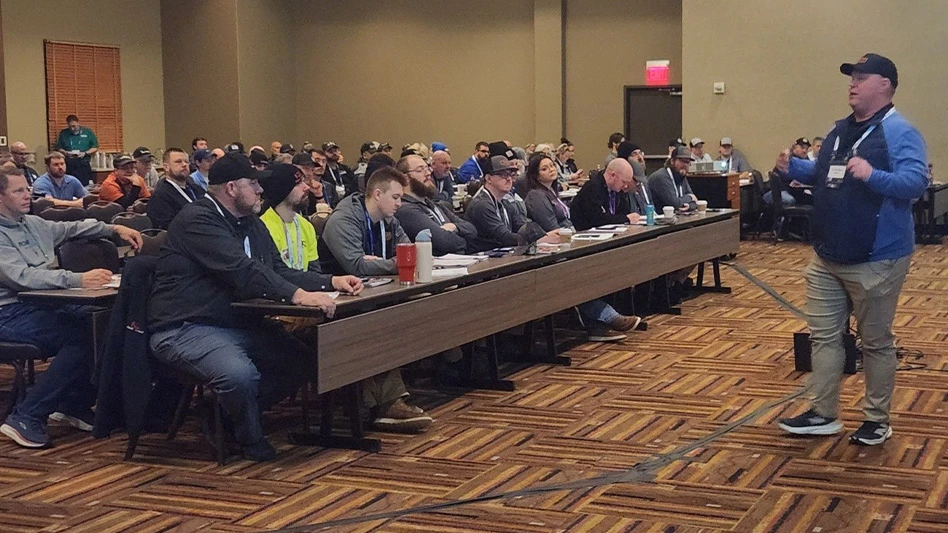
GET EVERYONE INVOLVED. I have spent at least 20 years conducting training sessions in many venues. My preference is not to conduct a lecture — a format where the instructor does most, if not all, of the talking. I prefer a semi-discussion format that involves the attendees in the presentation. What I find incredibly unnerving is the fear that most pest management professionals have of expressing themselves in front of their peers, even regarding the most basic questions. Invariably in most of my training sessions only five to 10 percent of the attendees openly participate.
In most cases those who don’t respond fear that they will be wrong. I wonder how this translates to their interaction with customers. Perhaps they don’t fear being wrong because they think the customer is less knowledgeable, or if they don’t know the answer they’ll make it up as they go. This is not communication; in essence it is lecturing. But with communication, the other fundamental skills are listening and responding accordingly.
There is a way to facilitate training while developing confidence and effective communication skills: role-playing sessions. This is best accomplished in small groups (of no more than five to 10 people) and with a variety of staff personnel present. In other words, don’t have only technicians, office staff or salespeople in one group. Diversity in the group will offer several perspectives on the same pest management or customer issue.
Have a group facilitator who poses problems to the group and have one member of the group respond in their appropriate capacity, e.g., service technician, order taker, salesperson, etc. Some of the best topics for role playing are those the company has had to deal with in the past. The facilitator should create an active dialogue as if they were the customer posing different questions and comments as the conversation progresses. The maximum interplay should be no more than 10 minutes. Once the initial communication is complete, have others in the group provide their input. This should be controlled by the facilitator who should not allow other participants to become overly critical. After an appropriate critique, pose a new situation to a different participant.
Role playing can be very effective in building staff confidence in responding to customers. Other benefits of this technique for management are hearing the message your employees are sending to your customers; identifying areas that require further training efforts; and discovering the image your staff is creating for your customers.
KNOWLEDGE IS POWERFUL. Today’s customers are becoming more informed about our business. The first message they hear from your staff will be the foundation for their perception of your company. You need to create a comfort level with the customer first by having the technical knowledge and second by having the communication skills to convey that information and win their confidence in your co-workers/staff and your company.
The author is president of Innovative Pest Management, Brookeville, Md. He can be reached at 301/570-3900 or via e-mail at rkramer@giemedia.com.

Explore the July 2006 Issue
Check out more from this issue and find your next story to read.
Latest from Pest Control Technology
- Earn CEUs from Your State at Next Week’s Mosquito Control Virtual Conference
- Preserving Culture, Providing Opportunities Key in Hoffman’s Decision
- Winter Weather Could Decide How Bad Mosquito Season Gets
- Trent Frazer Discusses How Mosquitoes Survive Winter
- Barnes Exterminating Acquires Tennessee Pest Solutions
- Pest Index Up 9% YOY in January
- Arrow Exterminators Acquires Hoffman's Exterminating
- PMPs Plan Mera Peak Summit for Parkinson's