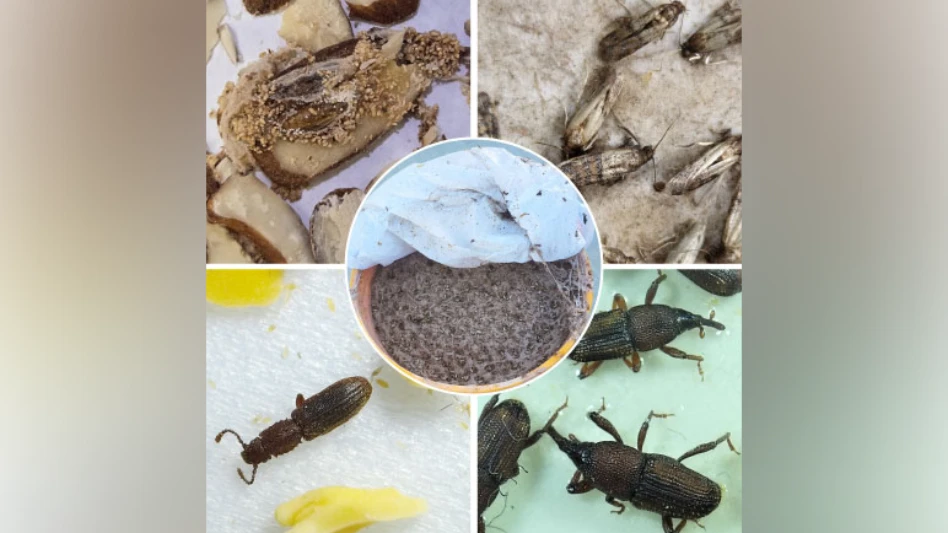
Online searches for “items frequently infested” by pantry pests are getting more robust, with top hits from university web pages detailing stored product pests (SPPs) and the different materials they can infest. Extension materials and pest management books by Truman, Mallis, Smith and others delve into more detail. Articles posted by pest control companies tend to hit on the high points: check expired spices and dried food items, keep pet food and bird seed in tight containers, and freeze or dispose of infested items.
Still, I find that these pests are tricky for both customers and inexperienced (sometimes even experienced!) technicians. Treatment for food-infesting pests is simple enough: to solve an issue caused by source pests, one must locate and eliminate the source! Now, throw in a packed-to-the-gills pantry closet, insistence from the customer that the pests are coming from here (when in fact they are coming from there) or plain old lack of experience and the process can become dragged out with longer-than-usual servicing times and multiple follow-up appointments. The truth is, stored product pantry pests continually surprise us with their biological ingenuity to survive on the most unlikely of substrates. The more successful experiences we have in finding and eliminating a pantry pest’s buffet of choice, the easier these calls become and the better off your technicians can be coached through future service calls by experienced personnel.
To keep this article within the proper prose confines, but to contribute to the compilation of wacky, wild sources where these pests have been found, I turned to colleagues in the Urban Pest Management Technical Committee (UPMTC). By the end of the day, I’d received an influx of emails from members eager to share their investigative infestation experiences. Alliteration, much? I digress.
It helps to first mention that many pests don’t fit into neat categories. For example, we may think of carpet beetles as fabric pests, but Dermestid beetles like the carpet beetle also can infest food materials. Silverfish are another example. While we might think of them as detritivores or paper-product eaters, they are just as commonly found thriving off household food materials. In the same vein, pests that are named after the food they have been found to infest, like the Indian meal moth, can also be found surviving off what we humans would consider non-food items.
There are many arthropods that could be considered SPPs. Below is my (incomplete) list of commonly encountered pantry pests — sorted by feeding category — and what materials they were found infesting, as reported by fellow UPMTC members.
INTERNAL FEEDERS. These are pests that infest whole grains and whose young complete their life cycle within the intact grain, kernel or bean. They include the rice, maize, and granary weevils and the Angoumois grain moth. Weevils were found infesting:
- Forgotten bird seed bags and deer corn buckets — usually in a closet or garage!
- Microwaveable eye covers with beans
- Stuffed animals and therapeutic heating pads made with beans or rice
- Cornhole and beanbags made with real whole kernel corn feed or beans
EXTERNAL FEEDERS. These are pests whose larvae develop on the outside of grains and feed on cracked or damaged kernels, processed grains or food debris. They include Indianmeal moths, as well as warehouse, varied carpet, black carpet, cigarette, drugstore and flour beetles. Drugstore and cigarette beetles were found infesting:
- Powdered septic cleaner — main ingredient: wheat bran
- Fire logs — Made from a combination of sawdust, bio-wax derived from plant sources, fibers (such as coffee grinds and nut husks), and oil. Crackling logs contain seeds to make them sound like natural wood as they burn
- Varnished loaf of bread on a bakery wall display
- Expired bag of black-eyed peas
Indian meal moths were found infesting:
- Potpourri
- Expired nuts, hot chocolate mix, salted crackers, cornmeal, quick oats
- Deer corn bins and bird seed bags
- Seed heads in dried weed arrangements
- Macaroni art and dried food ornaments: string of red peppers and hollowed fruit
- Oatmeal bath soap
- •Rice saved from a wedding ceremony
- German cockroach colony (presumed to be feeding on insect parts)
- Shop vacuums used to clean up debris
- Fiberglass insulation paper backing in an attic (adhesive unknown)
Varied and black carpet beetles were found infesting the following items:
- Taxidermy duck feathers
- Dog food in a wall-void rodent hoard
- Grain ingredients of soft and pellet rodenticide baits
- Insect light trap (ILT) voids feeding on dead insects
- Horse-hair insulation in old structures
- Rodent carcasses
- Bird nests in an attic
- Dead cluster flies in a wall void
OPPORTUNISTS. Scavengers can infest grain debris and other processed or damaged food products. They include red-legged ham, flour, sawtoothed and merchant grain beetles and silverfish. Secondary feeders may feed on old, expired, or otherwise compromised products that can harbor moisture and fungal growth. Secondary feeders include foreign grain, hairy fungus, spider beetles, psocids, silverfish and cheese mites.
Silverfish were found infesting:
- Accumulated flour in the insulation of a commercial bakery oven
- Old cardboard boxes in an attic
- Antique book bindings
Cheese mites were found infesting:
- Expired cheese-filled dry cat treats
- Organic sludge in decaying floor tiles
- Soggy bread under restaurant equipment
THERE YOU HAVE IT! Here is your incomplete guide to pantry pests based on first-hand experience from the members of UPMTC. Source pests force us to put on our Sherlock Holmes’ caps and, for me, are a reason to whip out my favorite line that drives my passion for pest control: “It’s never a dull day.”
The author is technical director for All-American Pest Control. She is a member of the Urban Pest Management Technical Committee and a co-host of the Beyond the Pest podcast (upmtc.org).
Explore the January 2026 Issue
Check out more from this issue and find your next story to read.
Latest from Pest Control Technology
- Certus Acquires Termio Pest Control in Arizona
- The Alliance Releases 2025 Annual Report, Showcasing Growth
- David Poplin Discusses Military Experience and How it Applies to Pest Control
- David Poplin Named PestVet of the Year
- Consulting Biologist Dan Collins Details Approaches to Effective Rodent Control
- Massey Announces the Promotions of Campbell, Graham
- BOM Hosts Dinner at NPMA Legislative Day
- Rear Admiral Scott Moore Shares Five Essential Leadership Principles