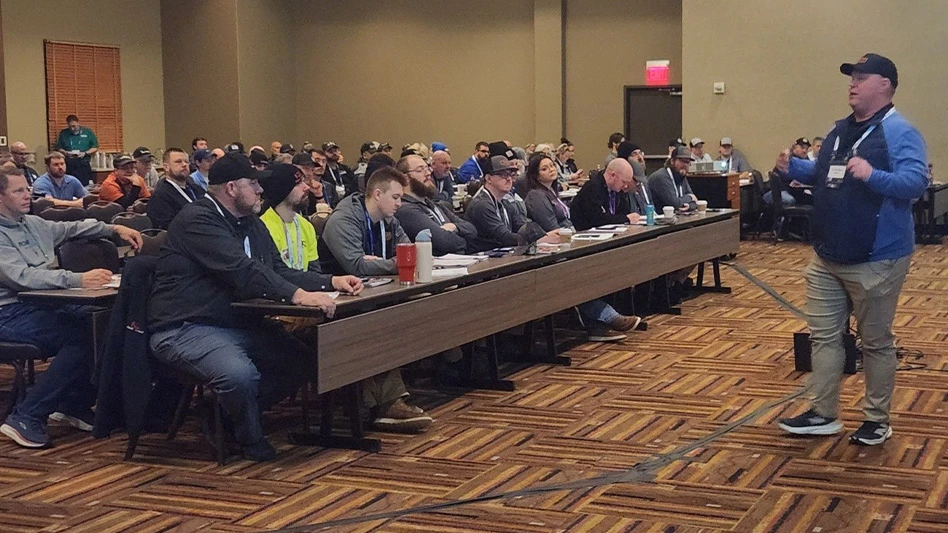
Every year the Entomological Society of America (ESA) meets in December at different locations around the U.S. There are university and government researchers and many foreign visitors who attend this important research event. It is a time to sit and listen, and to discuss the research that is important to their particular area of interest.
These sessions also reveal much valuable information for PCOs. In many cases it is here that you first hear of developing technology. The future of the pest control industry may well come out of some of these presentations. It was here a few years ago that we first heard about hexaflumuron and imidacloprid. If you don't know what these substances are, you aren't reading the magazines or paying enough attention at the industry meetings you attend.
The ESA is certainly a valuable meeting, and this year was no different. The urban session, as it is called, contains reports from the universities involved in the programs that give us the data needed for registration of the new pesticides, and ongoing investigations into how to best use these materials. The papers by graduate students, professors and manufacturers can give new insight into why a particular material works in some situations or doesn't in others. Important stuff, if we choose to think about it.
This year there was also an extra symposium on termite baiting. This is, or should be, a current topic of many PCOs' thinking. In this session, researchers from the U.S., China, Japan, France and Australia gave their research results in trapping termites, studying behavior, and baiting for control.
A WHOLE DAY OF DATA. The urban session had almost 40 papers presented. The research predominantly covered ants (pharaoh ants, big-headed ants, carpenter ants, ant baits), termites (subterranean termites, Formosan termites, drywood termites, termite baits), cockroaches (baits, habits, feeding preferences, behavioral changes, new control possibilities), plus two papers on industry surveys and consumer attitudes, one survey on the use of foam insulation around structures, and they even threw in a paper on yellow jackets.
The session took the entire day and extended into the evening. I am not going to list all the speakers involved; suffice it to say they are names you've heard before Roger Gold, Mike Potter, Jim Ballard, Coby Schal, Don Reierson as well as some new people who will be making their names known in the industry, such as Dan Suiter, who is now at Purdue University, and Faith and David Oi, who are now at Auburn University. The number of graduate students giving papers and the continuing mix of new ideas fostered an atmosphere of enthusiasm among the attendees.
Unfortunately, as is always the case, few PCOs attended this meeting. That's too bad, because considering the number of PCOs located in this area of the U.S., there could have been a strong representation from the industry, and they would have benefited from the program.
Baits, bait selection, feeding preferences, and baiting techniques for ants and cockroaches were discussed. The effects of IGRs on the behavior and feeding of female German cockroaches indicated that we may be able to affect the female's behavior and increase its feeding activities, thus making baits more effective against arguably the main target of our cockroach control programs.
There is also more attention being focused on the feeding preferences of cockroaches in general. Do cockroaches like to switch feeding sources? The indications are that the selection of the bait to be used may depend on the food naturally available in the habitat the cockroach occupies. I do not believe this is earth-shaking news, but it shows that our training programs for technicians have to become more sophisticated. Also, in an IPM program, evaluation goes beyond how many cockroaches are in a sticky trap, and merely determining that the place is a mess.
There is new work being done at Texas A&M University with parasites and natural control for cockroaches. There are new bacterial toxins being investigated by DowElanco. The newer growth regulator pyrproxyfen is also being investigated on a wider variety of insects. The termite bait being developed by FMC was also presented, and the American Cyanamid termite bait was discussed during the bait symposium as well. We can probably expect those products on the market by 1996.
SOIL DEGRADATION UPDATE. One paper was presented by Brad Kard of the USDA Forest Service Southern Forest Experiment Station in Gulfport, Miss. This is the laboratory that tests termiticides for registration, and has also been involved in the testing being done by ASPCRO (the Association of Structural Pest Control Regulatory Officials) aimed at determining the degradation of termiticides in the soil.
Over the last few years, Kard and his Gulfport colleague Skip McDaniel have been giving the industry updates on the soil degradation testing. The most recent article on this study, "The Latest On Termiticide Degradation," appeared in the May 1994 issue of PCT. This update indicated that termites break through the termiticide barriers around the degradation test plots.
The paper Kard presented at the ESA meeting indicated that further investigations of those breakthroughs suggests termites are building tubes through the top layers of the barriers, using untreated soil. This I find very disturbing, and you should too. Most of all, the regulators should find this extremely disturbing. As has been said before in this column and in many other places, termiticide soil sampling is an inexact science. If termites can penetrate a termiticide barrier under the conditions of this test, what does that suggest about the treatments we do every day? Just think of all the treatments that have been done following the label recommendation of covering treated soil with a layer of untreated soil.
Also, as these results undergo further analysis, we may finally have the data needed to support dare I say it? booster treatments. It sure is nice to find out that common sense can be supported by scientific data!
DOT MAKES YOUR DAY. There has been an amendment to the DOT regulations that affects PCOs. Congress passed an amend ment requiring that shipping papers be maintained in records for one year. This amendment is effective immediately. This means you have to keep copies of your day-to-day shipping papers in a file. The use of laminated sheets is not a very workable option any longer, since you would have to make copies anyway. The best option would be to get a standard shipping paper for your company that is printed on carbonless paper, so that when it is filled out and dated every day a copy remains at the office.
There are lots of questions regarding why this happened. The first is, how did this get through Congress without our knowledge? Next, if this is to keep tabs on the large amounts of hazardous materials being hauled by big shippers and hazardous waste haulers, why are we not exempted? Maybe with all the rhetoric from Congress this year about doing away with big government and decreasing regulation on small business, it is time to get some redefinitions for our industry.
George Rambo is a contributing editor to PCT magazine. Readers with comments can write PCT, 4012 Bridge Ave., Cleveland OH 44113; or contact the author directly at George Rambo Consulting Services, 1004 Van Buren St., Herndon VA 22070, 703/709-6364.
Explore the March 1995 Issue
Check out more from this issue and find your next story to read.
Latest from Pest Control Technology
- Earn CEUs from Your State at Next Week’s Mosquito Control Virtual Conference
- Preserving Culture, Providing Opportunities Key in Hoffman’s Decision
- Winter Weather Could Decide How Bad Mosquito Season Gets
- Trent Frazer Discusses How Mosquitoes Survive Winter
- Barnes Exterminating Acquires Tennessee Pest Solutions
- Pest Index Up 9% YOY in January
- Arrow Exterminators Acquires Hoffman's Exterminating
- PMPs Plan Mera Peak Summit for Parkinson's