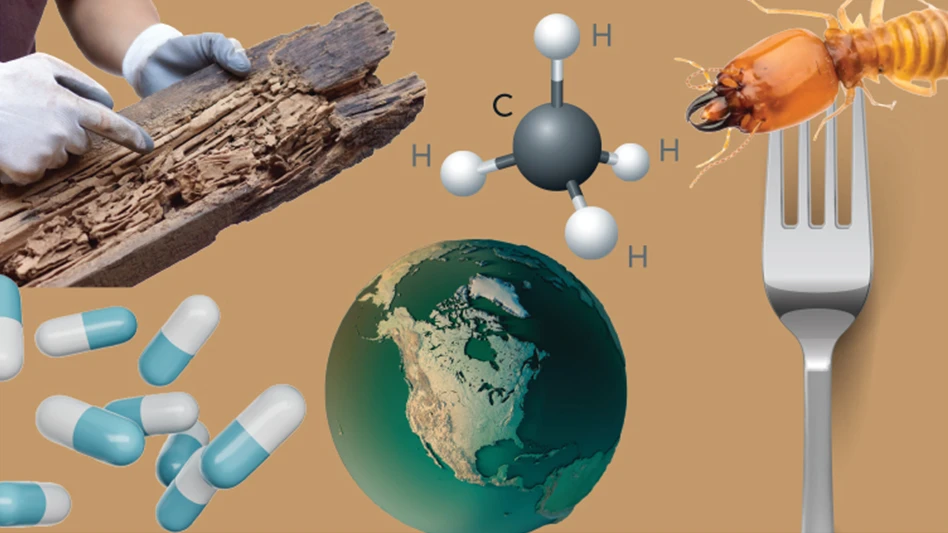
Wood: © weerapatkiatdumrong | iStock; Termite: © defun | iStock; Globe: © Frank Ramspott | iStock; Pills: © Hammad Khan | iStock; Methane: © PeterHermesFurian | iStock
Editor’s note: This article originally appeared in the February print version of PCT under the headline "Fact Finder."
If you have been in the pest control industry for any length of time, you may have learned a thing or two about termites. They are wood-destroying organisms that can be detrimental to a homes and other structures.
Let’s briefly review what we know about termites. They are considered eusocial, meaning they have overlapping generations, cooperative brood care, sharing of resources and a division of labor. They have a complex life cycle that is predetermined for them based on the needs of the colony of that time. In other words, a colony will produce more soldiers or more workers when they are needed.
There are four groups of termites: subterranean, drywood, dampwood and higher termites. Due to their social structure, termites have different castes: workers, who are responsible for maintaining and caring for the colony; soldiers, who are responsible for protecting the colony; and alates/reproductives, who are responsible for rearing young and starting the search to begin new colonies. Detailing termite biology, habitats, types, distribution or even eusociality would be interesting enough, but let’s explore some things you might not know.
1. TERMITES ARE BENEFICIAL. We often think about termites in a negative light. They can be detrimental to people’s homes and property. Can you say job security? However, termites in nature are quite beneficial to the environment. As humans, we only tolerate a small amount of decay around us. This is why it is important that we have detritivores that naturally decompose organic matter. Termites are the most efficient consumers of dead, decayed and other inedible food stuff. Termites can consume a large variety of food, but most impressively, they are able to consume living and dead wood. They can do so because of the symbiotic microbes that have taken up residence in their gut. These bacteria and protozoans produce enzymes that can break down cellulose. Termites are one of the only insects with this capability. When they are not naturally decomposing wood in nature, they often seek out people’s homes. As beneficial as their decomposing is, it can hurt the environment as well. Termites can damage important plants, including fruit trees and ornamentals.


2. TERMITES IN NATURE. Despite how peculiar the termite lifestyle may appear, it is a highly successful one. Termite societies are among the most populous in the animal world: A single colony can contain 20 million or more individuals. To house that many termites, colonies create elaborate structures, commonly known as termite mounds. These termite mounds can be anywhere from a few inches in height and diameter to more than 27 feet in height and 80 to 90 feet in diameter. The mounds are made of a variety of materials, but most consist of soil with or without excrement. Because of the large nature and number (across Africa there are more than 800 termite mounds per hectare) of these mounds, they can tie up an enormous amount of the soil where they reside. For example, in the Congo savanna, about 30 percent of the soil surface is occupied by termite mounds, which has a combined weight of more than 5.3 million pounds per hectare. This has devastating economic effects. These soil-dwelling termites are likely to cause damage to underground cables or pipes as a result of their earth-moving and soil-processing activities.
Termites also have an influence on the composition of soils. Termites have the ability to accelerate soil erosion by clearing off plant cover and removing organic matter from the soil, thereby increasing the likelihood it can be blown away. On the other hand, these mounds are generally highly fertile, high in organic matter and rich in calcium, phosphorus, magnesium and other vital plant nutrients. In some areas of Asia and Africa, these mounds are flattened and used for crop planting.
3. TERMITE FLATULENCE. Because termite colonies are large in number, they have an impact on the ecosystem. As a result of the fermentation processes that are carried out in their guts, termites produce large quantities of methane as a waste gas. Methane (CH4) is a greenhouse gas, i.e., a gas in the atmosphere that traps heat. Termite contributions to atmospheric methane levels have been measured and in some places are comparable to contributions made by human industrial activities. Termite flatulence (or termite farts) have the ability to affect ecosystem functions on a global scale.

4. TERMITE MEDICINAL USES. Termites are not just beneficial in nature. Because of the large quantities in colonies, termites have been historically sought out for medicinal uses. Termites have been used as a source for popular medicine. There have been 10 species of termites identified that are used for medicinal uses in 29 different countries. They have been used for alternative treatment for spiritual and physiological issues. N. macrocephalus, commonly known as the conehead termite, is the species used most frequently. This species is commonly used as a remedy for asthma. Another termite frequently used medicinally is the M. nigeriensis, a subterranean termite that is very widespread in Africa. This termite is commonly used for the treatment of wounds, sickness in pregnant women and a charm for spiritual protection. Other ways that termites have been used as medicine are in antifungal, antibacterial and antimicrobial therapy. They have been known to treat several diseases such as bronchitis, sore throats, flu, sinusitis, tonsillitis, hoarseness, anemia and whooping cough among others.


5. TERMITES AS FOOD. Finally, termites are used as food. The practice of eating insects is known as entomophagy. Did you know we eat insects everyday? The Food and Drug Administration (FDA) puts out a list of maximum permissible levels of insect infestation or damage that is allowable in our food. These are known as food defect action levels. These include a maximum number of insect adults, eggs, immatures, droppings or fragments of insects. For example, in every 100 grams of Brussels sprouts there can be no more than 40 aphids. A 1/2 cup of raisins can contain no more than 10 insects or equivalent in pieces and 35 fruit fly eggs.
Insects also are used intentionally in food. The Cochineal bug, typically found on cactus, when squished produces a red dye. This red dye is used in several foods such as Froot Loops, Starbucks cake pops, Nerds candy, yogurt, etc. Insects, including termites, are sought out as a food source around the world because they are a rich source of amino acids and protein.
For example, a serving of caterpillars has 28 grams of protein, which is equal to pork and fish. A serving of termites has 14.2 grams of protein. Hence, eating termites, and many other insects, is a staple in most cultures around the world. Termites have been used as a food source for generations. They were thought to improve the human diet, particularly for people who suffer from malnutrition due to a deficit of protein. There are 45 species of termites that are used as a food source in 29 countries. Africa is recorded to have the highest number of countries that eat termites. Congo specifically is recorded as having the highest number of species that are used as a food source. In Africa, the species of termite Macrotermes are known as the “Big Termites.” These termites are notable as a food source, not only for humans but also a favorite food source of gorillas and chimpanzees.
SUMMARY. In summary, termites and their impact on our world cover a full spectrum of “the good, the bad and the ugly.” The good is their positive impacts on the environment and use in medicine as well as food sources. The bad we know well: They cause detrimental damage to homes and even beneficial trees. Finally, the ugly: They can be good and bad all at the same time. The prime example is the mounds they create; they are full of nutrients but also can devastate the environment. Termites are a mixed bag, but there is so much to learn about them.
So the next time you go out for a termite treatment or inspection, just remember that a nutritious snack may be waiting for you!
Explore the February 2024 Issue
Check out more from this issue and find your next story to read.
Latest from Pest Control Technology
- Donny Oswalt Shares What Makes Termites a 'Tricky' Pest
- Study Finds Fecal Tests Can Reveal Active Termite Infestations
- Peachtree Pest Control Partners with Local Nonprofits to Fight Food Insecurity
- Allergy Technologies, PHA Expand ATAHC Complete Program to Protect 8,500 Homes
- Housecall Pro Hosts '25 Winter Summit Featuring Mike Rowe
- Advanced Education
- Spotted Lanternflies, BMSBs Most Problematic Invasive Pests, Poll Finds
- Ecolab Acquires Guardian Pest Solutions