Pest and Diseases Image Library, Bugwood.org

You get the call from your favorite food processing facility: Come quick, we’ve got bugs! Except, that’s not very helpful because what “bugs” are they? If we assume that they are some type of stored product pest, that narrows things down a bit. There are still a LOT of things it could be. When we talk about stored product beetles, entomologists have a special name for this group of insects. LBB — little brown beetles. Let’s be honest, they all look very similar and we are often dealing with some pretty small insects that often need some magnification for a correct identification. Here are some of the less encountered stored product beetles we find in homes and food processing and storage facilities.
FOREIGN GRAIN BEETLES.
This beetle resembles the flour beetle at first glance. Like flour beetles, they can feed on a wide range of foods and are typically found in and around grain-based products. However, foreign grain beetles mostly feed on molds instead of the grains themselves. They are a good indication that there are moisture and mold issues nearby. Foreign grain beetles are slightly smaller than the red or confused flour beetle and their pronotum is more square with two little bumps on the “shoulders.”
Humidity and moisture are very important for this species. In general, humidities below 65% mean the insects can’t develop. That high humidity is perfect for mold growth, which is their main food source. Adults lay more eggs on the fungal species on which their offspring can develop most successfully. They are attracted to lights, so insect light traps (ILTs) can help to monitor and capture them.
Fun fact. There is a strong seasonality to foreign grain beetles (FGBs), their populations are highest in late summer when outside populations are high.
Often, reducing moisture levels and drying out an area can eliminate problems with foreign grain beetles or, at the very least, significantly reduce their populations. Pesticide treatments are often unnecessary. If FGBs are mixed up with flour beetles, inspections will be off, and PMPs may look for infested foods rather than moisture-damaged product. While treatments will knock down exposed stages, foreign grain beetles will recover much faster because the treatments are not being targeted to the right areas and the food sources persist.
Fun fact. Among the many foods these have been found infesting, some of the weirder ones are BBQ sauce, chili pepper paste, olives and turtle shell!1

FLAT GRAIN BEETLES
These can look like small sawtoothed grain beetles or thinner and smaller flour beetles. Like those two species, flat (a.k.a. rusty) grain beetles are found in and around grains and grain products. Flat grain beetles can’t chew into whole kernels, but they can feed on the germ end and will often be feeding on grains broken up by other pest insects. If no grain is present, flat grain beetles can complete development on molds. They are small, rectangular-shaped and their pronotum is relatively large and square compared to flour beetles. Though similarly shaped, they don’t have the “teeth” on the thorax that sawtoothed grain beetles do.
Fun fact. There are 11 different species of Cryptolestes in the U.S., and they are very hard to identify to the species level.
Like foreign grain beetles, these require higher moisture and do best at about 70% RH. Finding flat grain beetles usually indicates high levels of broken kernels and higher moisture levels. Along with grains, these have been documented feeding on all kinds of dry goods like cocoa, coffee, peanuts and dried fruits.
Reducing moisture levels can help reduce flat grain beetle infestations. When the damaged grains and grain products are identified, removing and/or isolating them can eliminate most of the insects. These like to hide in cracks, so if new, damaged products are brought in, they will quickly be infested. Often, spot treatments are enough to control populations, and insect growth regulators are always helpful.
Fun fact. When testing different types of diet, researchers found that rolled oats and cracked sorghum, wheat flour and barley flour, and barley flour alone were preferred food sources.

MINUTE SCAVENGER BEETLES
This is another beetle often confused for the flour beetles and the flat grain beetles: the family of minute brown scavenger beetles. They are also called plaster beetles and mold beetles. As the name suggests, these feed on fungi, mold and mildew. They also will feed on moldy foods, especially grains. They can be found in leaf litter, under tree bark and ant and termite nests. Really anywhere there is damp and moldy organic matter.
Fun fact. A sampling study in Norway found 602 minute brown scavenger beetles out of a total of 8,552 beetles collected; about 7%.2
These can be differentiated from many of our other LBB by the thorax being narrower/smaller than the abdomen. They are about the length of flat grain beetles. Many outside species are perfectly happy outdoors and basic exclusion can keep them out. Any moldy foods they could be feeding on should be disposed of and reducing humidity can have a big impact.
Fun fact. When the coffin of a 17th century bishop was uncovered, they found 13 different families of beetles, and the minute brown scavenger beetle was the second most found beetle family.3
Since these feed on molds like many of our other little brown beetles, you may think it doesn’t matter to ID them. However, these can build up in high numbers in residences. New home construction has mold growing on the wood frame because it has sat out in the elements before siding and inner walls go up. Older homes can have moisture issues on timber, and because they are so small, they can get in by the smallest cracks. Mistaking them for other fungus feeding beetles can mean looking for the wrong habitats.

DEATHWATCH AND POWDERPOST BEETLES
Next up are the deathwatch beetle and the powderpost beetle. Since these beetles are in the same family, they are often confused with cigarette and drugstore beetles. The deathwatch and powderpost beetles feed on wood as larvae.
Deathwatch beetles prefer hardwoods, and powderpost beetles tend to softwoods. Both beetles develop very slowly and can take years to go from egg to adult.
Fun fact. Cigarette, drugstore, furniture, deathwatch, powderpost and spider beetles all belong to the same family (Ptinidae).
These beetles all have the same downward-facing head and oval shape. Drugstore and cigarette beetles are more oval than round, and are often less hairy than the wood-boring beetles. Many wood- boring beetles have longer antennae, and males of many species have clubbed antennae that resemble a fan. This is one that might need some magnification to determine the species. It can help to look at where they are in a structure and other conducive conditions to narrow down the identification.
Fun fact. Along with khapra beetles and house flies, drugstore beetles were recovered from food offerings from ancient tombs in Egypt.4
Mistaking these can seriously set back managing infestations. Cigarette and drugstore beetles are likely coming from some type of food or plant material. Cigarette beetles did not get their name from feeding on wood. These are tough because, along with typical food products, they can feed on dried plant material like dried flowers, spices, feathers and other things we don’t always think of as “food.” The other beetle species are coming from some type of wood product. Getting an identification wrong here means looking in the wrong place and at totally different treatments.

SPIDER BEETLES
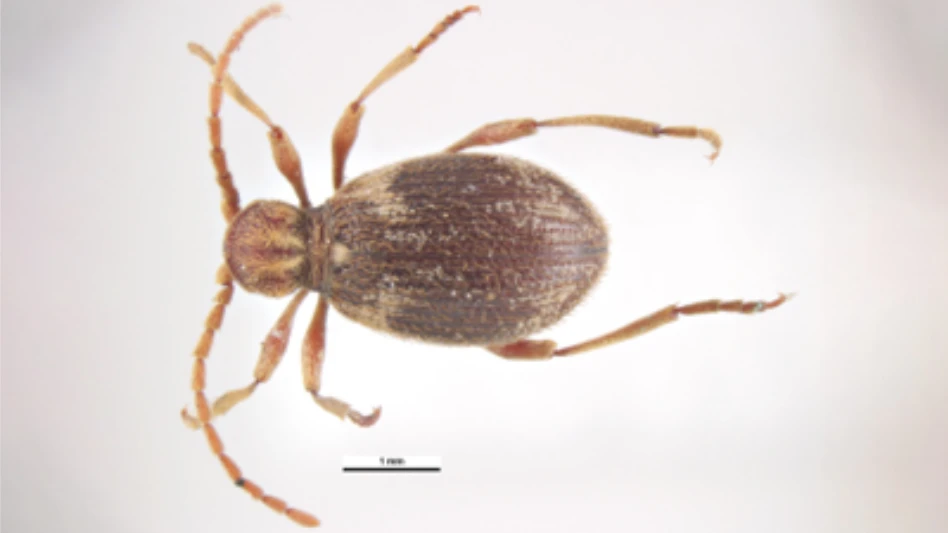
This next one can be confused with other LBB and many other arthropods. As their name suggests, spider beetles superficially resemble small spiders, cigarette and drugstore beetles, and other LBB. Most species encountered indoors are scavengers. They feed on all types of dry plant and animal materials, as well as moisture damaged foods. Spiders are predators and hunt for arthropods to eat.
Fun fact. A museum study found the shiny spider beetle larvae fed on dried meat, dried mushrooms, seeds, wool, hair, feathers, leather, book bindings, insect collections, books and all kinds of dried animal and plant specimens, leading to their threat to museums.5
As with many stored product beetles, infestations of spider beetles are linked to poor sanitation. Finding damp areas and the foods they are infesting is key to quick control. Eliminating those areas and sources can eliminate much of the issue. However, since they feed on so many different items, it’s important to keep an eye on other sources to make sure they don’t reinfest. When infestations aren’t readily located, they could be coming from nearby rodent, bird or bat nests in or around the structure.
Fun fact. Many spider beetles are cold-tolerant and are active at sub- freezing temperatures.
Most species of spider beetles are small, have a small head and a round abdomen, looking much like a spider. They like dark, damp areas and are mostly nocturnal. Like spiders, they can create silken webbing that looks a bit like Indian meal moths, but is typically not that heavy. These are also mistaken for bed bugs due to their shape and color. While spider beetles could certainly be in a bedroom, they are unlikely to congregate by the bed or areas close to the bed.
YOUR JOB: GET RID OF THEM.
Customers don’t care what “bugs” they are, they want them gone. However, it’s important to the professional. If we get a good ID, we can find those harborage areas, conducive conditions, foods and more that are contributing to the problem faster. We don’t have to waste time looking in areas and at goods that these beetles have no chance of being in. That leads to quicker control, safer foods and happier customers.
Sources
1https://www.mdpi.com/2075-4450/16/3/313
2https://onlinelibrary.wiley.com/doi/pdf/10.1111/jen.13477
3 https://lucris.lub.lu.se/ws/files/78356779/1_s2.0_S2352409X20300900_main.pdf
4https://onlinelibrary.wiley.com/doi/abs/10.1111/1475-4754.00113
5 https://peerj.com/articles/18700/

Explore the November 2025 Issue
Check out more from this issue and find your next story to read.
Latest from Pest Control Technology
- Terminix Strikes a Chord With Preventative Push in New ‘Ahhh’ Campaign
- Company Compassionately Solves a Severe Rodent Infestation
- Earn CEUs from Your State at This Week’s Mosquito Control Virtual Conference
- Jody Green Talks Ticks at Purdue Conference
- Truly Nolen Pest Control Promotes Freize, Hackett
- Preserving Culture, Providing Opportunities Key in Hoffman’s Decision
- Winter Weather Could Decide How Bad Mosquito Season Gets
- Trent Frazer Discusses How Mosquitoes Survive Winter