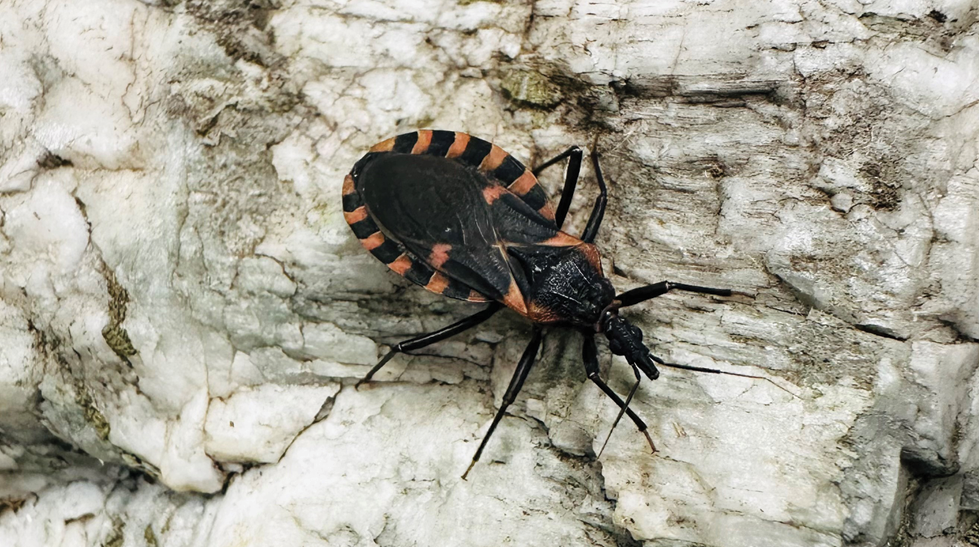
GAINESVILLE, Fla. — Triatomine bugs, commonly known as kissing bugs, are now considered endemic in the United States, according to a September report from the Centers for Disease Control and Prevention.
These blood-sucking insects are known vectors of Trypanosoma cruzi, the parasite that causes Chagas disease, said Dr. Norman Beatty, associate professor of medicine at the University of Florida’s Emerging Pathogens Institute.
Chagas disease, first identified in 1909 by Brazilian physician Carlos Chagas, affects an estimated 6 to 10 million people globally. While it’s traditionally associated with Latin America, Beatty said at least 11 species of kissing bugs are found across 32 southern U.S. states.
The insects typically emerge between May and August and are often found around woodpiles, outdoor clutter and animal nesting areas. They feed on wildlife, including raccoons, opossums and rodents, and may enter homes in search of new blood sources.
“In our lab, about 25% of collected kissing bugs had human blood in them,” Beatty said.
Dogs are particularly attractive to the insects, making kennels and resting areas high-risk zones. Once indoors, the bugs often hide in bedding, setting the stage for bites that can transmit the parasite.
The initial symptoms of Chagas disease include fever, swollen lymph nodes, heart issues and, in rare cases, encephalitis-like symptoms (inflammation of the brain). If untreated, the disease can become chronic, with heart complications developing 10 to 20 years later. There is currently no effective treatment approved in the U.S.
Pest management strategies, outlined in the Mallis Handbook of Pest Control, include removing animal nesting areas, reducing outdoor clutter, modifying lighting to reduce bug attraction, sealing entry points and applying residual insecticides such as pyrethroids.
Despite growing awareness, Beatty noted that more research is needed. “Kissing bugs aren’t listed on any EPA-approved pesticide labels,” he said. “We need more data on which insecticides are effective in the U.S.” — Amanda Joerndt
FTC Dismisses Court Appeal on Non-Compete Rulemaking

WASHINGTON — On Sept. 15, the Federal Trade Commission (FTC) announced steps taken to dismiss its court appeal regarding the non-compete rulemaking. The FTC released its statement that it would not be pursuing an appeal.
In April 2025, PCT reported on the FTC’s 3-to-2 vote to approve a new rule banning non-competes for all workers. For senior executives, existing non-competes can remain in force; for all other employees, existing non-competes are not enforceable.
Non-compete agreements are used by employers to protect trade secrets, confidential information and investments in employee training. Supporters argue that they help prevent unfair competition by restricting employees from immediately joining or starting rival businesses, especially in roles where proprietary knowledge is involved. Non-compete critics argue that such agreements can be overly broad and unnecessarily limit worker mobility and career opportunities.
The National Pest Management Association (NPMA) has kept a close eye on FTC’s actions surrounding non-compete agreements since first published in the Federal Register in January 2023, said Megan Striegel, senior director of public policy, NPMA. “The FTC’s recent decision not to appeal court rulings is a significant development, reinforcing what NPMA has said from the beginning: the original proposal overstepped the Commission’s authority,” said Striegel.
Striegel added, “NPMA has another opportunity to make our voice heard on how these agreements protect business investments, trained staff and customer relationships within our industry.”
NPMA encourages individuals within the pest management industry to stay informed and engaged throughout the public inquiry process, Striegel added. — Amanda Joerndt

ServiceTitan Introduces New AI Platform at Pantheon ’25
LOS ANGELES — At Pantheon ’25, Service- Titan’s annual user conference for trades professionals, ServiceTitan unveiled new AI-powered tools to help contractors streamline back-office operations, from customer contact to invoicing. Central to the launch is Atlas, an AI assistant integrated into the ServiceTitan platform.Built on the company’s Titan Intelligence engine, Atlas allows users to perform tasks like scheduling, dispatching, and reporting through natural language — typed or spoken, the company said.
“Atlas feels more like a co-pilot or chief of staff,” said Vahe Kuzoyan, ServiceTitan co-founder and president.
Key features include real-time field support via ServiceTitan Mobile; automated office functions like accounting, pricing and scheduling; commercial tools for logging, RFIs, billing and change orders; AI-driven booking agents, text scheduling and dispatch suggestions; and business insights that track performance and suggest improvements.
Atlas can also take direct action — such as adjusting marketing budgets or launching targeted campaigns based on job volume. “AI isn’t going to replace contractors, but it will transform how they operate,” added co-founder and CEO Ara Mahdessian. — Brad Harbison
EcoShield’s Exterminate Hunger Assists Food- Insecure Communities
CHANDLER, Ariz. — For 16 years, EcoShield Pest Control has worked to serve communities beyond pest control through its annual Exterminate Hunger initiative.
Co-founders Greg Nygren and Doug Cardon launched the program after hearing stories from technicians about families struggling with food insecurity. In 2023, the USDA reported 47.4 million Americans lived in food-insecure households — a need the company wanted to help address.
Each year, EcoShield technicians collect nonperishable food, hygiene items and baby supplies from customers and deliver them to local food pantries. The initiative now operates in 22 states, with 36 drop-off locations nationwide.
“We realized we could make it easy for people to give,” Nygren said. “We’ve got vehicles all over town.”

Branches partner with local food banks to tailor donations to community needs. Even the corporate office participates, often turning it into a friendly competition.
Cardon said Exterminate Hunger aligns with EcoShield’s culture of putting “people over pests.” The company hopes to eventually expand the initiative industry-wide.
“As much as this helps those in need, it does just as much good for our employees,” Nygren said. — McKenna Christy
West Nile Virus Deaths Reported in California, Texas
DALLAS and PLACER COUNTY, Calif. — Two recent West Nile virus-related deaths have been reported in California and Texas, according to the Center for Infectious Disease Research and Policy (CIDRAP) at the University of Minnesota and KDFW Fox 4 in Dallas.
CIDRAP reported Oct. 7 that a man from Placer County, Calif., had died from the virus. The county, located in the Central Valley, has seen five of the state’s 54 confirmed human West Nile virus (WNV) cases this year. Health officials there also reported high numbers of WNV-positive mosquitoes and dead birds.
In Texas, Dallas County Health and Human Services (DCHHS) confirmed the area’s first WNV death of the 2025 season. The resident, a man in his 70s with underlying health conditions, had the more serious neuroinvasive form of the disease. DCHHS has reported eight human cases and found 245 WNV-positive mosquito traps this season.
Health officials say WNV activity is unusually high this year. Infections are running about 40% above average nationwide.
According to the Centers for Disease Control and Prevention, more than 770 cases had been reported as of early September, including roughly 490 neuroinvasive cases. Typically, about 550 cases — including 350 severe — are reported by this point in the year, the Associated Press said.
Chorus to Expand into Pest Control Market
BIRMINGHAM, Ala. — Chorus Holdings has launched Chorus Pest, expanding its services to include termite protection, pest control and mosquito management. The new company will operate alongside Chorus Security, serving builders, commercial partners and residential homeowners.
Chorus Pest will be led by Steven Splawn and Eric Frye, former owners of Waynes Pest Control. Under their leadership, Waynes grew from a small local business in 2001 to a large regional pest control provider before being acquired by Anticimex in 2019.

“We’re excited to re-enter the industry with a team of proven talent,” Splawn said. “Chorus Pest is assembling an unparalleled group to serve and impact our communities.”
Frye added that Chorus Pest will operate in six markets: Birmingham, Huntsville, Auburn/Montgomery, the Alabama Gulf Coast, the Florida Emerald Coast and metro Nashville, Tenn. “This is possible thanks to the capital we’ve built — experiential, relational, network and financial — and the exceptional people joining us,” he said.
RNPC Wins 2025 HIRE Vets Medallion Award

CARSON, Calif. — Revolution National Pest Council (RNPC) received the 2025 HIRE Vets Platinum Medallion Award — marking the eighth consecutive year earning this national honor.
This places RNPC among 25 companies in the country to achieve this distinction for eight years straight. The HIRE Vets Medallion Award, established under the HIRE Vets Act of 2017, is the only federal award recognizing organizations for excellence in veteran hiring, retention and professional development.
“This achievement is a direct reflection of our team’s dedication and, most importantly, the meaningful work we do for our veterans,” said RNPC President Sterling Barbour. “Through our apprenticeship program and continued mentorship, we help veterans build sustainable careers and success beyond the classroom.”
Study: Half of Adult Deer Ticks in Northeast Carry Lyme Disease Bacteria
FRENCH LICK, N.H. — A new Dartmouth-led study found that 50% of adult blacklegged ticks (a.k.a., deer ticks) in the Northeast carry the bacteria that causes Lyme disease. Up to 25% of nymphs, the younger and harder-to-spot stage, are also infected.
Published in Parasites & Vectors, the study analyzed data from 1989 to 2021 across Connecticut, New York, New Hampshire, Vermont and Maine (Massachusetts and Rhode Island were excluded due to limited data). Researchers found that while tick populations have remained relatively stable, the percentage carrying Borrelia burgdorferi, the Lyme-causing bacteria, has increased. Lead author Lucas Priced said the study helps establish a comprehensive baseline to monitor trends. The Dartmouth team also is examining how climate change may impact tick populations and disease spread. — Source: Dartmouth College
IPMA Hosts Summer Meeting
FRENCH LICK, Ind. — The Indiana Pest Management Association (IPMA) held its 2025 Summer Meeting, July 17–18 at French Lick (Ind.) Resort, bringing together members and industry partners for networking, recreation and strategic discussions.While there were no formal training sessions, the event featured a one-hour legislative roundtable focused on Indiana’s regulatory landscape. Leaders emphasized the growing need for industry advocacy amid shifting political dynamics that could affect pest management businesses statewide.


Explore the November 2025 Issue
Check out more from this issue and find your next story to read.
Latest from Pest Control Technology
- Earn CEUs from Your State at Next Week’s Mosquito Control Virtual Conference
- Jody Green Talks Ticks at Purdue Conference
- Truly Nolen Pest Control Promotes Freize, Hackett
- Preserving Culture, Providing Opportunities Key in Hoffman’s Decision
- Winter Weather Could Decide How Bad Mosquito Season Gets
- Trent Frazer Discusses How Mosquitoes Survive Winter
- Barnes Exterminating Acquires Tennessee Pest Solutions
- Pest Index Up 9% YOY in January