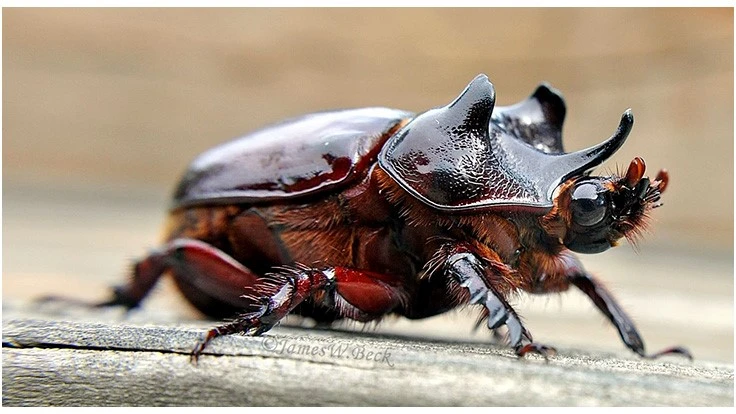
CLEVELAND, Ohio - PCT announces that James Beck, a pest control inspector, naturalist and field biologist with the New Orleans Mosquito, Termite, and Rodent Control Board (NOMTRCB), is the winner our 17th annual Best Pest Photo Contest. Beck wins $500 from PCT for his winning photo of the beetle Strategus aloeus, which he captured after he was done conducting a bird survey in extreme northern Louisiana.
“What I like the most about the picture is that it is of a wild specimen, not one taken in captivity,” he said.
After his bird work was done, Beck, an insect enthusiast, would look for other subjects to photograph. “Each night, I would run mercury vapor and high-intensity black lights to attract insects. Among many other interesting species that came into my lights, this aloeus was one of the best specimens. It hung around until the next morning, so I was able to get a day shot with natural light.”
Beck captured this photo using a Nikon D90 with a Nikon micro 40-millimeter macro lens. No special effects were used, but Beck said, “a large aperture was obtained at shooting with a small f-stop setting, thus the clean foreground and blurred backdrop.”
These details were noted by one of PCT’s judges, who wrote, “Wonderful image. It’s as if the front of insect is in focus and rest of insect is less in focus; great colors and very sharp.” A similar comment from a different judge stated, “Love how shiny the pest is. Really great framing of the pest.” A third judge wrote, “Love the perspective. From the angle it was taken the front of the beetle reminded me of a Triceratops dinosaur.”

Beck has been employed at NOMTRCB since October of 2017 and has been involved in field biology in one form or another for more than 25 years. His duties include routine mosquito surveillance and monitoring, which includes field collection from a variety of traps and in-lab identification of species. He also enters and manages mosquito data.
Beck said the Strategus aloeus is one of the largest beetle species in Louisiana, and one out of three in the genus Strategus. They are more common in the central and northern parts of the state, but some small populations exist below Interstate 10, he said. “Larvae feed on root systems and adults feed on fruit and flowers. Decaying fruit is one good way to attract numerous species of scarab beetles, including this one. Some damage from the larvae is occasionally a pest issue, if they feed on the root systems of ornamental garden plants or lawns, but this is not a widespread problem for the most part.”
PCT received dozens of entries in this year’s contest. In addition to Beck’s winning photo, the 10 finalist photos will be showcased in an online slideshow, coming soon.
Latest from Pest Control Technology
- Earn CEUs from Your State at Next Week’s Mosquito Control Virtual Conference
- Preserving Culture, Providing Opportunities Key in Hoffman’s Decision
- Winter Weather Could Decide How Bad Mosquito Season Gets
- Trent Frazer Discusses How Mosquitoes Survive Winter
- Barnes Exterminating Acquires Tennessee Pest Solutions
- Pest Index Up 9% YOY in January
- Arrow Exterminators Acquires Hoffman's Exterminating
- PMPs Plan Mera Peak Summit for Parkinson's





