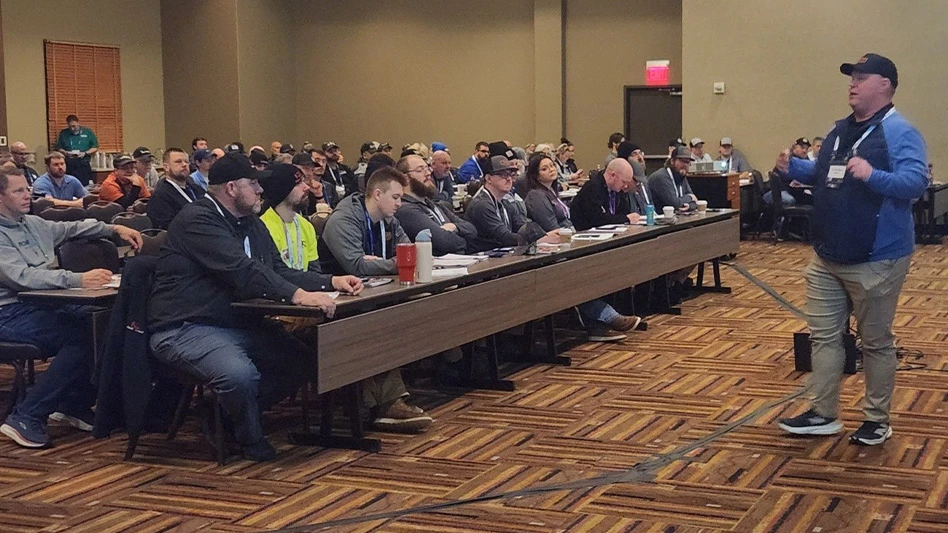
Skimming the proceedings of the conference on North American Termite Biology and Control exposed several Myth Conceptions about termites and their control. Organized by Dr. Brian Forschler of the University of Georgia and sponsored by Dow AgroSciences, this unprecedented three-day conference of the most prominent and respected scientists studying termites and their control was held in June 1996 in Nassau, Bahamas.
CHEMICAL BARRIERS PHASED OUT. The conference was introduced with the proposition that soil treatment barriers would be replaced by chitin synthesis inhibitors, metabolic inhibitors, insect growth regulators and other new methods. The researchers seemed unanimous in their concern that total colony elimination or suppression could not be assured given the current state of scientific protocols and some marketing practices. They were also at a loss as to how to confirm colony elimination in the field with a reasonable certainty. Even researchers whose work originally demonstrated the feasibility of bait efficacy in eliminating termite colonies seemed concerned that some marketing practices and commercial methods of measuring elimination of colonies in the field may be too speculative.
Chemical perimeter barriers for subterranean termite control may be more persistent in the mentality of PCOs and the regulatory community than in the soil. To the entomologists at the conference, the stand-alone perimeter soil barrier method was ancient history, and they anticipated that it would eventually be supplanted with an integrated approach utilizing wood treatments, structural treatments, soil treatments and baits, most likely within a site-specific IPM framework.
While EPA registration of termiticides is based on tests that show a five-year residual life of the toxicant in the soil, Roger E. Gold & Associates field-tested various termiticides and found none were consistently effective for five years in Texas soil. In fact, they were significantly degraded within a few months after application. The good news, however, according to Gold’s group, is that if the tested termiticides are adequately distributed in the soil, the chemical barrier should give Texans at least two years of acceptable performance in most cases.
SOME TERMITES AVOID BAITS. A recurring theme continued to be raised over the uncertainty of methods used to confirm that a termite colony was in fact eliminated. There is evidence of avoidance to certain treated baits by the termites. Researchers found evidence of termites feeding in wood stake controls inches away from bait stations that would have otherwise been presumed to have been effective. P.Y. Lai in 1977 observed that Formosan termites avoided application sites while remaining active in other interconnected feeding sites. He concluded that although the biological control agents used in his study repelled termites, they did not impact the colony population. In 1995, Nan-Yao Su reported that Formosan termites initially accepted treated baits, but avoided them later.
A popular myth conception with some PCOs — that the colony dies when the queen dies — was shattered. Barry Pawson and Gold found that with three common species of Reticulitermes, the very early instar individuals are selected to develop into reproductives within three months after separation from the mother queen. In the Mallis Handbook of Pest Control, 8th Edition, Mike Potter states that secondary reproductives of R. hesperus can be found in as little as six to eight weeks after breaking away from the parent colony. All that this small contingent of breakaways needs is a leaky roof or pipe, or condensate from all moisture-retaining construction or faulty building practices.
Development of these colonies above ground is neither appropriately nor responsibly considered by some members of the regulatory community that want to dictate control methods. They doggedly ignore the importance of an established infestation’s spontaneous ability to feed and flourish in the structure after being cut off from the soil.
COOKIE-CUTTER CONTROL DOESN’T CUT IT. It is naive to think that established structural infestations can be predictively controlled with soil treatments. Although this practice dates back for many decades with variable results, it is impossible to convey that message to some of the regulators. They would continue to have PCOs perform automatic cookie-cutter perimeter treatments using hundreds of gallons of a toxicant and still blame them for occasional failures.
While the conference proceedings described are two years old, in my opinion the ideas projected are both prophetic and far-reaching. As long ago as 1990, Bill Hawks of Wichita, Kansas, wrote a warning that PCOs and regulators’ notion of a termite job was a dangerous “cartoon” and that someday PCOs would awake in the middle of a nightmare. The nightmare is certainly here with the coming of the Federal Trade Commission investigations. However, it is good to know that there are dedicated scientists leading the way with gutsy, outstanding conferences such as this one. More myth conceptions that were exposed during the conference will be reported in future columns.
Harry Katz is a contributing editor to PCT.

Explore the June 1998 Issue
Check out more from this issue and find your next story to read.
Latest from Pest Control Technology
- Earn CEUs from Your State at Next Week’s Mosquito Control Virtual Conference
- Preserving Culture, Providing Opportunities Key in Hoffman’s Decision
- Winter Weather Could Decide How Bad Mosquito Season Gets
- Trent Frazer Discusses How Mosquitoes Survive Winter
- Barnes Exterminating Acquires Tennessee Pest Solutions
- Pest Index Up 9% YOY in January
- Arrow Exterminators Acquires Hoffman's Exterminating
- PMPs Plan Mera Peak Summit for Parkinson's