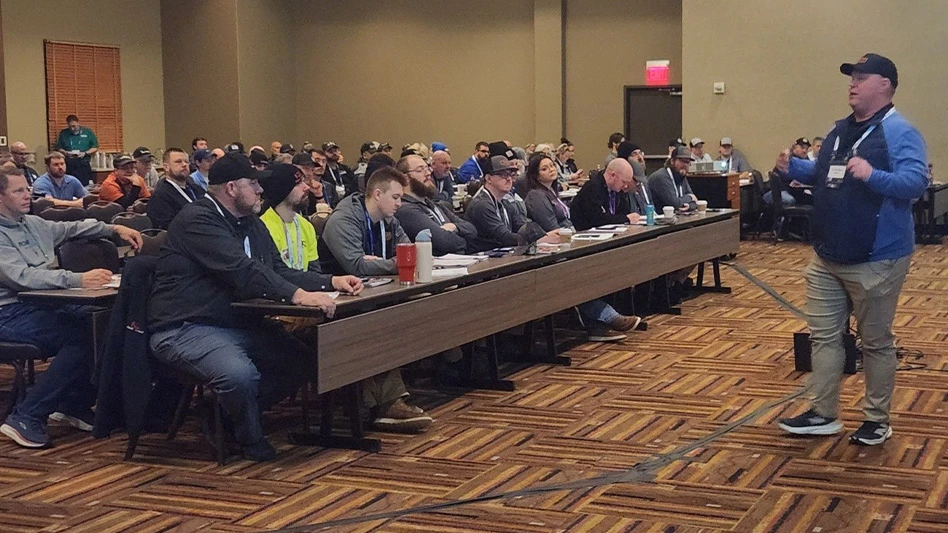
Giving talks about the pest control profession to civic groups, associations, clubs, and other community organizations is an effective, low-cost way to publicize your company and get the phone lines jumping with new business.
A regular challenge for most PCOs is determining how best to allocate dollars toward advertising and publicizing their businesses. Yellow page ads, radio and television time, newspaper and billboard space, direct mail, and advertising giveaways are among the usual contenders.
Rarely, if ever, is thought given to a thoroughly effective, low-cost means of making an impact by publicizing yourself and your company through public speaking. This offers the rare opportunity to tell audiences face-to-face about what you do, while at the same time offering education in the truest sense. Best of all, it almost always brings in new business.
Community organizations all across the country are constantly on the lookout for feature speakers who have something interesting to say. Program chairpersons are always in quest of individuals who are able to enlighten audiences, particularly when offered at no cost and when covering subjects that are "different." Fortunately, pest control is high on the list in this regard.
Despite common perceptions, public speaking is an art that can readily be cultivated by the average business owner. Any person capable of carrying on a lucid conversation can, with practice and persistence, give a competent talk before an audience. The object for giving a public speech by a pest controller should be to tell a story and to educate and inform the audience in an interesting manner. Polished, spellbinding, professional oratory is not needed.
How does one get an invitation to give a speech in the community? Once you've prepared your presentation, an announcement of the availability of your program in the local newspaper or on a community service cable channel can prove helpful. Direct contact with service clubs, trade groups, chambers of commerce, garden clubs, local professional organizations, and the like can also bring results. Here is where the PCO must demonstrate dogged perseverance to pan the gold.
'GEE WHIZ' STORIES. Many PCOs don't seem to realize what a strange fascination pests have for the average person not engaged in controlling pests. Go to a party or social gathering and the odds are that when your occupation is revealed, someone will come up with a personal experience involving insects or rodents or will have a question to put to you about your experiences as a professional. The press is full of "gee whiz" stories about pests, and Hollywood has long been known for cranking out schlock films involving "super bugs" that attract large audiences.
Our object here is not to offer a course in public speaking. It is our intention, however, to attempt to pass along some pointers that can assist the beginning speaker in improving and polishing his offering. In so doing, we again emphasize that with practice and determination, the average PCO can develop into a speaker who will win audiences.
Speech teachers are in agreement that one of the best preparations available to prospective speakers is the practice of reading out loud. Regularly pursuing this exercise, especially using a variety of inspiring and challenging passages, is excellent vocal practice that will give color and strengthen your tones. Make your speaking breath short, deep and easy, and try to concentrate on middle and lower registers of pitch. Likewise, the experts advise to stay out of your throat and speak up front right behind your teeth. Keep the mouth relaxed and channel tones through the mouth rather than the nose.
Prospective public speakers should practice their deliveries on and with their families, according to Dorothy Uris, author of Everybody's Book of Better Speaking. She also advises cultivating the habits of and listening to good TV and radio voices.
One of the best aids available to speakers is the tape recorder, which should be used constantly and made an ally as well as a critic. Record your speaking voice and aim for improvement with each effort.
WORD POWER. The speaker should strive to build a well-rounded vocabulary with the aid of two reference materials: a dictionary and a thesaurus. A familiarity with words, their meanings, and correct pronunciation and usage are prerequisites for success in speaking.
Wayne N. Thompson and Seith A. Fessenden, who wrote Basic Experiences in Speech, offer important guides to language usage worth repeating:
• Be extremely word-conscious, using a wide variety of references.
• Be aware that words mean different things to different audiences and between speakers and the audience.
• Use words that convey meaning clearly and accurately. Short words are better than long ones. Avoid technical words unless geared to specific audiences.
• Adopt an appropriate level of usage. At one extreme are stuffiness and affectation; at the other, the overuse of slang and vulgarisms.
• Use the language of speech rather than the language of written conversation. The language of the printed page can be too stiff.
• Use sentences of varied length and structure. A short sentence, particularly when placed among long ones, can greatly increase clarity and force. A common fault is to join ideas with "so" and "and" instead of ending the old sentence and starting a new one.
• Whenever possible, try to express yourself vividly and with originality. One well-chosen word can stamp a thought into the mind of a listener to an extent that a dozen colorless expressions cannot match.
POETRY IN MOTION. With the use of a mirror, the beginning speaker can test his or her bodily actions. Are there nervous mannerisms detected? Does the speaker walk about too much or does he or she stand unnaturally motionless? Are gestures avoided entirely or are gestures that are used awkward, badly timed, or self-conscious?
The role of gestures in giving a speech is important. The pros agree that appropriate gestures, when properly employed, add spice to a speech. The normal place for hands is at the side of the speaker. Never gesture with elbows at the side. Get them away from the body and let the arms move freely.
In practice sessions the speaker is advised to gesture freely to overcome speaker immobility. But in giving a talk, always use only those gestures that fit the speech situation. For example, in enumerating, synchronize the numbers with fingers pointing, point to indicate direction, use hands to aid with literal descriptions such as the height of a child, the width of a box, or the distance between points. A practiced speaker can improvise and use a wide variety of appropriate gestures to fit the presentation.
AUDIOVISUAL AIDS. The use of props and showing films or slides to supplement a talk is beneficial, particularly for the pest control speaker. We have found that both live and pinned insect specimens taken to a meeting garner real audience interest.
Videos, motion pictures and slides can "flesh out" a speech, but they must have relevance to your talk and be used sparingly. How many speakers have regretted showing audiovisuals, only to have half the audience deep in sleep after the lights are out for too long? Remember, when you talk before a lay group, you are not conducting a training session. As a rule of thumb, no more than a third of the time should be taken up with speaker aids in a given speech. SIZING THINGS UP. Before selecting a topic, the serious public speaker always tries to analyze the audience. He/she will want to know how many people will be present, their ages, their educational level, and any characteristic common to the majority of the audience.
Another important step in preparing to deliver a speech is an examination of the speaking situation. The speaker is advised to visit the site and make note of the size and acoustics of the room. He or she will also want to know in advance whether there will be other speakers on the program and whether the speech will be part of a special occasion.
`CONSTRUCTING' A SPEECH. It goes without saying that except in a scholarly session where specialists offer erudite papers, a speech is never read. Nor should a speech be memorized; memorization leads to stilted, mechanical deliveries. The use of an outline or prompting cards that are glanced at occasionally and stress the key points is perfectly acceptable. These, however, should be looked at sparingly. The prepared speaker, having practiced the delivery many times, should not have to resort to these "guideposts" too often.
All good public speeches spring from carefully constructed outlines. Outlines are road maps that consist of three essentials: an introduction, a body and a conclusion.
Introductions offer necessary background information regarding the subject. They should aim to arouse the audience's interest and bring the speaker and the audience into a state of friendliness. This, by the way, is the proper time for humor as an icebreaker.
The body of the speech typically occupies most of the speaker's time. In it a narrative is developed to explain the process or support the thesis.
The conclusion of the speech is the time for a summary and a wrap-up. Principles discussed in the body can briefly be repeated for emphasis and reinforcement, and there may be an appeal for action included.
If the speaker can adopt the idea that in giving a speech, he or she is informally conversing with a group of friends or potential customers who want to learn something, much of the imagined terror and the "butterflies" that are supposed to go with getting up to speak before an audience will be eliminated.
AN EXAMPLE. Let's suppose that we have decided to present a talk on termites to a group of realtors. These realtors have been utilizing the pest control industry to make inspections before closing home sales. As a group, they realize the danger of selling infested properties. We also have learned that the realtors have a vague idea that these pests "destroy wood" and nest in the soil.
We would like this speech to accomplish two goals: leave the audience with a greater knowledge of the biology, habits and destructive potential of these pests, and impress this group with our ability and success in offering quality termite control. What should we include in this speech?
For starters, the audience should be informed that termites make up an order in the wide, wonderful world of insects. Here we might point to the astounding fact that insects make up the largest number of individual kinds or species of animals more than 800,000, a number greater than all other animals combined.
You could make this even more impressive by stating that if all the known insects would line up and pass a single point in a constant parade, it would take a year and a month for them to complete the march. Mention can also be made of the fact that insects are found in all parts of the world except in the ocean, and that they are extremely adaptable and prolific.
The speaker could also give the impressive damage statistics attributable to termites, stressing the fact that more buildings are destroyed by termites than by lightning and wind storms combined. Here is a good time to show actual specimens of the queen, workers, soldiers and reproductives, or their pictures, along with actual damage specimens. Then, launch into the unique life history and habits of these highly social insects.
Your audience should also learn how to recognize the signs of termite damage, recognition of termite tubes and caste wings.
Next, preferably with the aid of your own in-house slides or a video, you can give a short presentation that documents an actual termite job done by your company. Begin by showing the inspector demonstrating inspection techniques and follow with shots showing soil treating, foundation treating and wood treating.
An appropriate ending can tell your listeners something about your company and your outstanding record in termite control. And don't forget to stress that controlling termites is a job for the professional it's not for do-it-yourselfers.
Following your talk, solicit questions from the audience. Before leaving, pass out professional-looking take-home literature (available from suppliers) with your company's name, address and phone number readily displayed.
Beside termites as a subject for a talk, there are many other suggestions for the PCO. To name a few: insects and public health; Lyme disease; social insects; animal parasites (fleas and ticks); the rodent menace; urban entomology; and cockroach allergies. Ingenuity, research and aiming the subject at the proper audience are all it takes to put together something interesting and informative.
STEPS FOR IMPROVEMENT. In How to Talk With People, author Irving J. Lee offers eight steps for improvement that summarize the subject for the fledging public speaker:
• Speak often.
• Choose a topic on which you are well-informed.
• Prepare carefully.
• Learn the sequence of ideas but never memorize a speech word for word.
• Prior to going before an audience, keep as relaxed as possible.
• Without calling attention to the action, take two or three deep breaths as you rise to walk in front of the room.
• When you reach the speaking position, take a firm stance and pause before beginning. Get the opening sentence in mind and look at the audience. Then begin.
• Plan a speech that involves platform movement. Maps, charts, and other audiovisual aids can add variety and help relax tension.
GROUP THERAPY. Without question, the best suggestion to prepare yourself to be a successful public speaker is to work and train with a group. No better source comes to mind for such an experience than Toastmasters International, a well established, highly successful organization dedicated to the training and development of amateur speakers. Holding regular meetings in which members follow a prescribed course of exercises, and in which everyone gets to speak and receives helpful criticism, the group is organized locally in many communities throughout the country.
To obtain more information about this group, look up "Toastmasters International" in the business section of your local telephone book's white pages. If there is no listing there, write or call the organization's national headquarters: Toastmasters International, 23182 Arroyo Vista, Rancho Santo Margarita CA 92688, 714/858-8255.
Another recognized source for training can be found in local community colleges and high schools, where adult education courses in public speaking usually are included in the curriculum.
It takes a lot of work and practice, but to become a proficient speaker who can get up before an audience to deliver a competent speech is an accomplishment that will do you proud and can help you and your business immeasurably. First, you get the heady experience of basking in the applause of an appreciative audience; then, the follow-up phone calls for pest control service from the company whose speaker gave such an enlightening talk.
Bob Berns is a staff correspondent for PCT magazine.

Explore the April 1996 Issue
Check out more from this issue and find your next story to read.
Latest from Pest Control Technology
- Earn CEUs from Your State at Next Week’s Mosquito Control Virtual Conference
- Preserving Culture, Providing Opportunities Key in Hoffman’s Decision
- Winter Weather Could Decide How Bad Mosquito Season Gets
- Trent Frazer Discusses How Mosquitoes Survive Winter
- Barnes Exterminating Acquires Tennessee Pest Solutions
- Pest Index Up 9% YOY in January
- Arrow Exterminators Acquires Hoffman's Exterminating
- PMPs Plan Mera Peak Summit for Parkinson's