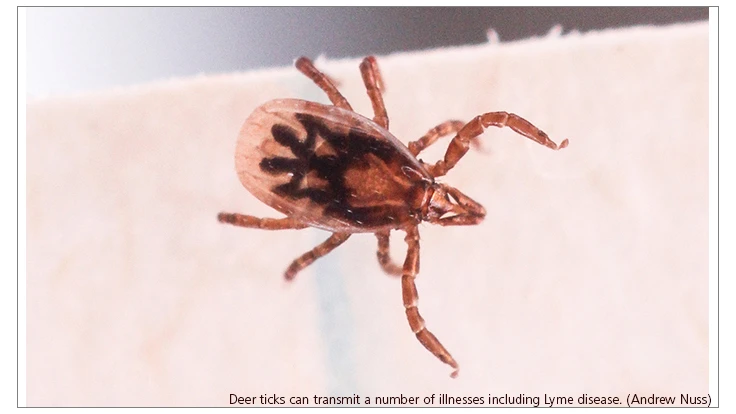
WEST LAFAYETTE, Ind. - An international team of scientists led by Purdue University has sequenced the genome of the tick that transmits Lyme disease, the most common vector-borne illness in North America.
The decadelong project, involving 93 authors from 46 institutions, decodes the biology of an arachnid with sophisticated spit, barbed mouthparts and millions of years of successful parasitism. The genome of Ixodes scapularis, known as the deer tick or blacklegged tick, also sheds light on how ticks acquire and transmit pathogens and offers tick-specific targets for control.
"The genome provides a foundation for a whole new era in tick research," said Catherine Hill, lead author of the paper, Purdue professor of medical entomology and Showalter Faculty Scholar. "Now that we've cracked the tick's code, we can begin to design strategies to control ticks, to understand how they transmit disease and to interfere with that process."
I. scapularis is the first tick species to have its genome sequenced.
The principle genome paper was published in Nature Communications on Tuesday (Feb. 9) and is available at http://dx.doi.org/10.1038/ncomms10507.
Latest from Pest Control Technology
- Donny Oswalt Shares What Makes Termites a 'Tricky' Pest
- Study Finds Fecal Tests Can Reveal Active Termite Infestations
- Peachtree Pest Control Partners with Local Nonprofits to Fight Food Insecurity
- Allergy Technologies, PHA Expand ATAHC Complete Program to Protect 8,500 Homes
- Housecall Pro Hosts '25 Winter Summit Featuring Mike Rowe
- Advanced Education
- Spotted Lanternflies, BMSBs Most Problematic Invasive Pests, Poll Finds
- Ecolab Acquires Guardian Pest Solutions