Dong-Hwan Choe, Nicholas Poulos and Chow-Yang Lee
Editor's note: The following article was written by Dong-Hwan Choe, Nicholas Poulos and Chow-Yang Lee, Department of Entomology, University of California, Riverside.
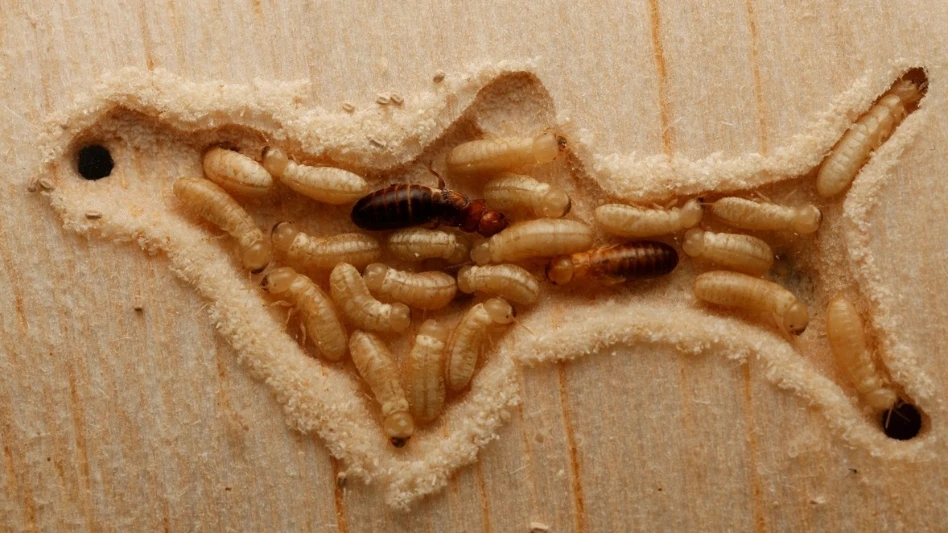
The western drywood termite, Incisitermes minor (Hagen), causes significant economic damage to wood structures in the United States, especially in California. When infestation is not widespread, localized insecticide injections can be effective for control. However, the extensive gallery systems of drywood termites and their tendency to gather in specific parts of the galleries can reduce the effectiveness of localized insecticide treatments. Chemicals that attract termites from a distance might enhance these treatments by increasing the number of termites contacting the insecticide residues. Two volatile compounds (terpenes), α-pinene and β-pinene, commonly found in many coniferous timber trees, were applied to artificial termite galleries to see if termites would be attracted from their original aggregation sites. Additionally, we examined whether adding these pinenes could improve the overall effectiveness of some insecticide products for drywood termite control.
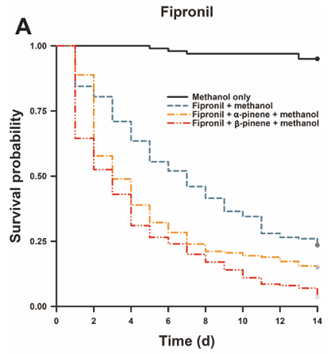
Behavioral study results showed that treatment with pinenes increased the likelihood that drywood termites would leave their original aggregation site and contact the treated part of the gallery. When tested with pesticide products applied in a small area away from the termite aggregation, β-pinene significantly sped up the termite control for the water-based fipronil treatment (Fig. 1). The efficacy of borate dust (disodium octaborate tetrahydrate) was not affected by the addition of pinenes. To find optimal combinations for localized insecticide injection, more work must be done to understand the relationships between different active ingredients/formulations and pinenes.
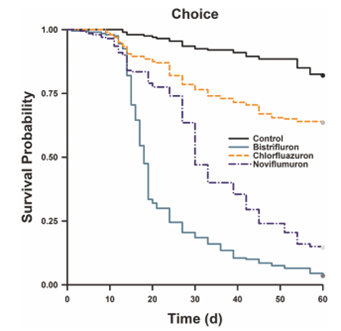
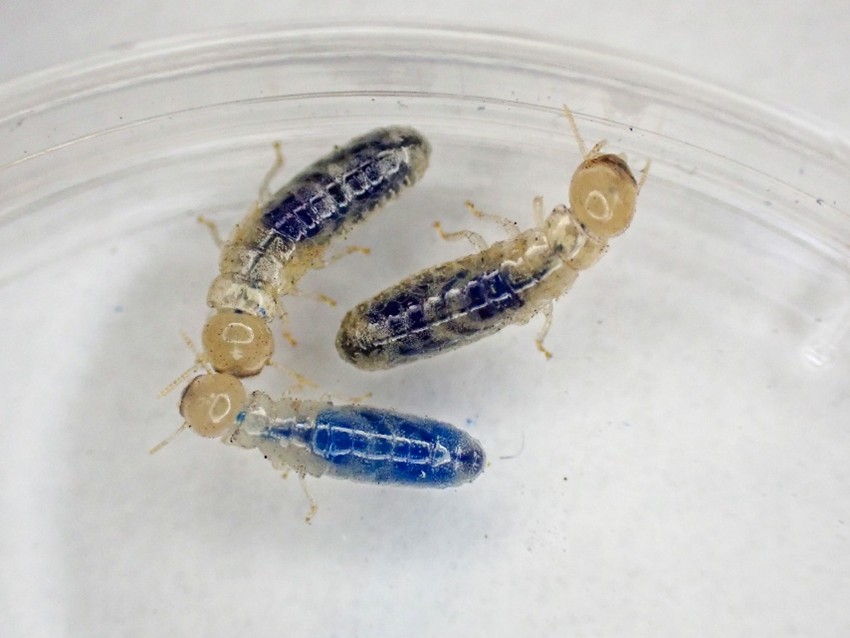
In the second project, we explored the potential of chitin synthesis inhibitors (CSIs) for controlling drywood termites. CSIs are a group of insect growth regulator that disrupt the production of chitin, an important component of insect exoskeleton. Specifically, we evaluated bistrifluron, chlorfluazuron and noviflumuron for their toxicity and ability to transfer horizontally among western drywood termites when applied to wood. In a no-choice bioassay, where termites only had access to treated wood, bistrifluron caused significantly faster death than chlorfluazuron or noviflumuron at 0.1% and 0.5% (wt/wt) over 60 days, achieving 99% mortality. In a choice bioassay, with both treated and untreated wood available, using 0.1%, bistrifluron still caused faster death than the others over 60 days, with 96% mortality (Fig. 2). In a transfer bioassay, a group of termites fed bistrifluron, called donors (D), was placed with unexposed nestmates, called recipients (R). Based on visual markings, the food from donor termites was quickly transferred to recipients within 24 to 48 hours (Fig. 3). Overall, survival patterns were similar between 1:19 (5% donor) and 10:10 (50% donor) D:R ratios, both reaching 100% mortality by day 90. This shows that even with limited numbers of termites that ingested the compound, lethal amounts of bistrifluron were retained and effectively transferred.
The study successfully demonstrated the potential of CSIs in drywood termite control. The transfer of toxicant occurred in the laboratory colonies and led to high mortality. However, it remains to be seen if similar transfer levels and final mortality could be achieved when a CSI is used for larger groups of western drywood termites. We believe that an “in-wood baiting” system with CSIs as the AI could be viable, and it might offer a new tool for drywood termite control in the future.
In the third project, bacterial communities of fresh and aged fecal pellets from western drywood termites were studied to determine if microbial signatures can distinguish between new and old pellets. If successful, this approach could help identify active infestations. Fecal pellets were collected from termites that fed either on the wood they were found on or on Douglas-fir (D-fir) commercial lumber. The samples included freshly produced pellets as well as those that were 3 months, 6 months and 12 months old. These samples underwent gene sequencing to identify their bacterial content.
Natural-wood pellets contained, on average, over five times more bacterial DNA than D-fir pellets. A decrease of up to 190-fold in bacterial DNA was observed from fresh to 12-month-old pellets. For pellets from termites fed on D-fir, comparisons between different ages revealed specific differences in their bacterial compositions. The study also identified five bacterial groups that were consistently present in all fresh pellet samples but completely absent in older samples. Besides providing a basis for characterizing the microbiome of western drywood termite fecal pellets, these findings suggest several candidate biomarkers for further study to develop a cost-effective method for distinguishing fresh from aged fecal pellets.
Overall, we have been exploring several key areas of drywood termite management — enhancing local treatment options, researching CSIs for potential use in drywood termite control, and developing new methods to improve drywood termite detection. As drywood termites remain a challenging pest to detect and control, we hope this research will provide useful solutions and tools for pest management professionals in the future.
Latest from Pest Control Technology
- BOM Hosts Dinner at NPMA Legislative Day
- Rear Admiral Scott Moore Shares Five Essential Leadership Principles
- 2026 NPMA Legislative Day Photo Gallery
- Fleetio Launches AI Service Advisor
- Shannon Sked Discusses Preemption and Legislative Day Importance
- Routes to Riches with Kemp Anderson: Ep. 1 — 2026 Outlook
- NPMA Honors Industry Leaders At 2026 Legislative Day
- NPMA Legislative Day Highlights Farm Bill Momentum and Push for Pesticide Preemption