Missiti started working alongside her Uncle Steve, who recommended she obtain her license so she would be more knowledgeable when customers called with pest problems. After graduating, Missiti began going out in the field and secured a full-time route. When she received her first technician uniform, she described the pants as “dark brown gas station chinos.”
“The uniform did not fit. I’m 5’2” — I had to cuff the pants up,” Missiti recalled. “The shirts had patches on the arm. I thought, ‘Am I going into the military?’ They were these starchy, tight, stiff, solid button-down shirts that were totally oversized for me.”
Eventually, the uniform became unbearable to wear. She couldn’t function well enough on the job and felt she didn’t look like a professional pest control technician. What did she do then? Missiti changed her uniform, foregoing the chinos and button-downs for khaki pants, work boots and a polo shirt (much more comfortable than the button-down, she emphasized). This new uniform allowed her to feel feminine and more like herself.
“I think the uniform was extremely important in helping me build up my confidence at that time in my life. I wasn’t worrying about what I was wearing, I was focusing on how I was going to solve the customer’s problem,” she said.
INDUSTRY ADVANCEMENT. While women aren’t new to the pest control industry, there has been a concerted effort to attract them to the field in recent decades. The National Pest Management Association (NPMA) has held its Women’s Forum for the last five years. These forums are held for pest control professionals to connect and develop their career progression skills for continued leadership in the industry while also honoring women in the field with the annual Impact Awards. Groups like Professional Women in Pest Management (PWIPM), established in 1988 by NPMA, and Women in Pest Control (WIPC), founded in 2017 by Bobbie Terry, also are dedicated to empowering women in the industry.
Women leaders such as Missiti, who served as the 2023-24 NPMA president, have been role models for other women in pest control. To become the role models they are today, these women had to lead the way in making changes that would better accommodate women, and technician uniforms were a crucial part of that.
MORE THAN A UNIFORM. Abell Pest Control, based in Ontario, Canada, celebrated its 100th anniversary in 2024. A lot has happened at the firm in a century. Liz Abell, the fourth-generation leader of the family company, said she sought feedback from female employees about their uniforms during the anniversary year. Many shared that they were not feeling their best in the uniforms, which led to a six-month exploration project meant to gather more feedback and test alternatives.
“From both my own experience and what I hear from other women in the field, the biggest challenge is fit, specifically with work pants,” Abell said. “The ones from our supplier are unisex, which means many of us have to go a size up for comfort but then end up with a loose waist that needs a belt. That creates extra bulk that isn’t comfortable for long days out in the field.”
To help Abell find the best fitting pants for employees, the company explored options with Mark’s, a Canadian retail company, allowing route managers to try on different types of pants that worked and felt best for them. In addition, a more breathable quarter-zip shirt came out of the project.
Although testing clothing samples and finding the best solutions for employees in different regions was a challenge, Abell said the effort was worth it for the company to give female technicians peace of mind when in the field. “It might seem like a lot of work for something as basic as clothing, but when you wear a uniform every day, comfort and pride matter,” she said. “The right fit isn’t just about appearance — it’s about supporting performance and making all members of our team feel valued.”

TAILORED TO SUPPORT. As branch manager of New Jersey-based Viking Pest Control, David Brown has been on the forefront of helping find the best-fitting uniforms for employees, male and female alike. Viking uses a uniform company that offers women’s cuts and sizing for shirts, pants and shoes; when a woman joins the company, she can pick which fits of shirts and pants work best for her.
Brown said having the right uniforms is just one part of supporting and employing women in pest control. “I think pest control has definitely been a male-dominant industry, and uniforms are just the tip of the iceberg when it comes to including women,” he said. “It’s about making them feel more comfortable and empowered, thereby encouraging them to be in the industry.”
Michael Keith, owner of Cal Coast Pest Management in National City, Calif., said he’s also had to go the extra mile to help his female technician find the right uniform. “The pant material was similar to those old school b-boy sweats,” he said. “It was one of those really thin, water- resistant materials.”
Sometimes, finding the right uniform requires a little bit of innovation. Noelle Goins, owner of Get Goins Pest Control in Los Angeles, Calif., said it’s critical for uniforms to be compliant with California’s pest control regulations. She knew she needed to have chemical-resistant shoes, long-sleeved shirts and pants long enough to go over her boots. While there were strict requirements for her to follow, Goins said it was still important for her to feel both protected and feminine. She found that high-waisted pants and body suits (still labeled with company branding, of course) worked best for her, allowing her to avoid wearing an uncomfortable belt while preventing her shirts from becoming untucked.
“Finding the right uniform was definitely a process. It didn’t happen overnight,” Goins said. “But, for the most part, I feel like women in this business are detail-oriented, so we don’t mind taking the time to research something until we find what we’re looking for.”
THE FUTURE IS FEMALE. In 2004, Courtney Carace started working at Pest-End as an office administrator. Today, she is the chief operating officer and a second-generation owner alongside her husband, Adam Carace, and sister-in-law, Amanda Forrestall. As more female technicians began joining Pest-End, Carace said she knew the company needed uniforms specifically suited for them. This year, she said Pest-End was able to hire several women technicians and have them try a few different pant styles.
“Pants have always been the Achilles heel in the challenge there,” she said. “We’ve been able to narrow that part down to have more uniformity, but we still give employees a couple different options to choose from. Some prefer a tighter fit while others prefer a looser one. You want to make sure people are comfortable.”
While the right uniforms are a small element of a pest control technician’s job, Carace said she believes they signal to customers that they’re prepared to provide the highest quality service. “It was really important to offer uniforms that were tailored for women,” she said. “It extends the message, especially being a women-owned company, that women do belong in this industry and that representation matters. Uniforms that fit properly are normalizing our presence in these roles.”
The author is assistant editor of PCT.
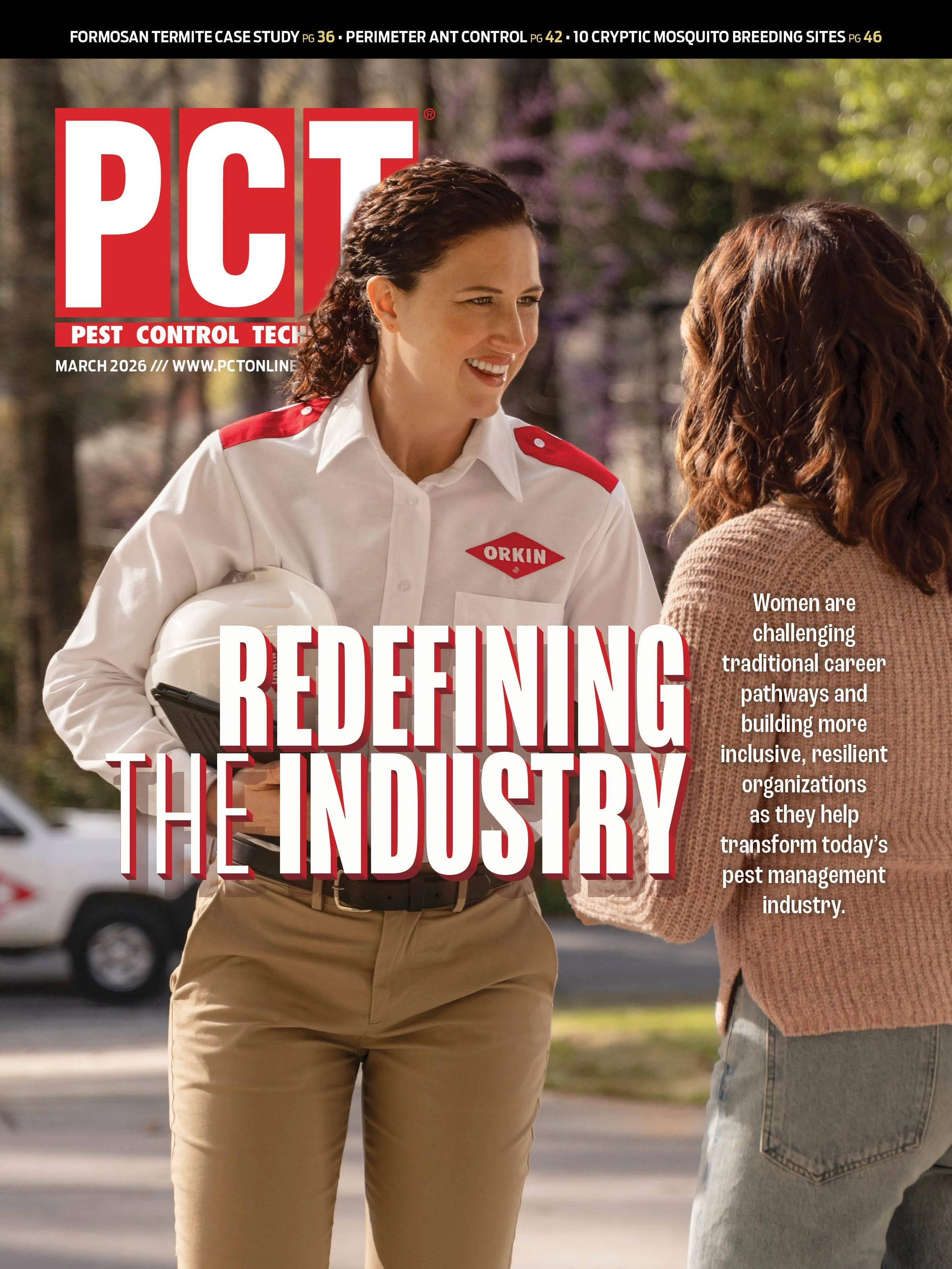
Explore the March 2026 Issue
Check out more from this issue and find your next story to read.
Latest from Pest Control Technology
- Certus Acquires Termio Pest Control in Arizona
- The Alliance Releases 2025 Annual Report, Showcasing Growth
- David Poplin Discusses Military Experience and How it Applies to Pest Control
- David Poplin Named PestVet of the Year
- Consulting Biologist Dan Collins Details Approaches to Effective Rodent Control
- Massey Announces the Promotions of Campbell, Graham
- BOM Hosts Dinner at NPMA Legislative Day
- Rear Admiral Scott Moore Shares Five Essential Leadership Principles