AdobeStock
CLEVELAND – Termite control continues to be an important revenue-generating segment for PCOs. Customers seek professionals to protect one of their most important assets — their homes — from termites. While it’s known that termite control services are always in demand, how has that been reflected in business earnings in recent years?
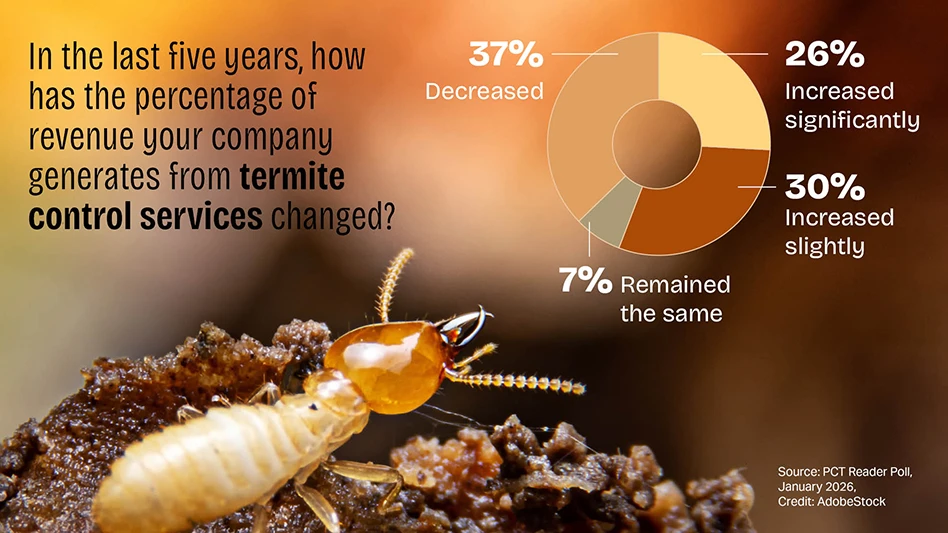
According to results from a recent PCT reader poll, 37% of respondents said their company’s percentage of revenue generated from termite control services decreased in the last five years while 30% of respondents saw a slight increase. Twenty-six percent found a significant increase in revenue and only 7% said their revenue from termite control services has remained the same in the last five years.
Redd Pest Solutions, Gulfport, Miss., has averaged a 15% annual growth in its termite customer base over the past five years, Eddie Brewer, president, said. This growth, he said, was driven by customer retention.
“Rather than chasing one-time treatments, we concentrate heavily on prevention, especially for our customers already on our general pest programs,” Brewer said. “When you educate homeowners early and position termite protection as part of ongoing home care, growth tends to happen naturally and sustainably.”
Operating in the southeastern region of the United States means the conditions for termite activity are conducive. Brewer said that termite pressure isn’t a “maybe” in the company’s service areas, it’s a “when.” The company is also seeing longer termite activity seasons, he said. In many cases, activity is almost year-around because of the region’s warm and humid climate, which is ideal for native subterranean and Formosan termites.
The biggest change we’ve seen is longer activity seasons. Because of our warm, humid climate, both native subterranean termites and Formosans remain active much longer than in other parts of the country. In many cases, activity is nearly year-round, depending on weather patterns for the that year.
“On top of that, Formosan [termite] pressure has steadily increased over the years. Colonies are larger, feeding is faster and damage can escalate quickly,” Brewer said. “That’s pushed both homeowners and pest professionals to think more proactively about prevention.”
Billy Blasingame, owner, Blasingame Pest Management, Griffin, Ga., said the company doesn’t do “heavy” termite control services but still sees success in that department. At one point in the company’s history, Blasingame Pest Management sold its renewal business; after a noncompete they jumped back into offering it.
“[2023] was such a big year for us,” Blasingame said. “Things are trending back upward for us on our termite side.”
Termite control itself has changed over the past several decades, Blasingame said, especially with the rise in popularity of baits.
“We’re about 30 miles south of Atlanta. Termites are very prevalent,” Blasingame said. “And you can really see that using bait systems because when you check a property, you may find termite activity in a particular station on the front, west corner of the house. You’re going to eliminate those and then two years later you may go back to that same property and find them on the back corner of the house. It really illustrates how prevalent termite colonies are on the ground just everywhere.”
Latest from Pest Control Technology
- Earn CEUs from Your State at Next Week’s Mosquito Control Virtual Conference
- Preserving Culture, Providing Opportunities Key in Hoffman’s Decision
- Winter Weather Could Decide How Bad Mosquito Season Gets
- Trent Frazer Discusses How Mosquitoes Survive Winter
- Barnes Exterminating Acquires Tennessee Pest Solutions
- Pest Index Up 9% YOY in January
- Arrow Exterminators Acquires Hoffman's Exterminating
- PMPs Plan Mera Peak Summit for Parkinson's





