iStock | heng_Wei
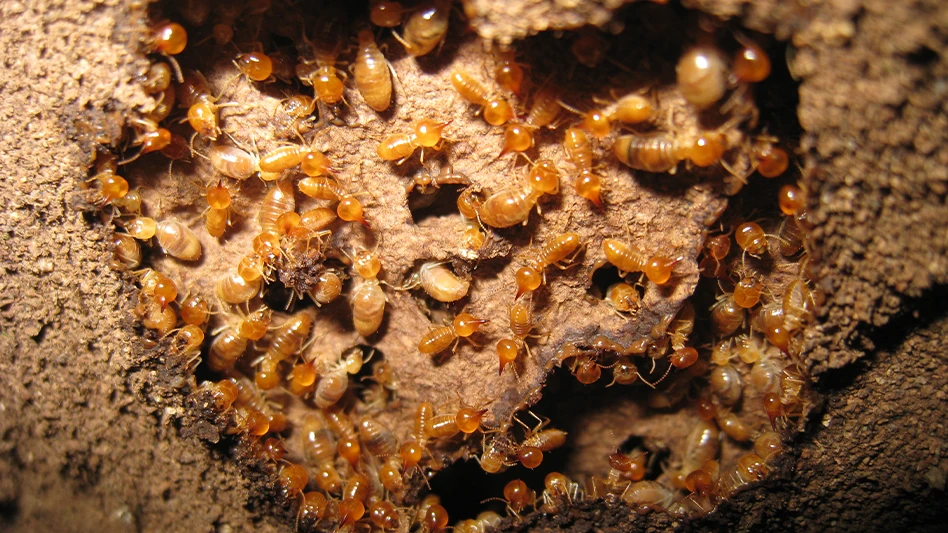
TUCSON, Ariz. — According to Paul Opocensky, manager of Truly Nolen’s Saddlebrook, Ariz., office, subterranean termite swarms were 30 days behind the seasonal pest pressure average, a result of issues such as climate trends, such as longer drought periods and a later rain season. Once swarms did arrive, they did so in big numbers, accounting for a significant amount of his office’s September service calls.
Opocensky said the heavy rain periods didn’t start until early August, compared to last year’s monsoon season starting around June, causing subterranean termite swarms to stay underground.
“On hotter days, the termites are [hiding] where it’s cool and they stay down in the ground and don’t come up unless they have a reason to,” he said. “The delay in the rain coming this year definitely put us back, but we are seeing an uptick in our termite activity over the last couple of weeks.”
Correlation to termite activity comes with wet weather, moister and temperatures ranging from 65°F to 85 to 90 °F, Opocensky said, adding geographic location plays a factor in the heightened termite activity.

Opocensky’s technicians have also spotted termite swarms more frequently in the field, he said. Subterranean termites cannot colonize inside of walls. They come up through the ground, ingesting soil and forming tubes to come out of the ground, whereas drywood termites can colonize inside the structure itself, live in dead wood and chew through the wood itself.
Because subterranean termites emerge from the ground, "they are ingesting soil and creating their tubes with that, so a lot of times if there is mud or dirt packed in with the wood [structure]. It’s a good sign it is subterranean termites coming up,” he said. “The drywood termites are in areas where they’re eating away the wood and there’s not a whole lot of extra debris.”
When treating drywood termite swarms, [frass] will appear and can change colors, like spheres comparable to salt and pepper granules.
“As [drywood termites] are eating the wood, they’re not doing anything with the dirt,” Opocensky said. “They are eating wood, digesting that and when their droppings are coming out, they are filling up the nests inside of the homes and once it gets to a level, they have to get rid of it so they chew a hole in the wall and kick that out so there will be a little pile of their droppings.”
Examining the home’s foundation is an important step in treating termites.
”Depending on the [wood] slab, you have to treat [the infested area] a certain way. Sometimes if it’s a monolithic slab, you need to put material on the outside right along the edge because it’s just cemented all the way across the foundation,” Opocensky said.
Another common mistake is cricket droppings being confused with termite frass. Their droppings are usually solid black and can be misidentified as drywood termite frass.
In the past, Opocensky said the company would treat drywood termites in Arizona by fumigating. Truly Nolen was seeking a termite treatment for drywood termites that would leave behind a residual.
Truly Nolen’s research & development department created an application called the Tru-Guard System, a high-pressure wall injection. Technicians insert a needle, turn on the machine, which saturates the wood in all directions, including into the colony and it dies off.
“We wanted something that left a residual chemical,” Opocensky said. “We found this to be much more effective and have a long-standing effect on keeping the termite swarms away.”
Right now, desert areas in the Southwest are busy with termite swarms, Opocensky said.
“The southwest area in southern California is probably experiencing a little more termite activity right now. Not the cities along the ocean but more inland, desert locations,” Opocensky said. “Usually, our termite season goes through the end of October and starts to die off when it gets cold at night. It could technically go a little later this year. It will just depend on what the weather looks like.”
Latest from Pest Control Technology
- Earn CEUs from Your State at Next Week’s Mosquito Control Virtual Conference
- Preserving Culture, Providing Opportunities Key in Hoffman’s Decision
- Winter Weather Could Decide How Bad Mosquito Season Gets
- Trent Frazer Discusses How Mosquitoes Survive Winter
- Barnes Exterminating Acquires Tennessee Pest Solutions
- Pest Index Up 9% YOY in January
- Arrow Exterminators Acquires Hoffman's Exterminating
- PMPs Plan Mera Peak Summit for Parkinson's





