Though slower acting than sprays or dusts, baits are an effective form of ant control because they play into ants’ social nature. As Camille Landry, technical director at Full Scope Pest Control, Houston, Texas, explained, in social insects, “it’s better to get them to come to us than to try to get a chemical on them. It’s using their natural behavior and food source.”
A bait needs to be attractive and palatable to foragers, which consume and share the bait with other ants. The type of bait used — liquid, gel or granular — often depends on environment, Landry said. “It has a lot to do with whether we're dealing with ants inside or on the exterior,” she said. “So, if it's an interior, I would say gel bait. And on the exterior, we use more of a granular bait. Especially here, we're dealing with a lot of fire ants on the exterior in people's yards and close to the perimeter.”
To maximize the intake of granular baits, the Mallis Handbook of Pest Control recommends determining the particle size preference of a particular ant species.
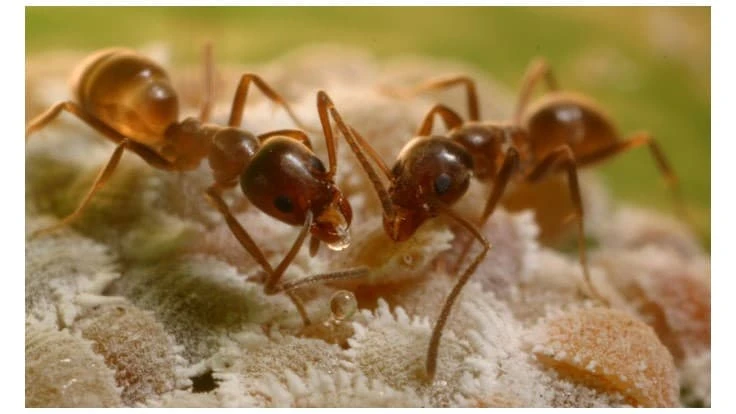
Kathy Daw, owner/manager at Bob’s Pest Control, El Paso, Texas, agreed that granular baits are her go-to for exterior ant control, though she occasionally uses a liquid bait, depending on the situation. According to Mallis, liquid baits are ideal for ants that have coevolved with honeydew-producing insects, such as Argentine ants, which consume more sucrose when it is in a liquid rather than a gel.
Gel baits don’t always hold up outside in the Texas heat, Daw said. “The temperatures here in El Paso are usually pretty, pretty warm in the summertime and/or fall and spring,” Daw said. “And if I'm applying the gels outside, they turn basically to complete water. It doesn't hold up with the weather, at least from my experience.”
Therefore, she prefers using gel baits inside, where she said they work well for ant control and have the added bonus of providing the customer visual satisfaction. “They can see immediately that they're getting ants to the gel source and it's working really well,” she said.
For added customer satisfaction, it’s important for PMPs to spend time educating their clients about how baits work and how long it will take to see results, as baits do tend to be slower acting than other forms of ant control. The delayed activity of the toxicant is key to ensuring distribution throughout the ant colony.
In addition to gel baits, Full Scope also applies non-repellents on interior ant trails to achieve control. “But the gel works because a customer is seeing that the ants are coming straight to the gel,” Landry said.
On the exterior, Landry said Full Scope uses granular baits consistently around the perimeter of a house for insects such as ghost and rover ants. “And that's just because it's a slower kill on the workers, so it has time to be shared with the colony and take it back,” she said. “So it works really well, and it's always part of our toolbox. That's something a tech is almost always applying. Here in Texas, because of our subtropical climate, there’s lots of organic matter, lots of harborage areas for ants. We have a good population here. We're really always trying to be proactive rather than reactive for ants.”
Latest from Pest Control Technology
- Earn CEUs from Your State at Next Week’s Mosquito Control Virtual Conference
- Preserving Culture, Providing Opportunities Key in Hoffman’s Decision
- Winter Weather Could Decide How Bad Mosquito Season Gets
- Trent Frazer Discusses How Mosquitoes Survive Winter
- Barnes Exterminating Acquires Tennessee Pest Solutions
- Pest Index Up 9% YOY in January
- Arrow Exterminators Acquires Hoffman's Exterminating
- PMPs Plan Mera Peak Summit for Parkinson's





