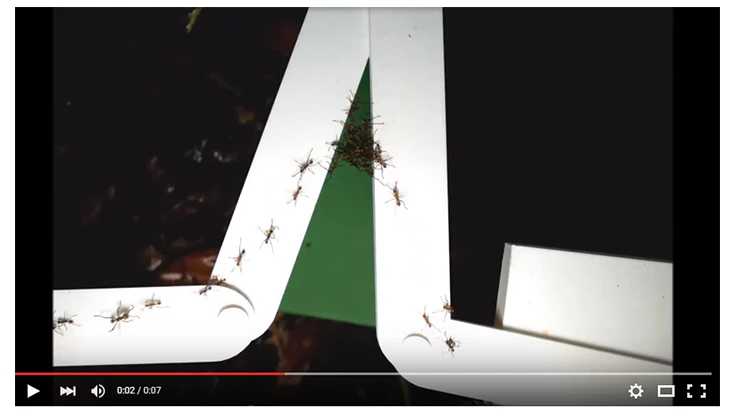
As reported on Phys.org, researchers are studying how army ants build living bridges by linking their bodies to span gaps and create shortcuts across rainforests in Central and South America. An international team of researchers has now discovered these bridges can move from their original building point to span large gaps and change position as required.
The bridges stop moving when they become so long that the increasing costs incurred by locking workers into the structure outweigh the benefit that the colony gains from further shortening their trail. Bridges dismantle when the ants in the structure sense the traffic walking over them slows down below a critical threshold.
Co-lead author Dr Christopher Reid, a postdoctoral researcher at the University of Sydney's Insect Behaviour and Ecology Lab and formerly with the New Jersey Institute of Technology, said the findings could be applied to develop swarm robotics for exploration and rescue operations. By analysing how ants optimise utility, researchers may be able to create simple control algorithms to allow swarms of robots to behave in similar ways to an ant colony.
The paper, 'Army ants dynamically adjust living bridges in response to a cost-benefit trade-off', is being published in the journal Proceedings of the National Academy of Sciences (PNAS).
Source: Phys.org
Latest from Pest Control Technology
- Earn CEUs from Your State at Next Week’s Mosquito Control Virtual Conference
- Preserving Culture, Providing Opportunities Key in Hoffman’s Decision
- Winter Weather Could Decide How Bad Mosquito Season Gets
- Trent Frazer Discusses How Mosquitoes Survive Winter
- Barnes Exterminating Acquires Tennessee Pest Solutions
- Pest Index Up 9% YOY in January
- Arrow Exterminators Acquires Hoffman's Exterminating
- PMPs Plan Mera Peak Summit for Parkinson's





