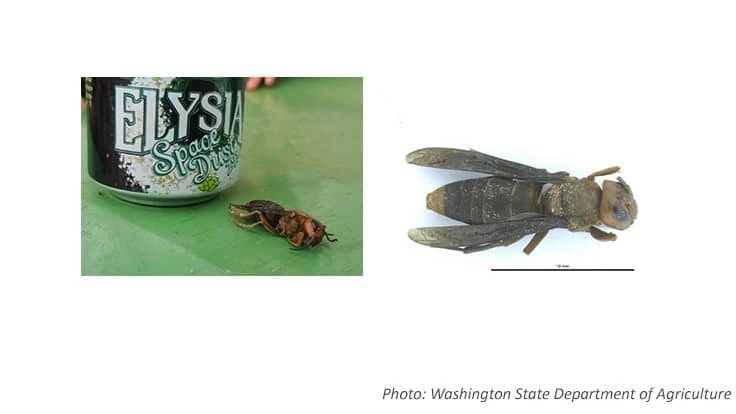
OLYMPIA, Wash. — Entomologists from the Washington State Department of Agriculture (WSDA) and U.S. Department of Agriculture (USDA) confirmed the first report of an Asian giant hornet in 2021 in Snohomish County, Wash.
This is the first confirmed report from Snohomish County and appears unrelated to the 2019-2020 Asian giant hornet introductions in Canada and Whatcom County, Wash.
A resident found a deceased hornet near Marysville, Wash., and submitted the report the evening of June 4 on WSDA’s online Hornet Watch Report Form. When WSDA retrieved the hornet on June 8, the specimen was dried out, and entomologists observed that it was a male.
Being the first detection in Snohomish County and having different coloring than previously collected specimens in North America, the hornet was submitted to the USDA Animal and Plant Health Inspection Service (USDA APHIS) for final verification.
On June 11, WSDA and USDA APHIS entomologists confirmed that the collected specimen was Vespa mandarinia, also known as the Asian giant hornet. WSDA DNA testing and the color variation of the specimen indicate that it appears unrelated to the Whatcom County or Canadian Asian giant hornet introductions.
Given the time of year, that it was a male, and that the specimen was exceptionally dry, entomologists believe the specimen is an old hornet from a previous season that wasn’t discovered until now. New males usually don’t emerge until at least July. There is no obvious pathway for how the hornet got to Marysville.
“The find is perplexing, because it is too early for a male to emerge,” said Dr. Osama El-Lissy, deputy administrator for the USDA’s Plant Protection and Quarantine program. “Last year, the first males emerged in late July, which was earlier than expected. However, we will work with WSDA to survey the area to verify whether a population exists in Snohomish County. USDA will continue to provide technical expertise and monitor the situation in the state. USDA has already provided funding for survey and eradication activities as well as research into lures and population genetics.”
Sven Spichiger, WSDA managing entomologist, said the new report underscores the importance of public reporting for suspected invasive species like the Asian giant hornet.
Latest from Pest Control Technology
- Earn CEUs from Your State at Next Week’s Mosquito Control Virtual Conference
- Preserving Culture, Providing Opportunities Key in Hoffman’s Decision
- Winter Weather Could Decide How Bad Mosquito Season Gets
- Trent Frazer Discusses How Mosquitoes Survive Winter
- Barnes Exterminating Acquires Tennessee Pest Solutions
- Pest Index Up 9% YOY in January
- Arrow Exterminators Acquires Hoffman's Exterminating
- PMPs Plan Mera Peak Summit for Parkinson's





