© Samuel | AdobeStock
FULTON, Md. – There’s an invasive insect making headlines for its sting, which causes health concerns. The Asian needle ant (Brachyponera chinesis) may have recently gained attention in the U.S., but it has existed in this country for almost a century.
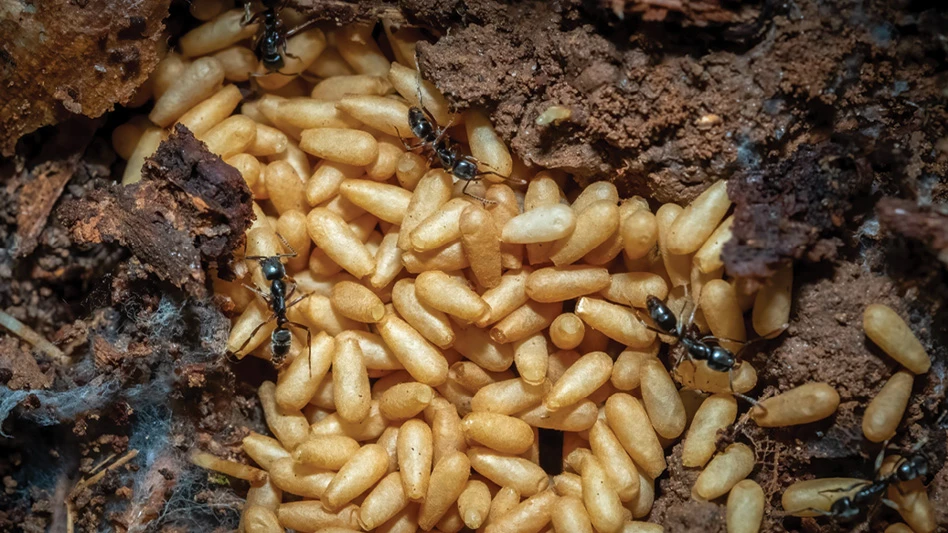
The nondescript ant, which is tiny (.12 to .25 inches) with a shiny brownish black coat, can be hard to spot if you’re not looking for it. The Asian needle ant, belonging to the Formicidae family, is native to China, Japan and the Koreas, and most likely arrived in the U.S. by the nursery and landscaping industry, said Dr. Kathy Heinsohn, technical and training entomologist for the American Pest, an Anticimex company located in Fulton, Md.
As of today, Asian needle ants have been identified in the southeastern and northeastern regions of the U.S. and small populations are being found in Texas, Washington state and Wisconsin, Heinsohn said.
Ecological and Health Concerns. Asian needle ants are best known for their sting. Heinsohn said their sting “may be even more potent than the fire ant sting.” It’s likely that someone wouldn’t know they’ve been stung, until the pain sets in, “persisting in waves of painfulness” for 48 hours, she said.
Some people who are stung could go into anaphylactic shock. According to the U.S. National Forest Service, a study showed that in the Asian needle ants “native range,” 2.1% of people stung experienced anaphylaxis. “If you’re in that small group of people who are anaphylactic, then you could be sent to the hospital,” Heinsohn said. “It could even be lethal.” The Asian needle ant isn’t naturally aggressive, but it will sting to protect its nest and itself.
The Asian needle ant typically starts appearing more during the spring, Heinsohn said, which makes interactions with them likelier. “What I think happens is people are outside and interacting in their environment — camping, gardening, moving wood piles, pavers, things like that. And they’re not expecting this ant.”
Similar to the impact of other invasive species, the Asian needle ant displaces native ants of the area it inhabits. Native ants aid in the dispersal of seeds and help enrich soil. Their ecological importance is threatened by Asian needle ants (and other invasive ants).
Dr. Jason Williams, postdoctoral research associate at the Entomology and Nematology Lab, University of Florida, said Asian needle ants aren’t often found in homes because they seek more natural areas. “You tend not to find other ants where you find Asian needle ants,” Dr. Williams said. “They just tend to dominate those environments, unfortunately.”
Unique Behavior. Asian needle ant behavior is interesting. The ant is both polygynous and polydomous, meaning it has multiple queens in a colony and many satellite colonies. “If the nest is disturbed, they can do what’s called budding,” Heinsohn said. “And one of the many queens can take a few workers with her and go set up a new nest site. And this is not unlike other invasives like odorous house ants and Argentine ants.”
It’s typical for ants to use pheromones to communicate and guide the others to new locations, but the Asian needle ant doesn’t use pheromones to trail. “In fact, they do this bizarre behavior called ‘adult transport,’ where they pick up fellow workers and carry them to a new nest site,” said Heinsohn.
In comparing invasive ant species, Williams said fire ants tend to create large, organized trails while Asian needle ants may operate individually. “They don’t have the numbers that fire ants have,” Williams said. “You might find a single worker wandering around as opposed to a large trail of them.”
When making their nests, Asian needle ants like to set up shop near termite colonies, said Heinsohn, because it’s one of their favorite foods. Their nests are small, but they can still be noticeable, and are “usually most associated with moisture, like in damp hardwood, moist mulch, fallen logs, leaf debris, under pavers or stones where there’s trapped moisture,” she said.
Recommendations. Not everyone may encounter Asian needle ants, but if you’re gardening or buying nursery or landscaping stock, here is some advice:
- Wear gloves
- Carry antihistamines or an EpiPen (if you personally may experience anaphylaxis)
- Inspect potting soil
One of the ways someone could accidentally introduce the Asian needle ant to their yard is through gardening and landscaping, especially through potted plants. Therefore, if you run into this specific ant, it can make a big difference if you shake them into a bag and dispose of them.
If PMPs treat Asian needle ants by spraying them, it could cause budding behavior and result in the spread of more colonies. “We need to find better ant treatment protocols for this particular ant, but right now baiting seems to be the best option,” Heinsohn said. It’s important to remember that when treatment approaches aren’t specific to invasive species such as the Asian needle ant, it harms and displaces native ants.
Entomologists like Heinsohn urge more specific research and educational awareness on the Asian needle ant. If PMPs had a specific approach to treating Asian needle ants, they could become less of a problem and a scare, both medically and ecologically.
“The major concerns are the medical concerns, but even a somewhat greater concern is the ecology of areas,” Heinsohn said. “And so much habitat is being modified. So, we’re encroaching on their habitat in the woods, and then they are outcompeting the native ants.”
Latest from Pest Control Technology
- Google Ads Mistakes That Cost PCOs Thousands
- Zach DeVries Details his Cockroach Research, Importance of UK Short Course
- Sprague Strengthens California Leadership Through New Appointments
- PestInsight Empowering Youth in Africa and Beyond Through Education
- Guest Editorial: Making Safety the Standard on Every Service Call
- Truly Nolen Pest Control Promotes Tuck, Stewart
- Little to No Hesitance When Asking for Customer Reviews, PCOs report
- Arrow Termite & Pest Control (La.) Acquires Ark-La-Tex Exterminators