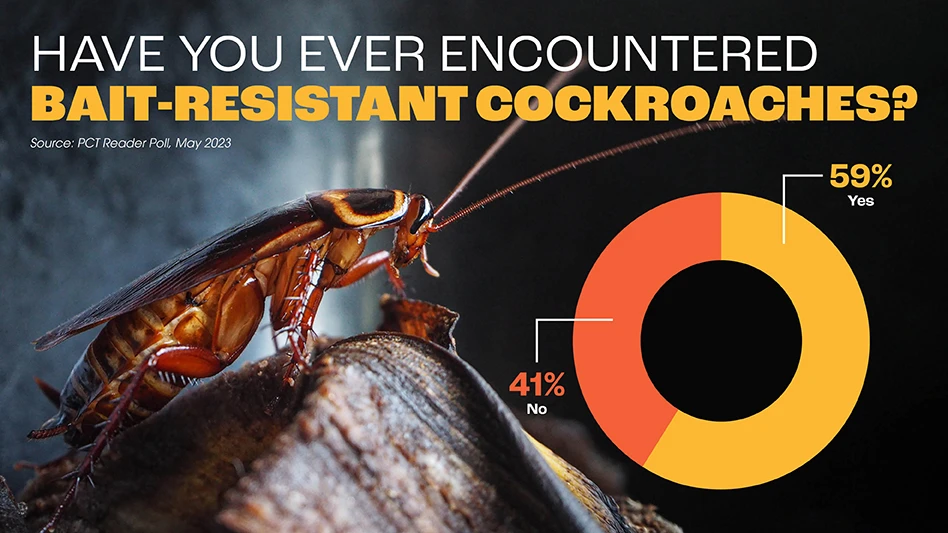
CLEVELAND – According to those who responded to PCT’s most recent reader poll, 59 percent said they have encountered bait-averse cockroaches, while 41 percent said they have not.
Chelle Harzter, owner of 360 Pest and Food Safety Consulting, said she has had multiple encounters with bait-averse roaches in both residential and commercial accounts. “It can be resistance, when they survive eating the active ingredient, or it can be aversion, where they have ‘learned’ not to like the taste of the bait and they just avoid it. It's why we stress SO MUCH to rotate baits.”
Hartzer explains how she rotates baits in these sitations. “I will typically use two, even three different baits at the same time to see which one they are currently eating. I would also use a liquid application in low areas like baseboards and under equipment, if that's possible. And you definitely need to add an IGR to that liquid. Also, make sure the customer is not treating with their own products — they are usually repellent and will push cockroaches away from your bait.”
Mohammed El-Damir, technical and training director of Adam’s Pest Control, Maple Grove, Minn., also said he has observed bait-averse roaches in residential and commercial accounts, mostly in apartment buildings. “In these situations, we recommend that customers stop self-treating. We also recommend cleaning the area where the baits are placed to remove any trace of things that irritate them. Finally, we suggest switching the bait with something else with different AI, formulations, or food matrices.”
Like other companies, Sprague will switch baits if they believe cockroaches are averse to the bait they are using. Roden added German cockroaches are a rising problem in Sprague’s service areas and that she suspects there are more issues than just avoidance. “Overreliance on bait, not checking to see if they like the bait, not using dusts when appropriate, not treating the right areas, and forgetting to rotate pesticide classes,” are all reasons for German cockroach control failure, she said.
Participate in our current poll: How many in-person events do you plan on attending this year?
Latest from Pest Control Technology
- Earn CEUs from Your State at Next Week’s Mosquito Control Virtual Conference
- Jody Green Talks Ticks at Purdue Conference
- Truly Nolen Pest Control Promotes Freize, Hackett
- Preserving Culture, Providing Opportunities Key in Hoffman’s Decision
- Winter Weather Could Decide How Bad Mosquito Season Gets
- Trent Frazer Discusses How Mosquitoes Survive Winter
- Barnes Exterminating Acquires Tennessee Pest Solutions
- Pest Index Up 9% YOY in January