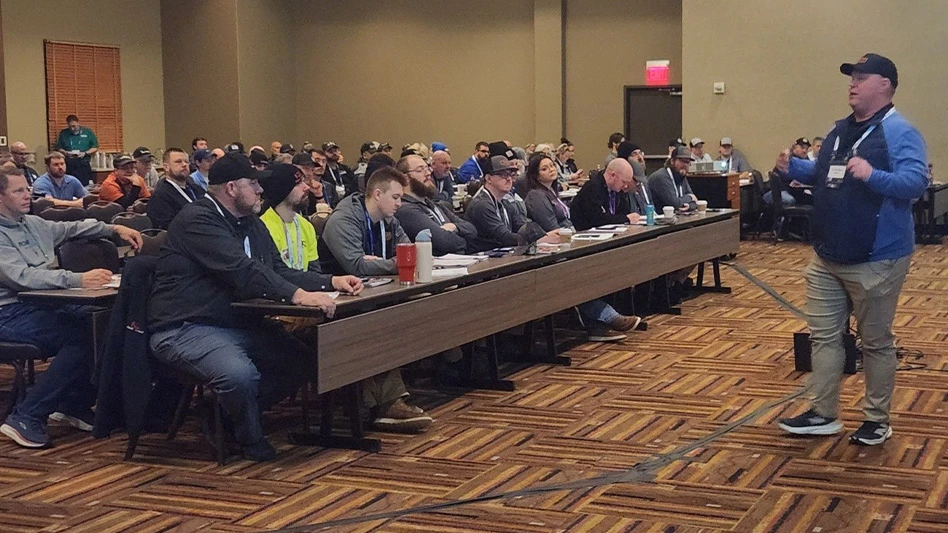
Mike Heinz, president, agricultural products, started the summit by giving a general overview of the company. Heinz noted the following. BASF generated $54.4 billion in sales during 2005 – 12 percent of which came from agricultural products. Heinz added that the ag segment generated $3.3 billion in sales during 2005 – 23 percent of which came from insecticides.
Stephen Briggs, director, specialty products, BASF, provided an overview of this business segment, which includes the pest control market ($550 million); the turf and ornamental market ($800 million) and vegetation management market ($500 million). The pest control market consists of the termite and general insect segments; the T&O market consists of the golf, lawn care, sports turf, commercial turf and ornamentals segments; and the vegetative management market consists of the forestry, utility, aquatic, bareground, roadside and invasive weed segments.
In the pest control market, Briggs says consumers are more aware of pests that can damage their No. 1 asset – the home. They want protection against termites and ants, which have replaced termites as the No. 1 household pest. “Pest control operators are looking to companies like BASF for new, innovative products,” Briggs says. “For example, they want a compound to take care of bed bugs, which are on the rise in hotels, partly because of international travel and the fact that fewer pesticides are being used indoors.”
PerimeterPlus is an example of innovation meeting customer needs, according to Briggs. It’s an innovative application with Termidor, the company's termiticide. PCOs used to have to drill holes in the ground every 12 to 18 inches to apply Termidor. Now, PCOs can trench the soil back and apply PerimeterPlus around the house, then push the soil back and complete the job.
“It’s less labor intensive and allows PCOs to treat more homes,” Briggs says of the product that has a 10-year guarantee.
REGULATORY UPDATE. In addition to discussions about the ag and specialty markets, a legislative panel of Washington insiders discussed the relationship between pesticides and the federal government. Greg Thies, director of BASF government relations says the ag market is the second most regulated segment in the United States behind the pharmaceutical industry. He says the mid-term election in November will affect the ag industry because there’s a lot on the table, such as the Farm Bill and the Endangered Species Act update.
Todd Willens, senior policy director and member of the House Resources Committee, says seven months have passed since the reauthorization of the Endangered Species Act passed in the House. There are 1,300 species on the list and 10 have been recovered. “We have a priority of recovering species to the point they don’t need to be regulated by the federal government,” he says. “If we don’t do something now, Congress will miss an opportunity. It’s an extremely slow process. The Senate might take this up. The House was active, now we’re waiting on the Senate. However, environmental groups don’t want to pass a bill for the Endangered Species Act.”
Jim Jones, director, office of pesticide programs for the Environmental Protection Agency, says the EPA has improved the process of registering and reregistering products via the Pesticide Registration Improvements Act (PRIA).
“We’re making decisions within two years about a compound,” he says. “PRIA gives the agency time frames and a check from the manufacturer that covers 25 percent to 30 percent of the EPA’s cost. We’re meeting 99.9 percent of the requests. During the past 10 years, we’ve passed about 100 new synthetic chemicals and didn’t register five because the requirements are clear and the industry understands those.”
Jones says he expects to see the globalization of pesticide licensing by governments working together to master license products because it will be cheaper for them and quicker for the manufacturer to bring products to market.
Additionally, Allen James, president of RISE, says phosphorus in fertilizer is being targeted by activists. James says various industries such as pest control, lawn, ag and golf aren’t organized on a local level and need to join forces to defend themselves against activists. RISE is implementing a grassroots initiative to defend against activists. James says communication is key, yet RISE can’t communicate with the general public effectively because it’s too expensive to do so. Instead, it’s targeting groups of individuals such as school superintendents.
The author is editor of Golf Course News, a sister publication of PCT magazine.
Latest from Pest Control Technology
- Earn CEUs from Your State at Next Week’s Mosquito Control Virtual Conference
- Preserving Culture, Providing Opportunities Key in Hoffman’s Decision
- Winter Weather Could Decide How Bad Mosquito Season Gets
- Trent Frazer Discusses How Mosquitoes Survive Winter
- Barnes Exterminating Acquires Tennessee Pest Solutions
- Pest Index Up 9% YOY in January
- Arrow Exterminators Acquires Hoffman's Exterminating
- PMPs Plan Mera Peak Summit for Parkinson's