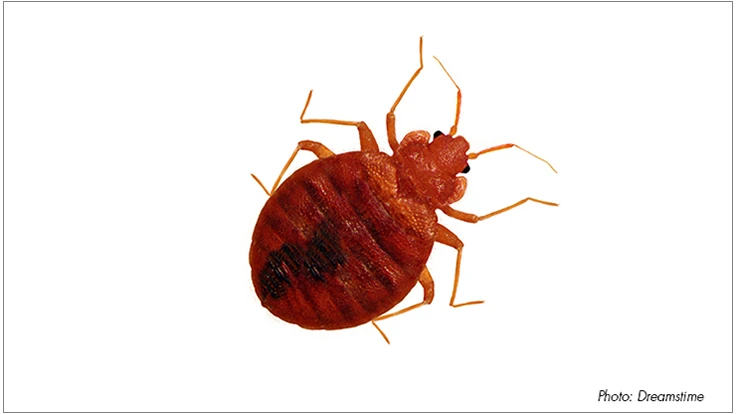
Many studies have been done on how effective certain pesticides are when they are applied to bed bugs. However, most have not allowed the bed bugs to take a blood meal after being exposed to pesticides, which can change the mortality rates, according to an article in the Journal of Medical Entomology.
Researchers from Rutgers University found that bed bugs that were allowed to feed after being treated with insecticides either had greater rates of survival, or they took longer to die than bed bugs that were not allowed to feed after being treated, ESA reports.
“Our results indicated that post-treatment feeding significantly reduced or slowed down bed bug mortality,” the researchers wrote.In one case, bed bugs that were unable to feed after being sprayed with an insecticide had a mortality rate of 94 percent. But bed bugs that did feed after being sprayed with the same insecticide had a mortality rate of just 4 percent after 11 days.
This difference is important because most experiments that test the efficacy of insecticides against bed bugs are performed in labs where the bed bugs can’t feed after being exposure. However, in the field, bed bugs can feed after being treated with an insecticide, and the reduced or slowed mortality could give them a chance to reproduce.
Click here to read the entire article.
Source: Entomological Society of America
Latest from Pest Control Technology
- Earn CEUs from Your State at Next Week’s Mosquito Control Virtual Conference
- Preserving Culture, Providing Opportunities Key in Hoffman’s Decision
- Winter Weather Could Decide How Bad Mosquito Season Gets
- Trent Frazer Discusses How Mosquitoes Survive Winter
- Barnes Exterminating Acquires Tennessee Pest Solutions
- Pest Index Up 9% YOY in January
- Arrow Exterminators Acquires Hoffman's Exterminating
- PMPs Plan Mera Peak Summit for Parkinson's