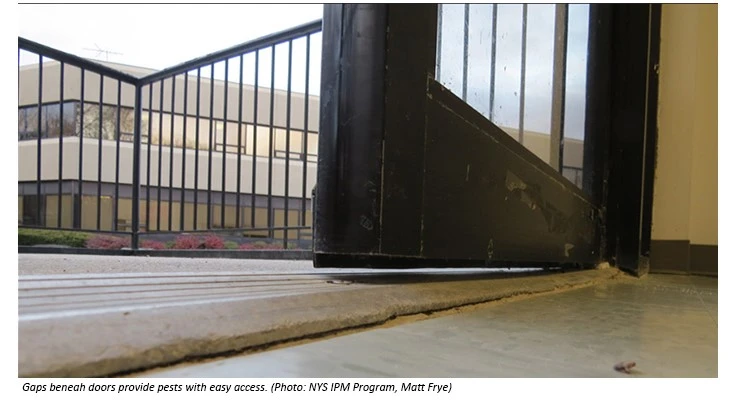
Exclusion offers permanent work, the opportunity to help reduce health and safety risks, and a better reputation for the pest control company for providing complete work.
Matt Frye, PhD, and Jody Gangloff-Kaufmann, PhD, from the New York State IPM Program at Cornell University, are part of the Scientific Coalition on Pest Exclusion (or SCOPE). SCOPE provides pest management professionals with the tools and practical references needed to perform pest exclusion. Pest management professionals learn to recognize common entry points, use effective techniques and how to implement those methods.
As part of their presentation at NPMA PestWorld 2017, Frye and Gangloff-Kaufmann shared with PMPs benefits and opportunities of exclusion programs.
BENEFITS. While SCOPE is evaluating and making a case for the exact numbers, costs, and time behind exclusion work, the cost benefits for pest control companies adopting exclusion include greater customer satisfaction and reduced call-backs, explains Gangloff-Kaufmann. Exclusion offers permanent work, the opportunity to help reduce health and safety risks, and a better reputation for the pest control company for providing complete work.
For a pest management company to successfully adopt an exclusion program, the company would need to “recognize the value in exclusion” and try to “hire people from the construction industry, handyman-types, or wildlife control experts,” states Gangloff-Kaufmann. In order to properly price and sell exclusion work, pest management professionals need to explain risk reduction and overall building improvements. Price and sell exclusion for what it is worth, and emphasize the permanence of the process, she says.
OPPORTUNIITIES. For pest management companies specifically, pest exclusion can be offered as a routine service. Pest control companies can offer annual inspections twice a year: in the spring to assess winter damage, and in the fall to prevent entry, describes Gangloff-Kaufmann. Opportunity will always exist to identify new entry points and to repair and replace materials. Once the pest management professional performs the exclusion work they will need to follow-up to evaluate the success of the work, she says.
For the pest management industry as a whole, opportunities exist to meld pest exclusion with larger programs, such as fire safety. “Preventing fire from moving within the building will also help prevent pests from moving,” Gangloff-Kaufmann says. Pest exclusion can also be dovetailed with weatherization because, for example, sealing windows and doors accomplish both objectives.
One last survey question by SCOPE revealed that when asked the question “Overall, is pest exclusion a valuable part of your work in pest management?” 85 percent of respondents said “yes.” Even though only 20 percent of technicians are carrying sealant, the positive response provides a “good, optimistic look at the industry” suggesting that exclusion is important, notes Gangloff-Kaufmann. She concludes, “Hopefully people will learn more about [exclusion] and begin development.”
Matt Frye, PhD, and Jody Gangloff-Kaufmann, PhD, from the New York State IPM Program at Cornell University, are part of the Scientific Coalition on Pest Exclusion (or SCOPE). SCOPE provides pest management professionals with the tools and practical references needed to perform pest exclusion. Pest management professionals learn to recognize common entry points, use effective techniques and how to implement those methods.
As part of their presentation at NPMA PestWorld 2017, Frye and Gangloff-Kaufmann shared with PMPs benefits and opportunities of exclusion programs.
BENEFITS. While SCOPE is evaluating and making a case for the exact numbers, costs, and time behind exclusion work, the cost benefits for pest control companies adopting exclusion include greater customer satisfaction and reduced call-backs, explains Gangloff-Kaufmann. Exclusion offers permanent work, the opportunity to help reduce health and safety risks, and a better reputation for the pest control company for providing complete work.
For a pest management company to successfully adopt an exclusion program, the company would need to “recognize the value in exclusion” and try to “hire people from the construction industry, handyman-types, or wildlife control experts,” states Gangloff-Kaufmann. In order to properly price and sell exclusion work, pest management professionals need to explain risk reduction and overall building improvements. Price and sell exclusion for what it is worth, and emphasize the permanence of the process, she says.
OPPORTUNIITIES. For pest management companies specifically, pest exclusion can be offered as a routine service. Pest control companies can offer annual inspections twice a year: in the spring to assess winter damage, and in the fall to prevent entry, describes Gangloff-Kaufmann. Opportunity will always exist to identify new entry points and to repair and replace materials. Once the pest management professional performs the exclusion work they will need to follow-up to evaluate the success of the work, she says.
For the pest management industry as a whole, opportunities exist to meld pest exclusion with larger programs, such as fire safety. “Preventing fire from moving within the building will also help prevent pests from moving,” Gangloff-Kaufmann says. Pest exclusion can also be dovetailed with weatherization because, for example, sealing windows and doors accomplish both objectives.
One last survey question by SCOPE revealed that when asked the question “Overall, is pest exclusion a valuable part of your work in pest management?” 85 percent of respondents said “yes.” Even though only 20 percent of technicians are carrying sealant, the positive response provides a “good, optimistic look at the industry” suggesting that exclusion is important, notes Gangloff-Kaufmann. She concludes, “Hopefully people will learn more about [exclusion] and begin development.”
Latest from Pest Control Technology
- Earn CEUs from Your State at Next Week’s Mosquito Control Virtual Conference
- Preserving Culture, Providing Opportunities Key in Hoffman’s Decision
- Winter Weather Could Decide How Bad Mosquito Season Gets
- Trent Frazer Discusses How Mosquitoes Survive Winter
- Barnes Exterminating Acquires Tennessee Pest Solutions
- Pest Index Up 9% YOY in January
- Arrow Exterminators Acquires Hoffman's Exterminating
- PMPs Plan Mera Peak Summit for Parkinson's





