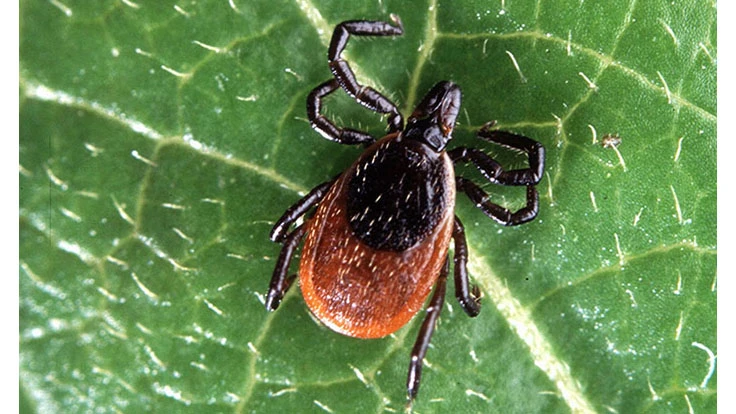
Ticks are responsible for the transmission of more vector-borne diseases than any other arthropod or insect in the U.S., according to the Centers for Disease Control and Prevention (CDC). They estimate that in the U.S. 300,000 or more people are annually diagnosed with Lyme disease, which is transmitted by ticks.
As a protector of public health, if you’re already providing mosquito barrier control services, you can easily expand and begin offering tick barrier control services.
Tick control service is rapidly growing and is a season extender on either side of mosquito control services. The active months for treating mosquitos and ticks generally correspond with each other — with a little overlap. Depending on the area of the country and the weather, tick treatment can begin as early as April and go to as late as November — with spring being the most important time to treat. As a general schedule: first treatment in mid-May — as close as possible to the emergence of larval ticks; second in mid-June; and, final treatment when the mosquito season is winding down.
You can use the same products and equipment for both mosquito and tick barrier treatment—backpack sprayer/misters, truck-mounted power sprayers, and granule spreaders. Any pyrethroid used for mosquito control can be used for tick control, but at a rate that’s 2–3 times higher. Always following label instructions.
Differences in mosquito and tick barrier treatment application techniques
Spray where they live. Mosquitoes, depending on the species, will have resting sites 10’ and above. Ticks live at ground level, so use the mister/blower more like a leaf blower, keeping the nozzle low. Use attachments to help angle the spray to be almost parallel to the ground and keep the blower air-flow rate as close to maximum as possible. As with mosquito treatments, never treat edible plants, flowers, or blooming plants.
Include the lawn. For mosquito control, you don’t need to treat a maintained lawn, as it isn’t a resting site. For tick control, treat the lawn. This is where they lay their eggs and live.Perimeter treatment
Tick treatment generally focuses on the edge of the property. Treat 2-3’ inside the yard margin and 10–15’ into wooded, brushy areas. Thoroughly treat undergrowth and concentrate on path boarders, especially deer paths.
Technician safety
Technicians are at a real risk of vector-borne diseases when conducting tick treatments. One in 20 tick bites may transmit a pathogen, so if a technician is bitten by five ticks, they have a 25 percent chance of contracting a disease. In addition to required personal protective equipment (PPE) per product label, wear light-colored clothing and tuck your pant legs into your socks during application.
Homeowners are treatment partners
Barrier treatments are only one part of a mosquito and tick control efforts. Best practices include customers, particularly when it comes to property modifications. Part of our responsibility as an industry is to educate customers on their part of the process. Consider distributing flyers to customers on what they should and shouldn’t do, such as: dump standing water; do not remove foliage after it’s been treated; repair gutters; remove harborage sites prior to treatments; and, other common sense precautions.
Rodents: another partner in tick control
Ticks mostly travel by host and mice are a nice method of locomotion. They’re also a great source of pathogens. White-footed mice, an efficient transmitter of Lyme disease, can infect up to 95% of the ticks that feed on them.
To help control ticks, don’t kill the mice, put them to work!
To kill ticks on mice, here’s an easy DIY project:
• Start with a cardboard tube, such as a toilet paper tube.• Treat cotton balls with a mixed solution of pyrethrum.
• Allow the cotton balls to dry.
• Stuff several cotton balls into the tube.
• Place the tubes at 10–15’ intervals around the perimeter.
• Mice will take the cotton and use it as bedding. As they roll around in the cotton, they’ll also collect the pyrethrum, which kills the ticks!
Latest from Pest Control Technology
- Earn CEUs from Your State at Next Week’s Mosquito Control Virtual Conference
- Preserving Culture, Providing Opportunities Key in Hoffman’s Decision
- Winter Weather Could Decide How Bad Mosquito Season Gets
- Trent Frazer Discusses How Mosquitoes Survive Winter
- Barnes Exterminating Acquires Tennessee Pest Solutions
- Pest Index Up 9% YOY in January
- Arrow Exterminators Acquires Hoffman's Exterminating
- PMPs Plan Mera Peak Summit for Parkinson's





