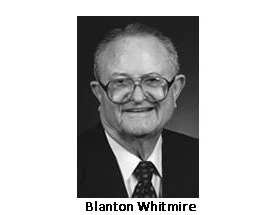
ST. LOUIS, Mo. — Blanton Whitmire, whose contributions to the pest control industry include founding Whitmire Research Laboratories (a BASF legacy company) and developing the innovative “crack and crevice” aerosol technology, died on May 24.


In retirement, Blanton and wife Peggy, who passed away in 2010, continued their charitable work, giving back to the community and sustaining a variety of educational, religious, and environmental causes. They established endowments at numerous institutions, including Western Carolina University, St. Louis Community College, and St. Louis’ Donald Danforth Plant Science Center, a nonprofit scientific facility dedicated to improving the human condition through plant science. The Whitmires received the Missouri Botanical Garden’s Greensfelder Award for their support in 2004. In 2005 Whitmire received an Honorary Doctorate of Humane Letters from Western Carolina University.
A memorial service will be held Saturday, May 30, at 1 p.m. at First Presbyterian Church in Kirkwood, Mo.. In lieu of flowers, the family asks that you consider a donation to any of the nonprofits referred to here.
|
Blanton Whitmire Memories On the technical side, Blanton always thought out of the box. We had many conversations about “what if” scenarios. What if a single bait placement could effectively control roaches? What if we could develop such a powerful attractant that no insecticides would be needed? Together with Dr. Charles Wright at North Carolina State University, Blanton promoted the science of urban entomology, and believed that the future of the industry was in educating and mentoring university students and pest control professionals in the science and art of structural pest management, with emphasis on ethics and professionalism. On the personal side, Blanton was super attentive. He loved to listen to reports of new discoveries and the accomplishments of students. He was also a very humble person. I remember the touching speech Blanton delivered when he was presented North Carolina State University’s 2000 Watauga Medal for his steadfast championing and implementation of less intrusive pest control. Consistent with his unassuming and humble personality, he gave all credit for his success to his employees and colleagues. — Coby Schal, Blanton J. Whitmire Distinguished Professor of Structural Pest Management, North Carolina State University For 44 years, I counted Blanton Whitmire as one of my best and closest mentors and friend. His patience, wisdom and constant positivity were sources of inspiration for all who knew him and through serious illness, he maintained his cheerful attitude and encouraging words. He was one of the founders of Whitmire Research Labs where I started working in 1971. It is because of him that I was able to start Compelling Communications 18 years ago. He passed peacefully Saturday night at his home with his family at his side. I will miss his good humor and wise words. — June Van Klaveren, owner of Compelling Communications and longtime Whitmire Micro-Gen Laboratories employee He was truly an industry icon. Clearly the Whitmire Training Schools and the Prescription Treatments were the truly novel and innovative developments that will always be associated with him. Those were truly memorable workshops and I don't think either the quality of research or practical knowledge presented have been duplicated ever since. — Mike Rust, Distinguished Professor of Entomology and the Graduate Division, Department of Entomology, University of California, Riverside We did a lot of research on Whitmire products, and Blanton showed his respect for Dr. Charles Wright by endowing a couple Urban Entomology professorships at NCSU. After the book “Silent Spring” generated a lot of pressure on insecticides and their use, Blanton used his technical and business savvy to introduce the crack and crevice injection technology. Although it was a technology that was being used to some extent by PMPs, Blanton knew this was the “wave of the future”, the right way to effectively and efficiently apply insecticides in the urban environment, and the way to meet environmental standards that would be imposed on the industry. And he did this not only because it was a good business strategy, but more importantly because he truly wanted to help, and advance, the industry — Dr. Gary Bennett, Professor and Urban Pest Management Center Director, Purdue University Blanton epitomized giving back to the pest control industry. Many are aware that he endowed two entomology chairs at North Carolina State University. He and his wife, Peg, also gave a gift to Western Carolina University to support programs in environmental science and early childhood education. Blanton enriched the lives of many employees and their families when he elected to sell Whitmire Research Laboratories through an Employee Stock Ownership Program (ESOP). It is very likely that he could have sold the company for greater personal gain, but this was a way for him to give back to the employees. What I will remember most is Blanton’s positive attitude and that he was always looking towards the future. Even late in life he spent little time reminiscing. When he did talk about the past it was only for lessons learned, never regrets or wishing he had done something differently. We spoke regularly and he never failed to ask how the industry was doing and what was new. I will miss him greatly — Gary Curl, president, Specialty Products Consultants, Mendham, N.J., and formerly of Whitmire Research Laboratories Certainly, as most industry professionals did and continue to do so, I did teach Purdue students and the Purdue conferees his revolutionary thoughts of moving from baseboard spray jockeying to the need for "prescription based" targeted pesticide applications to pests’ harborage. To me, I feel this was his greatest contribution as it was a major step towards the evolution of urban pest management into the IPM era. — Dr. Bobby Corrigan, RMC Pest Management Consulting, Richmond, Ind. |