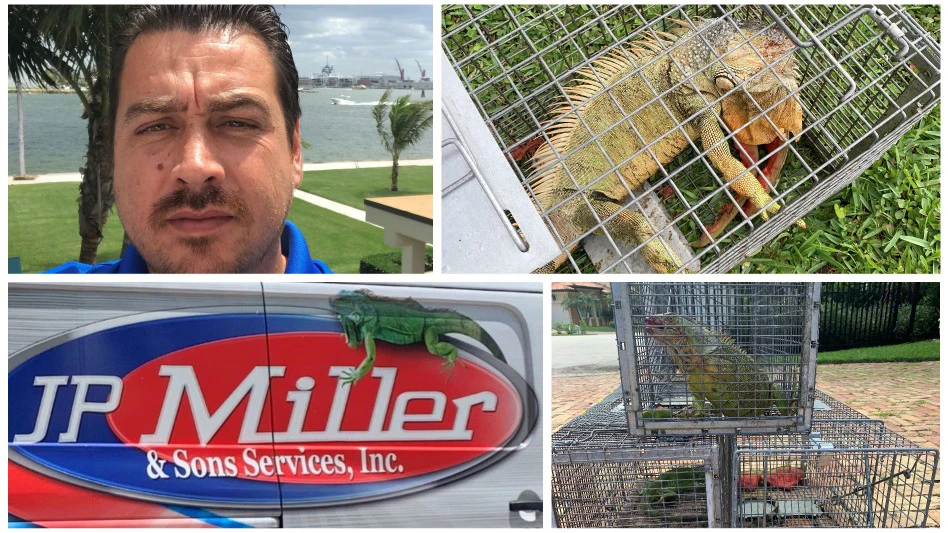
DEERFIELD BEACH, Fla. - “I’ve got a guy for that.” It’s a phrase we’ve all heard, or muttered ourselves, when talking to friends and/or acquaintances about service providers.
In Broward County, Fla., and surrounding areas “the guy” who traps iguanas is Luis Valle, a service professional with JP Miller & Sons, Deerfield Beach, Fla. Valle, 42, has developed a reputation as the go-to trapper and expert on iguanas, an increasingly problematic pest in Florida, which has a subtropical climate that is ideal for the cold-blooded reptile.
“Kids will get them as pests and when they go off to college the parents will let the loose out the backdoor,” said Valle, whose comfort working with iguanas is traced back to age 16 when he owned and took care of a pet iguana.
One of the reasons iguana populations proliferate is because males typically have multiple female partners. “That’s just how they roll,” said Valle. Seasonal residents (aka, “snow birds”) will return home and “their whole backyard will be covered with them — their pool area, their roof, you name it — they're all over their property. So, we come in and we just start removing them one by one.”
Dr. William Kern, an associate professor in the Department of Entomology & Nematology at the Ft. Lauderdale Research and Education Center of the University of Florida, told PCT that iguanas have become a nuisance to Florida residents “because of damage to the landscape excavation, of nesting burrows that can then lead to erosion, especially along shorelines.”
And it’s not just damage to foliage and landscaping that is a concern, Valle said. “They tend to poop around pools, so there is a real concern for Salmonella poisoning.”
While some pest and wildlife control companies use sharpshooters to control iguanas, JP Miller & Sons performs live trapping almost exclusively, the exception being to control the occasional “smart iguana.” After being trapped, iguanas are brought back to the JP Miller & Sons office where they are humanely euthanized.
Valle harkened back to his youth when figuring out how to best bait iguanas. “I just thought about what my iguana would eat. You know, basically they're vegetarians and they like fruits and flowers and things like that. I started out using peaches and mangoes, and then as I started getting more familiar with wild iguanas, I found that watermelon works best.”
Like all good trappers, Valle uses a combination of art and science to catch iguanas. For example, he’ll look for iguana poop and possible pathways from roof to ground to help him with trap placement.
Prebaiting also is an important part of his trapping protocols. In addition to placing baits such as watermelon inside a (closed) trap, he will place it alongside the outside of a trap. This helps the iguana get used to and comfortable with the trap. “I have a two- to three-week trapping period,” he said. “So, on my first trip I will put the bait inside and outside of the closed trap. You can see them fighting to get in the trap and get it. Then when I come back I will put a leader of watermelon (to lead the iguana into the trap)” and once the iguana enters the cage it automatically closes. This type of pest control requires patience, diligence and excellent organizational skills.
Valle added that several other technicians at JP Miller & Sons trap iguanas, helping the company carve out a niche as a service provider who does this line of work. In fact, the company even has an iguana on its truck to help market it as the iguana-trapping company.