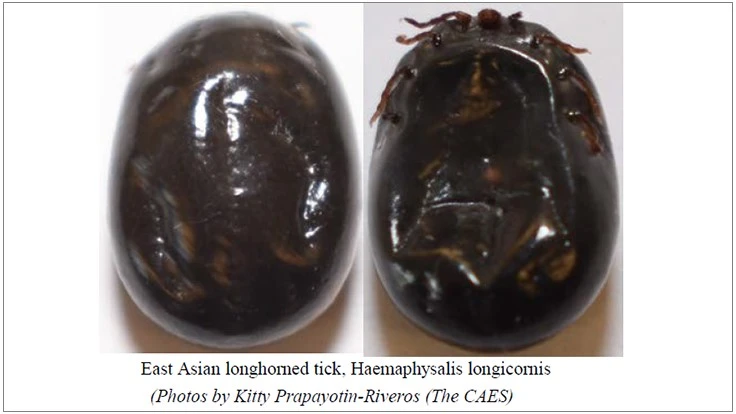
The Tick Testing Laboratory at The Connecticut Agricultural Experiment Station (CAES) is reporting the first evidence of an east Asian longhorned tick (Haemaphysalis longicornis) having bitten a resident of Fairfield County.
In a CAES press release, the station noted that the east Asian longhorned tick is an invasive species that was initially discovered on a New Jersey farm in 2017, and has subsequently been found in eight other states (AK, CT, MD, NY, NC, PA, VA and WV). It was most recently detected in Connecticut in July 2018.
Longhorn ticks have been found to carry several human pathogens in Asia, ut it is unknown is this tick will be capable of transmitting native pathogens such as those that cause Lyme disease, babesiosis, anaplasmosis or Powassan virus.
In a CAES press release, the station noted that the east Asian longhorned tick is an invasive species that was initially discovered on a New Jersey farm in 2017, and has subsequently been found in eight other states (AK, CT, MD, NY, NC, PA, VA and WV). It was most recently detected in Connecticut in July 2018.
Longhorn ticks have been found to carry several human pathogens in Asia, ut it is unknown is this tick will be capable of transmitting native pathogens such as those that cause Lyme disease, babesiosis, anaplasmosis or Powassan virus.
Latest from Pest Control Technology
- Earn CEUs from Your State at Next Week’s Mosquito Control Virtual Conference
- Preserving Culture, Providing Opportunities Key in Hoffman’s Decision
- Winter Weather Could Decide How Bad Mosquito Season Gets
- Trent Frazer Discusses How Mosquitoes Survive Winter
- Barnes Exterminating Acquires Tennessee Pest Solutions
- Pest Index Up 9% YOY in January
- Arrow Exterminators Acquires Hoffman's Exterminating
- PMPs Plan Mera Peak Summit for Parkinson's





