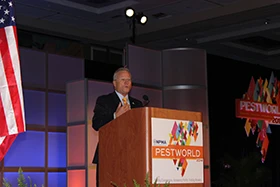
 NPMA President Billy Tesh addresses PestWorld '14 during the opening ceremony. NPMA President Billy Tesh addresses PestWorld '14 during the opening ceremony. |
It’s been a busy couple of years for the National Pest Management Association. And it’s been a busy 40 years for NPMA President Billy Tesh.
Born and raised in Greensboro, N.C., Tesh has been in the pest control business since age 14. A graduate of North Carolina State University, he and his wife, Laurie, founded Pest Management Systems Inc. (PMi) in 1984. PMi has several related companies as well: Sister company GroundWorks was founded in 1995; PestOne in 1999; CrawlSpace Care Technologies in 2006; followed by CrawlSpace Depot in 2011.
And this year, Tesh serves as NPMA president. “I am more than proud to be president,” he said. “I am here to serve the organization and the industry and I will do what’s best for this industry.”
It’s an exciting time to be at NPMA, Tesh said. There’s a lot going on at the association, and at the top of the list is a strategic plan that touches virtually every member in some way. In addition, Vision 2020 is an initiative, which, in part, is helping the pest management industry determine its strengths and challenges. NPMA Gives, a new program that recognizes NPMA member companies that have demonstrated leadership through their dedication and contributions to the good of the community, was presented at NPMA Academy in July. NPMA staff is energized. And the manufacturing and distributor communities are willing to participate from a financial standpoint as well as from a participation standpoint. Another highlight is that the association paid off the NPMA building last year; the building, which is located in Fairfax, Va., is valued at around $4 million. “What’s great about paying off the members’ building is that we now have an asset that's free and clear,” Tesh said.
Board member and NPMA member involvement is at an all-time high, Tesh said. In particular, there has been a concentrated effort on NPMA board engagement. “NPMA CEO Bob Rosenberg is getting things out to the board almost weekly. This is where we are, this is what we’re doing,” he said.
And while there are many changes at NPMA, Tesh says the industry has changed as well.
“The professional pest management industry is not about pesticide application anymore,” Tesh said. “People look at us differently. To that point, PMi hired four people this year. One was a former auto mechanic and one worked with computers. They both said, ‘We didn’t know your industry was this professional and all the things you did to protect people and property.’”
“I’m fortunate to be the president now,” Tesh said. “The organization is running smoothly, staff is energized and there are a lot of good things going on. It’s really a great place to be.”
PCT’s Jodi Dorsch sat down with Tesh to talk about the plans for his year as NPMA president.
PCT: How did you become involved with NPMA?
Billy Tesh: I have been a member of NPMA since I became a member of the North Carolina Pest Control Association (you automatically join NPMA with joint state membership). But I immediately realized the importance of one voice at both the state and national levels.
I was heavily involved in NCPCA and was the president at a really young age (26). I was running into a vat of legislative issues that had never been introduced before (like chlordane issues), and I learned quickly how NPMA could help us achieve our goals at the state level and as an individual. All of these organizations we have are only as strong as the members. With that understanding, I committed to becoming as involved as possible, which ultimately led to my presidency.
PCT: What does the NPMA strategic plan mean for members and the industry at large?
BT: The strategic plan is pretty simple actually. It is to do whatever it takes to support the members and the industry. It’s a big challenge. We have pollinator issues, product stewardship issues…all those things are driven outside of our industry. And our industry has to respond. As a result of that, NPMA and its members are saying, “OK, what do we need to do moving forward?” Part of the strategic plan is to create a better understanding of what our responsibilities are. What I mean by that is getting all of the stakeholders involved in our meetings that we have pertaining to these issues. How can we better influence the end result and make sure it’s factual? Everything we do should be based on fact and science. Unfortunately, a lot of our adversaries don’t follow that rule. They use emotion to play on the general public’s emotions. Our job is to cut through the fat and get our industry moving in the right direction.
The strategic plan also focuses on us looking at areas where we could improve our service to our members. For instance, we just returned from a commercial summit that focused on the needs of PMPs serving primarily commercial accounts. PPMA has done a great job promoting professional pest control to the consumer market, but we haven’t been able to do the same for the commercial market. We’re looking at different initiatives to see how we can improve the association experience for all of our members.
PCT: How is NPMA’s strategic planning “to do” list progressing?
BT: NPMA staff has an Excel spreadsheet of all the things they have as goals and where they are in process for the policy department. They send it to me every few weeks. It’s several pages of issues and each time they meet, they report on where they are, who is responsible and how we are progressing. Every time I look at it I wonder, “How are they getting all this stuff done?” And it’s not just that they’re focusing on one thing — there are 30 different items.
Part of the strategic plan was to support the industry and we’re doing that with some new hires. Previously we only had one entomologist on staff. He was excellent and qualified, but he was overwhelmed. Was our industry properly being taken care of as a result? Probably not. He was also taking care of PPMA’s needs too. One of the things with strategic planning was to identify the need and hire the people to meet those needs. With these new people, we’re better able to support the industry.
PCT: What are some other changes occurring at the association?
BT: Everything that we do now is about clarity and understanding, from staff to the executive board to full membership. We want full disclosure, and that’s the way it should be. An association should be fully open to its members. That’s why you now see financials being posted on the NPMA website — you don’t have to call and ask for them to be emailed to you. They are right there for members to access.
We’ve also been working to cross some “t”s and dot some “i”s. Previously, as treasurer, one of my responsibilities was to review and update NPMA’s policies and guidelines. For example, many associations have done away with constitutions. So we eliminated ours and rewrote the bylaws. But nothing was done without us talking to our peers at the board level and receiving ratification by NPMA membership.
PCT: What are some of the ways members and board members are becoming more involved in the association? And why is that important?
BT: NPMA is a lot different now because NPMA members have become more involved. Also, NPMA is driven by a very active board of directors. Board engagement is one of the big things that (former NPMA presidents) Laura Simpson, Kevin Pass and I worked on, and Bob Rosenberg and staff supported that 100 percent.
You cannot be a strong association if you don’t have members engaged and involved. And it starts at the board. If you don’t have a strong board and an active board you don’t have an association.
I’ve called members throughout my tenure on the executive board and said, “I need your advice, I need your help” and they get involved. Sometimes people just need the question asked. People have called me and said, “If you need anything, you call me. I’m here to help you.” That helps me understand I have strength behind me — and so do our association’s staff members.
PCT: In what ways are NPMA’s new hires/staff restructuring good changes?
BT: When you look at the reorganization of the staff, we’ve added people and did a restructuring. The new structure is designed to benefit members. It’s designed to improve efficiencies, maximize staff's ability and better serve our members.
One of the things we talked about in our strategic plan was what would happen if something happened to Bob and he couldn’t operate as CEO. We want to rely on the strength of NPMA to go through and maintain what we’ve already built.
It’s just like a pest control company. You’ve got to build it as a company so not any one person can negatively affect the operational efficiency of that company or association.
With that understanding, there is a completely new structure in place to allow staff to work effectively and efficiently. When we bring in a new executive vice president after Bob retires, everything still will continue to move forward in a positive manner and this new EVP won't have to worry about a lot of problems — the structure is in place.
I learned in my organization years ago one of the hardest things is to hire people, give them responsibility and walk away from that process. One of the things I teach my team is to work harder on the business than in the business. If you are in there doing pest control every day, you can’t be managing the process. It’s more important for the manager to manage the process. We can hire people to do that. We can’t efficiently hire people to manage like you can. Bob has been able to do that. He’s great at getting people engaged and getting the excitement going. (Former NPMA EVP Rob Lederer) had hired the best of the best. There is no doubt he went out and found really great people and that gave us a great foundation to keep building on. What we have today is a very effective and efficient association. That’s something to be proud of.
PCT: How has NPMA committee work changed over the past few years?
BT: There are 393 individual members serving on committees this year. That’s almost 400 people putting their time and effort into committees to make sure this industry moves forward. (And that does not include PPMA.) The strength of the association is based on committees doing their job. The committees come up with ideas, bring it back to the super committee (a committee comprised of all committee chairpersons), and the super committee takes it and runs it up the ladder.
The super committee meets to communicate where each committee is. It's a clearinghouse of sorts and that's where we try to eliminate replication of any issue. For example, the K-9 committees and bed bug committees were each working on issues that related to (and that duplicated) one another. So when the chairs come together, we make sure everyone understands what everyone else is working on.
PCT: The succession planning committee, whose job it is to find NPMA’s next EVP, meets behind closed doors. Can you give us an update on their work?
BT: The succession planning committee is designed to come up with a job description, how it can be filled by an individual and what their credentials should be.
When we asked Bob to step up to the plate at the very beginning, he said, “I’m not qualified.” We said, “You’re crazy. You care, you have the best knowledge of the industry. Everyone loves you. You’ve been through the school of hard knocks.”
The No. 1 responsibility viewed by our members is government affairs and he was the head of it. Why would he not be the perfect person to step in as interim? Finally we talked him into interim EVP, then he agreed to do it until he retires. NPMA staff said they would stand behind him as our leader. That’s a strong commitment when your staff says, “We want you.” We did a lot of due diligence as an executive board. One of the unique things about any EVP is that one of their qualities should be that they listen and react — not dictate. That’s perfect for Bob.
As far as the next EVP, when you have a ship that’s running as well as it is right now, you don’t change it much. You just continue to build on it. Until we see the individuals that apply, there’s no way to know who will get the job. We don’t want to narrow the scope of those applying. Once the committee writes the job description we’ll be able to advertise for it. If you look at the position a couple of years ago, it’s totally different than what that job looks like now.
PCT: What do you think the future of pest management looks like?
BT: The pest management industry today is a lot better than it was 20 years ago, when our industry was faced with a lot of challenges in the way we were perceived by society as a whole. We as an industry didn’t respect ourselves. We thought of ourselves as spray jockeys and our kids who grew up in this industry then thought of it as “dirty.”
Today we are totally different. We are only at the beginning of the change in that philosophy. We have the ability with what we’re doing with Vision 2020, and the NPMA strategic plan. And of course many others in the industry are changing this mindset too. Mergers have given some companies the ability to transition their company to the next level. We have QualityPro and PPMA that understand that going to that next level is not only the best thing, it’s what we should be doing.
Our industry is not only about applying pesticides. When I talk to manufacturers I tell them you should not be looking at manufacturing product because pest control is a process. Your product may be part of that process but I don’t treat anyone’s home based on a product. I treat based on the prescribed policies and procedures that I know work to take care of the problem. That’s IPM — do exclusion first then use whatever product you need. But the product is not the first choice. The product is a result of the prescription of what it takes to fix the problem. The same way a doctor does when he does his analysis of whatever’s ailing you. He prescribes different procedures — exercise, change your diet and then take this medicine. I believe that our industry doesn’t perform pest control — we practice the science of pest management.
------------------------------------
PMi Celebrates 30-Year Anniversary
Billy Tesh’s pest management firm, Pest Management Systems Inc. (PMi), Greensboro, N.C., is celebrating 30 years in business this year. And instead of a party, the firm decided to host an event dedicated to Raising Roofs for Habitat for Humanity.
“This is the 11th year we have done the event at the Greensboro Grasshoppers Ballpark, and we call it Tropical Jersey Night. It has raised almost $60,000 for Raising Roofs. We worked with Raising Roofs to build seven homes in five days for Habitat and the families in the Greensboro area,” said Julie Tesh, Billy’s daughter. “It is truly an amazing week and it changes lives. We feel very fortunate to continue to be able to help and support this, and to date the builders have built homes and changed lives for over 50 families.”
On Aug. 14, PMi invited the almost 8,000 people at the stadium to celebrate the firm’s 30 years in business. More than 150 friends and family were invited to come join PMi for a cookout on the party deck. The firm raised its highest amount yet — more than $15,000.
Billy Tesh threw out the first pitch, he spoke about PMi’s work with Habitat and how the company was happy to celebrate 30 years.