UF | IFAS
There are a number of species of crazy ant in the U.S. None are native. The most widely distributed is the longhorned crazy ant, Paratrechina longicornis. These crazy ants are found throughout the U.S but they have attained greater pest status along the Gulf and Southeast coasts. In northern states, crazy ants are indoor pests year-round since they don't overwinter there.
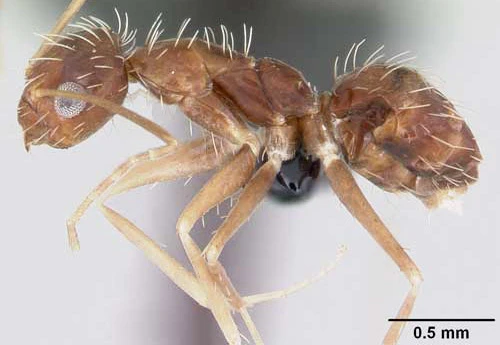
Identifying Crazy Ants: Workers are about 1/8-inch (3.0 mm) long or slightly less, and are dark brown to black, sometimes with a faint bluish iridescence. They have unusually long legs and one node between thorax and abdomen. The basal segment of the antenna (the scape) is also unusually long, twice as long as the head, and the antenna does not have a club.
Use the ants' habits for confirmation. Are they moving in a rapid, jerky manner? The crazy ant gets its name because it darts here and there in a spastic, apparently haphazard way, as though it isn't quite sure where it wants to go.
In coastal Texas, Florida and other Gulf Coast states there are two invasive crazy ant species with similar biologies and behaviors. They are the tawny crazy ant (Nylanderia fluva) Caribbean crazy ant (Nylanderia pubens). They are reddish-brown in color.
Crazy Ant Colonies: Colonies can have thousands of workers and many queens. Colonies may swarm in spring but more often reproduce by budding off new colonies. Colonies are difficult to find because the ants occupy flimsy, shallow, unstable nest sites and, like other tramp ants, they move the colony frequently and quickly. If the ants are disturbed, a typical nest of 2,000 workers and up to 40 queens can be moved to a new location in a matter of minutes. Like other tramp ants, crazy ants can also split the nest into two or more colonies.
Where to Look for Crazy Ants: Crazy ants often locate their nests under trash or debris, remain a few days or weeks, and then move on. Nests can be up to 100 feet away from feeding sites and indoor ants can be foraging in from outside nests.
Outside: Look for nests in trash and junk piles, tree holes, rotten wood, in or under potted plants, in mulch or under groundcover plants, or in soil under sidewalks or objects. Look for foraging ants tending aphids on foundation plants. Crazy ants often enter buildings in fall, after rains, or when their outdoor aphid "honeydew" supply drops off.
Inside: Look for nests in wall or floor voids, under carpet, behind baseboards and window frames, in potted plants, or near hot water pipes. Usually found on the ground floor but have been found as high as the 20th floor in apartment buildings.
Bait Monitoring: If you're using bait to control them or to track them to a nest site, be aware that, like many ants, crazy ants shift their food preferences with the season. They tend to prefer sweets in spring and fall, and insects and other protein foods in summer.