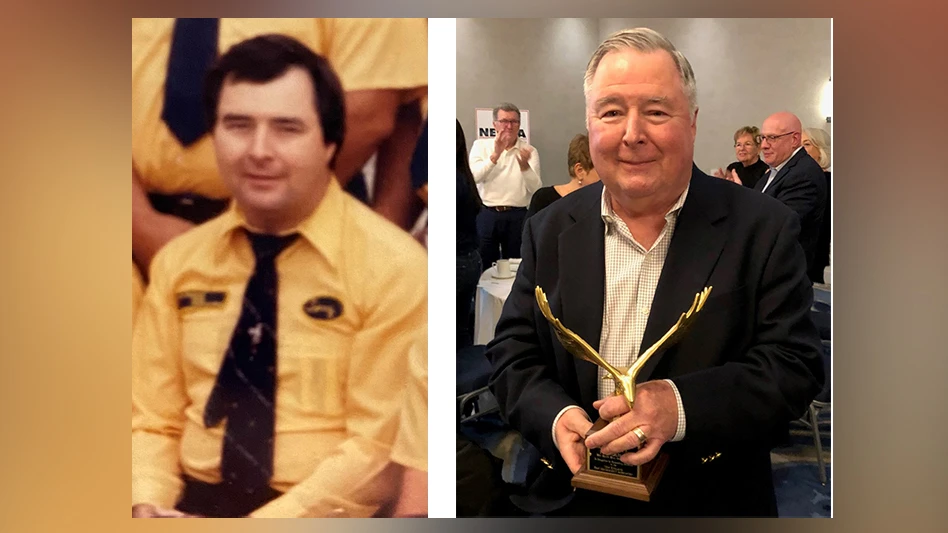
Photos: Big Blue Bug Solutions.
Tony DeJesus recently retired after 45 years in pest control, all with Big Blue Bug Solutions, Providence, R.I. DeJesus started as a service specialist in 1977 and worked his way through the ranks, retiring as vice president.
In addition to his contributions to Big Blue Bug Solutions, DeJesus has given back to the industry in numerous ways, including as an active member of the New England Pest Management Association (NEPMA), where he was recognized with the Bartlett W. Eldredge Award for his association contributions.
He also left his mark on the community as an ambassador, including spearheading a holiday drive for veterans and hosting an award-winning radio show where he answers pest questions from listeners throughout Southern New England.
PCT caught up with DeJesus to learn more about his pest control journey.
PCT: What brought you to Big Blue Bug Solutions?
Tony DeJesus: Believe it or not, my grandfather, Ed Boyle, worked for Big Blue Bug Solutions for 40 years. We actually worked together for a couple of years when I started. He was the one who would tell me stories about chasing rats and cockroaches. It sounded interesting to me. Then as I got older, I was working as a sales rep for Panasonic, but I wasn't happy with it. He said to me, “If you are interested, I can get you an interview.” He also warned me that it wasn’t for everyone. But once I got hired, I took to it like a duck to water. That was 1977 and I was 25.
PCT: What was Big Blue Bug Solutions like in 1977?
TD: We had a small office and there was no big blue bug on the roof. We probably had about 25 technicians. You were the technician, the sales rep, the specialist. You did everything on the route back then. And we kept track of our routes on index cards.
This was before the time of computers so routing was not very efficient. When the company had grown to a point where they needed somebody else, all the other technicians gave some of their work (to the new hire). So, you're literally driving 30 or 40 minutes between stops because that was that was your route. And of course, the technicians didn't give you the good stops. But it was a good way to "cut your teeth" solving problems.
PCT: What was pest control like back then?
TD: When I first started we were just phasing out the chlorinated hydrocarbons, but I do remember using chlordane and lindane early on. And we were phasing into the organophospates. And for rodents we used things like red squill and strychnine. For the first few years I actually carried cyanide in my car for dusting rodent burrows.
PCT: You said you took to the profession like a duck to water. What was it about pest control that you love so much?
TD: I think it was the job satisfaction, that when you solve someone's problem, if someone has you into to a house and they had a problem with roaches…or if you show up at a restaurant for a problem with roaches or mice that would have closed it down…you were a hero to those people.
PCT: What have been the biggest improvements or the best way the industry has advanced throughout the years?
TD: The use integrated pest management, where we are going in and inspecting and not only coming in to treat for a problem, but trying to make sure that the customer doesn't repeat the problem. So whether it's sealing up holes to keep rodents out, sealing up cracks and crevices and doing things like drain cleaning, we are using less pesticides and more skills and knowledge to solve problems. We went from being called the bug man to being pest management professionals.
PCT: What is it that you liked about working for Big Blue?
TD: It's a family-owned business and they really care about their employees, from (founder) Mr. (Lenny) Goldman to Steve Goldman and now to Brian, Scott and Kevin Goldman - the three brothers that are running the business. The business never changed from one leader to the next. It’s a company that cares about its employees.
I think the fact that Mr. Goldman started off by putting Steve on the road as a technician and doing all the jobs, and then Steve then did the same thing with his three sons…they all understand what it’s like to be technicians and they can relate to you.
The company is involved in the community. We do Toys for Tots. I went to Steve Goldman several years ago with the idea for ROVAC (Remember Our Veterans at Christmas). We collect unwrapped gifts and deliver them to the Rhode Island Veterans Home. It was Steve Goldman’s caring that got it started. He provided the seed money to get it started. Now we are the largest private donator to the Veterans home. We eventually got other businesses involved and other groups like Knights of Columbus of Rhode Island.
PCT: How did how did the radio program come about?
TD: It started about 30 years ago. I came on as a guest on a local show where people could call and ask a question or [the deejay] would ask me questions. I did this on a quarterly basis. Then it kind of mushroomed and one day I got a call from the program director of the station and he said, “Would you like to have your own show on a Saturday morning?” I was part of what they called the Saturday Morning Professional. We also had other professionals like veterinarians, auto mechanics, lawyers, financial advisors, etc. I was the pest management professional. Each of us would have an hour-long program.
PCT: What what were some of the different topics and some of your highlights from that radio program?
TD: I was basically trying helping people out with their pest issues and providing them tips and also raising awareness about things like Lyme disease and West Nile virus. I would have guest speakers come on. For example, I interviewed Dr. Tom Mather from the University of Rhode Island (director of URI’s Center for Vector-Borne Disease and its TickEncounter Resource Center) to talk about things like West Nile virus and EEE when they would pop up. Now with cameras, people can take a photo, email or text to me and I can give them advice over the air.
PCT: You've been real active with the New England Pest Management Association, including on the legislative front. How did you get involved in regulatory issues that impact the industry in New England?
TD: I served on the NEPMA board and basically each board member represented a different state and we also had ad-hoc members. When legislative issues came up in one state, we all got involved and supported each other. If something bad happened in one state, it would eventually just mushroom over to other states. So, we all kind of helped each other out. If somebody had an issue, we would all try to testify before the legislature or write letters or whatever it might be. And we were able to keep some legislation - some bad stuff - down.
PCT: You were honored by NEPMA with the Bartlett W. Eldredge award (which recognizes an individual who has made a long-term commitment to the betterment of the pest control industry in New England). What was the significance of the award to you?
TD: To me, it was that I was recognized by my peers, that they appreciated the contributions I made to the industry and that my career mattered. I treasure it. The other names on that award that have won it over the years are all my heroes. I was just so honored and couldn’t believe that I won it.
PCT: What do you think that you're going to miss the most about your day-today involvement in the pest control industry?
TD: It's the people. I'm a people person, so I will miss talking on a day-to-day basis with the technicians. Them calling and saying, “I've got this problem.” It's an old cliché, but It's not the job, it's the people. Whether it’s talking with technicians, the ladies in the office or brainstorming with Brian, Scott and Kevin Goldman and the other managers, that is what I will miss most.
PCT: What are your retirement plans?
TD: Well, I'm still doing my radio show for the company. I hope to get involved in my community a little bit more. Somebody just asked me if I would want to to be part of the high school I graduated from. They have a Hall of Fame committee. I'm a deacon in my church, and I serve on a couple of committees there and I want to get out, enjoy nature a little bit more. I love looking at birds and things like that. One of my retirement gifts from the company was this big photographic telescope lens that I can use to watch birds.
Latest from Pest Control Technology
- Earn CEUs from Your State at Next Week’s Mosquito Control Virtual Conference
- Preserving Culture, Providing Opportunities Key in Hoffman’s Decision
- Winter Weather Could Decide How Bad Mosquito Season Gets
- Trent Frazer Discusses How Mosquitoes Survive Winter
- Barnes Exterminating Acquires Tennessee Pest Solutions
- Pest Index Up 9% YOY in January
- Arrow Exterminators Acquires Hoffman's Exterminating
- PMPs Plan Mera Peak Summit for Parkinson's





