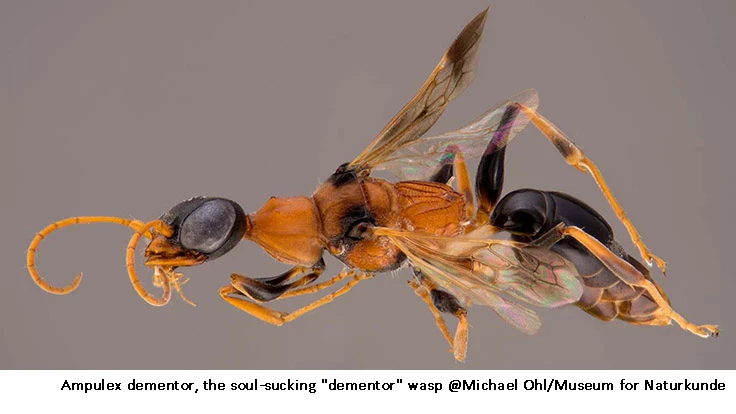
The Ampulex Dementor, named after the terrifying soul-suckers from the “Harry Potter” movies, is one of a 139 new species discovered in Asia's Mekong Delta in 2014, according to a World Widlife Fund report.
The Greater Mekong Region (Cambodia, Laos, Myanmar, Thailand, and Vietnam) teems with life. Irrawaddy dolphins splash in the Mekong River, wild elephants and tigers roam Thailand’s forests, and giant ibises stalk the watering holes of Cambodia’s Eastern Plains Landscape. In total, over 430 mammal species, 800 reptiles and amphibians, 1,200 birds, 1,100 fish and 20,000 plant species call this region home. Every year, scientists describe new species increasing this tally and highlighting how much more is left to discover: between 1997 and 2014, 2,216 new species were discovered.

In 2014, new species included a soul-sucking “dementor” wasp. WWF described the wasp as “the stuff of nightmares – a newly-discovered wasp that turns cockroaches into zombies.”
“The Ampulex Dementor, named after the terrifying soul-suckers from the “Harry Potter” movies, is one of a 139 new species discovered in Asia's Mekong Delta in 2014, according to a World Widlife Fund report.
“A wasp that steals its prey’s free will with a single sting before eating it alive sounds like a monster straight out of a storybook. Visitors to the Berlin natural history museum Museum für Naturkunde (MfN) certainly thought so, voting to name this wasp Ampulex dementor after the soul-sucking dementors from the Harry Potter series.
“A. dementor hunts cockroaches, injecting a venom into the mass of neurons on its prey’s belly that turns the roach into a passive zombie. Cockroach wasp venom blocks receptors of the neurotransmitter octopamine, which is involved in the initiation of spontaneous movement. With this blocked, the cockroach is still capable of movement, but is unable to direct its own body. Once the cockroach has lost control, the wasp drags its stupefied prey by the antennae to a safe shelter to devour it.
“The dementor wasp and its bizarre hunting tactics bewitched the public at MfN during a public poll to name the yet-undescribed wasp. After participating, visitors said they felt a personal connection to the dementor wasp and were more interested in this region’s unexplored nature.
“This type of personal bond with nature is essential for conservation. Despite the global impacts of environmental degradation, biodiversity loss can seem very divorced from people’s day-to-day lives. Opportunities to participate in describing biodiversity create an immediate connection with the wild, weird world beyond visitors’ usual urban lives. “I am convinced that events like this increase people’s curiosity about local and global fauna and nature,” said Dr. Michael Ohl, one of the researchers who led the naming process. People’s perceptions of nature have real world consequences: positive views of previously ignored or disliked organisms can lead to calls for better conservation management.”
Latest from Pest Control Technology
- Earn CEUs from Your State at Next Week’s Mosquito Control Virtual Conference
- Preserving Culture, Providing Opportunities Key in Hoffman’s Decision
- Winter Weather Could Decide How Bad Mosquito Season Gets
- Trent Frazer Discusses How Mosquitoes Survive Winter
- Barnes Exterminating Acquires Tennessee Pest Solutions
- Pest Index Up 9% YOY in January
- Arrow Exterminators Acquires Hoffman's Exterminating
- PMPs Plan Mera Peak Summit for Parkinson's





