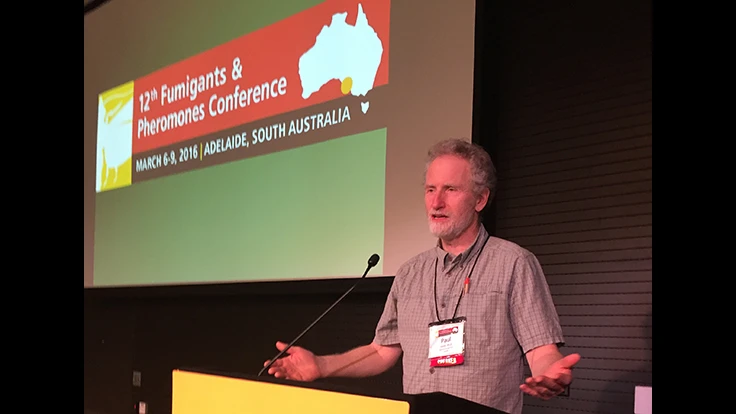


ADELAIDE, Australia — The 12th Fumigants & Pheromones Conference, a biennial conference on stored product protection, was held March 6-9, 2016 in the festival city of Adelaide, South Australia. The event, attended by 180 people from 26 countries, was the "best to date" according to conference organizer Dave Mueller, president of Insects Limited.
“The world class speakers, new Adelaide Conference Center, very special dinner at the Adelaide Oval, record number of sponsors, local host organizers, ‘The Legend,’ and the warm weather made this conference the best since 1993 when the first conference was held in Luebeck, Germany.”
The goal of the biennial conference is to bring together people that work in stored product protection worldwide. About 3,000 people from 60 different countries have attended the conferences since the first one first one was held in Northern Germany in 1993. “This meeting allows for us to partner with like companies in different countries to understand how they perform their business and make comparisons and contrasts with how we ourselves work in the United States,” said Mueller.
As in year’s past, topics were chosen by the previous evaluation sheets. Speakers are chosen after Mueller has vetted them at other conferences, and several speakers are from Mueller’s companies Fumigation Service & Supply and Insects Limited. Additionally, conference sponsors receive a “What’s New” 15-minute segment to discuss their new technology and field research.“What separates this meeting from others throughout the world is that we push hard to offer practical examples and personal field research on what works and what does not work,” Mueller said.
This was the first time this conference was held in Australia. Simon and Sue Ball of Australian Fumigation in Adelaide were the local organizers. Barbara Bass, Peggy Rutkowski, and Lisa Orbaugh organized many elements of this conference from their offices in Westfield. Speakers included Nayak, Mueller, Corrigan, Baributsa, Ryan, Lombardi, Ball, Emery, Fields, Daglisch, Self, Schlipalius, Waggoner, Thoms, and Simmons. In addition, research posters, “What’s New” sessions from manufacturers, and industry displays were part of the program.
Australia is an island continent located about 30 hours from Europe and 20 hours from North America by airplane. Many past participants in the Fumigants & Pheromones conferences found it difficult to travel this long distance to attend. But the Australians, who live far away from European and North American conferences, were excited to have this conference in their country. Adelaide 2016 was attended by 105 Australians. They came from Brisbane, Melbourne, Perth, Sydney, Adelaide and places in between; and there is a lot of “in between” in Australia. Australian conference attendees represented the federal government agencies, the grain traders, pheromone distributors, fumigation companies, food companies, universities, fumigant scrubber companies, federal stored product research organizations, bin sealing companies, and export grain terminals.
Marinko Vranjes, Global Sealing Services,Perth; “Tight bins allow for better fumigations.” One take home message from this conference is that Australians seal their grain bins tight enough to hold a half lost time for 5 minutes. Most North American grain bins don’t come close to being this tight.
Grain is a major export for Australia. They continue to pride themselves on producing and shipping quality grain throughout the world. The government of Australia is so focused on exporting quality grain products that they have enacted a grain standard law that doesn’t tolerate insects in their export grain. Considering that Australia is a warm country with the ideal conditions for pest insect growth and development, ‘Nil Tolerance’ is a challenge. Canada has such high standards for their export grain; however, the cold winters make this easier to achieve. The Australians often fumigate their grain with phosphine every 120 days while in storage. This would be similar to the Oklahoma area in the United States that fumigates wheat, on average, three times a year.
Because of the heavy dependence on phosphine fumigants for protecting grain while in storage, the Australian researchers lead the world in understanding and detecting the presence and absence of genetically linked phosphine fumigant resistance. Dr. Manoj Nayak of DAFF in Queensland led off the conference with an explanation of how his lab in Brisbane searches for phosphine resistance and ways to manage this serious challenge. The options are growing for phosphine but the cost is significantly higher. David Schliplalius, Ph.D., researcher on genetic resistance in stored product insects to phosphine has led to the discovery of the mode of action of phosphine: Fat metabolism in the mitochondria of the cell. This secret has been explored for over 70 years and many theories were proposed but Dr. Schlipalius has discovered the mode of action through genetics of phosphine resistance. This announcement was a highlight of the conference. (see page xxx)
Rodents received attention from favorites Dr. Bobby Corrigan and Dr. John Simmons. Dr. Corrigan presented some of his training from his New York City Rodent Academy and Dr. Simmons directed his comments toward rodent management in food facilities in Europe.
Most of the presentations were practical in nature. Mueller, Kelley, Van Ryckeghem, and Daglisch offered pheromone topics: The Practical Use of Pheromones, The Practical Use of Beetle Traps, and Mating Disruption for Indian meal moth (Plodia interpuncella) in food warehouses and The Practical Use of Pheromones in Australia.
Jeff Waggoner, Fumigation Service & Supply, USA; presented the practical use of sulfuryl fluoride on structures.
In all, there were 21 presenters in the first two days. The evaluation sheets gave the speakers high ratings. One evaluation sheet stated: “What we enjoyed most about this conference was the range of speakers and attendees available to talk to. This has been an excellent opportunity to meet people from this industry and share so much knowledge from their expertise.” One person mentioned: “I liked the interaction with others and understanding how things are done in different countries.”
There was much fun and good cheer in Adelaide during the Gala Dinner sponsored by Douglas Products, USA. The food was delicious, the atmosphere and view over the famous Adelaide Cricket Stadium was impressive, and famous former Test Cricketer for Australia, Wayne Phillips, “The Legend,” told hilarious stories. However, the best part of the evening was the traditional singing contest from the various countries. The massive Australian contingent sang “Waltzing Matilde” while their American counterparts sang: “Home, Home on the Range.” But the winner of the coveted mini-cricket bat (signed by ‘The Legend’) went to Zimbabwe. Zane Accutt, Delport Tobacco of Harare, brought down the house with his tribal hymn from his native country.