istock: Víctor Suárez Naranjo
Some species of ants can prove trickier to control than others, and those challenges vary depending on the regions and environments in which PMPs work.
For Camille Landry, technical director at Full Scope Pest Control, rover and ghost ants are the two most difficult species to control in the North Houston area.
The trouble in controlling rover ants lies in their large populations and many small, single-queen colonies. Inside, this species can often be found nesting in bathrooms and kitchens, while popular outdoor harborages include cinder block exterior walls and underneath shingles. According to the Mallis Handbook of Pest Control, rover ants seem to prefer sweet liquids. Difficulties most often arise when the nest is located far away from control efforts.
“Our strategy is ant gel on the interior, as well as a nonrepellent on the trails and then a boric acid bait on the exterior,” Landry said. “So, you're getting consumption and something that's carried back. It's a double whammy, really.”
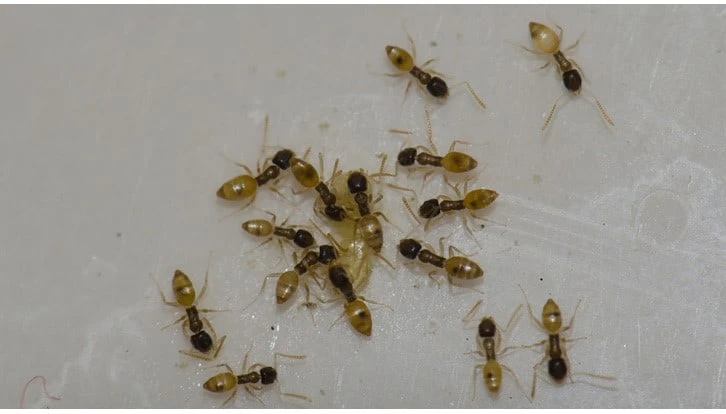
Ghost ants, distinguished by a distinct “rotten coconut” smell when squished, are usually found in humid habitats, often under bark or in soil, rotten wood, leaf litter and plant cavities and detritus. They often enter homes through windows and doors and gravitate toward house plants, breadboxes and shower curtain rods, behind baseboards and between cabinets, feeding on sweets and grease. They respond best to liquid and gel baits, according to Mallis.
Landry said taking a proactive, preventative approach rather than reactive makes all the difference in controlling difficult species. “Our techs are constantly looking and sourcing and moving stuff around, shoveling to see if we can get any ant activity and then treating appropriately, versus trying to treat them on the interior after we've sprayed a repellent or some type of thing that forces them inside, which increases service calls and decreases profit. And customer satisfaction changes.”
Chris Brennan, owner of Brennan’s Pest Control, Oak Park, Ill., said odorous house ants present a challenge in the Chicago area. He has experienced success using non-repellent sprays in tandem with baits for this species, as well as other small invasive ants, he said, including carpenter ants.
Odorous house ants, which emit an odor similar to the ghost ant, can often be found near leaf litter, bricks, firewood, logs, boards and landscape timbers. According to Mallis, they gravitate toward nest sites that are moist and shady or near food. Even when they invade a building, their nests are usually located outside. They prefer sugars and protein over lipids.
Kathy Daw, owner/manager of Bob’s Pest Control, El Paso, Texas, also cited carpenter ants as a challenging pest to control. Treatment all hinges on identification, she said, so “if you can identify them properly, then you know exactly how to treat and what to do. The problem is if you’re not identifying them properly.”
Finding nest and foraging trails is essential when controlling carpenter ants, and nests are notoriously difficult to find, says Mallis. Carpenter ants, which become active in the spring, typically nest near stacked lumber or woodpiles, wood in contact with soil, water-damaged wood, sites with improper drainage, vegetation in contact with a building, trees, stumps and landscaping timber. The handbook recommends feeding foraging carpenter ants diluted honey and sliced-up insects, such as crickets or mealworms, and then following them to track down their nests.