Mosquitoes, the ever-present and annoying pests, have caused quite the stir in recent years as news articles and television segments have featured frightening stories about mosquito-borne diseases. Consequently, the desire for mosquito control has been on the rise. “We have a lot of mosquito problems, but have really started pushing [the control service] in the last five or so years” due to the West Nile virus and Zika virus, says Joe Martin, entomologist and part owner of Terminix in Louisiana. “When it gets in the news, it makes people realize the dangerous diseases that mosquitoes can carry,” he says.
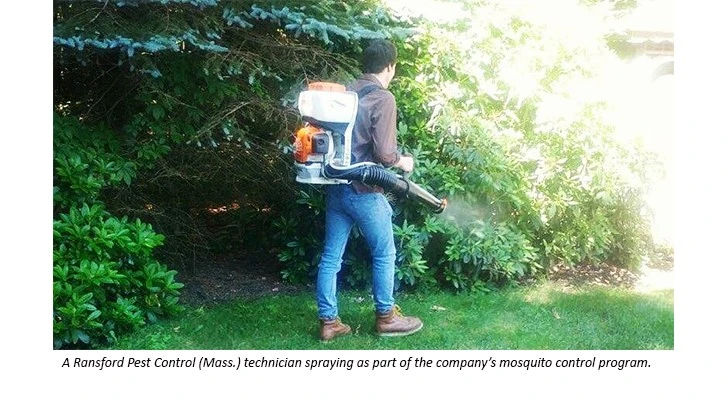
With increased customer demand, growing revenue streams emerge. Capitalizing on a market opportunity, while offering a much wanted and needed service, is exactly what Eric Richmond, CEO of Ransford Pest Control Services in Massachusetts, did. A trusted vendor suggested to Richmond that by not offering mosquito service and sticking only with his traditional pest control services, such as rodents, roaches, ants, flea, and termites, his company was “missing the boat,” shared Richmond.
Some inherent obstacles in offering mosquito control services, however, do exist. “We’re never going to get rid of all the mosquitoes, and second, we all need to work together to decrease the [pests],” Martin says. He explains to residential customers that standing water on their property in places like pools, tires, buckets and water bottles need to be emptied because this is where mosquitoes breed. Additionally, certain parishes (similar to counties in other states) in Louisiana schedule trucks to “drive around and spray in the evenings,” Martin says.
In addition to educating customers and working in concert with municipality spraying, Martin’s company offers additional mosquito treatment for residential customers. He recommends a combination of residual spray around the house and shrubbery along with a “mosquito trapping” product, such as the In2Care product. Trapping products act as lures and contain an Insect Growth Regulator to prevent any laid mosquito eggs from developing into adults, and block the female from spreading disease.
This type of population control system is a good solution for customers who do not like chemicals around their homes and for communities that are sensitive to pesticides. By offering this service, Cherrington’s company has added a regular treatment service as monthly maintenance is required.
Initially Richmond had been reluctant to offer a mosquito control service because he was “concerned with overspray.” There are many houses on smaller lots in his area (Massachusetts), so “my concern was that [the service] wasn’t going to do much by treating just one of the yards,” Richmond said. A population control system, however, changed his mind and eliminated his concerns.
As another treatment option, Andrew Sievers, owner and entomologist of Northeast Pro-Con Solutions in Massachusetts, offers “one hundred percent all-natural mosquito and tick treatment.” Although this option is more expensive and treatments are required more often than with synthetic treatments, customer demand has helped Sievers to create an exclusively all-natural additional mosquito control service to his pest management company.
Latest from Pest Control Technology
- Earn CEUs from Your State at Next Week’s Mosquito Control Virtual Conference
- Preserving Culture, Providing Opportunities Key in Hoffman’s Decision
- Winter Weather Could Decide How Bad Mosquito Season Gets
- Trent Frazer Discusses How Mosquitoes Survive Winter
- Barnes Exterminating Acquires Tennessee Pest Solutions
- Pest Index Up 9% YOY in January
- Arrow Exterminators Acquires Hoffman's Exterminating
- PMPs Plan Mera Peak Summit for Parkinson's