When it comes to the cockroaches in and around structures, the German cockroach (Blattella germanica) is the most common species pest management professionals encounter. This pest is most often found around kitchens and bathrooms where conducive conditions are present. With advanced generation cockroach gel baits and the use of assessment-based protocols or integrated pest management (IPM) programs, these troublesome pests have become much easier to control. However, improper identification of species similar to the German cockroach can lead to continued pest sightings and leave technicians scratching their heads.
Two species, the field cockroach (Blattella vaga) and the Asian cockroach (Blattella asahinai) strongly resemble the German cockroach. A case of mistaken identity can occur if the sighting happens as the pest scurries away, or if one is only provided photos from a customer. Even more problematic is if the customer has done their own identification with an internet search. Another small cockroach that is sometimes confused with the German cockroach is the brown-banded cockroach (Supella longipalp). Distinguishing it by its physical appearance is easier, but due to its small size and somewhat similar behavior, it too has been confused with the German.
Below, we’ll review a couple stories where mistaken identity occurred and how proper identification of the correct species involved led to control. We’ll also briefly discuss the biology and provide some IPM recommendations for these other species.
THE ASIAN COCKROACH. When Matt Remmen was an entomologist for a large regional pest control company, a restaurant on the west side of Orlando, Fla., called to report the return of a German cockroach infestation. The complaint required a site visit due to the sudden and severe nature of the infestation. When patrons complained of cockroaches around the restaurant, it had to offer them free meals. The company had resolved a previous German cockroach infestation some time before, but with this new appearance causing a number of diners to complain, the client demanded immediate action.
The restaurant workers noted that cockroaches were flying toward and congregating near the lights of the outdoor patio at the restaurant. While German cockroaches can infest light fixtures, hearing how these cockroaches were found in large numbers, almost exclusively outdoors, was a big clue that a different pest was involved. Furthermore, running around the lights unperturbed at night is not what one would expect from a German cockroach. Knowing this, Remmen captured a live cockroach and tossed it into the air. Although they are not adept fliers, this creature easily flew away and quickly scuttled into a hidden area. This simple test helped determine that these German cockroach lookalikes were actually Asian cockroaches.
The Asian cockroach appears nearly identical to the German and they can be found from Florida to South Carolina and west to Texas. The nymphs are a bit easier to identify as they are pale along the margins of the abdomen and are smaller than German cockroach nymphs. Still, distinguishing the two by morphological traits is extremely difficult. In most cases, as was done here, the two species can be distinguished by behavior. Asian cockroach adults can fly and are attracted to light. They are most active in the evening, around dusk. They may enter structures and become a nuisance, landing on lamp shades, illuminated walls and televisions. However, they usually don’t become established indoors.
Outdoors, populations of Asian cockroaches can grow quite large. They can become a pest when conditions are favorable, such as weedy vegetation, thick grass or an accumulation of leaf litter. Like many peridomestic species, these cockroaches are omnivorous scavengers. They have been observed feeding on organic debris, plants, dead insects, the eggs of moths, honeydew from aphids and more. In nurseries, they can be a pest of roses and other plants, harboring in potted plants. They can also be a problem in the citrus industry through their feeding on young foliage and can become a sanitary concern in packaging and processing facilities when brought in with the harvested fruit.
The source in this instance was tracked to a nearby unkept citrus grove. The Asian cockroaches were living and breeding among the fallen leaves and detritus. They were eventually controlled through broadcast applications with a pyrethroid, along with a focus on areas that were considered conducive. At the restaurant, spot treatment applications were made around the lights. Once the identity of the pest was correctly determined, the problem was solved in short order.
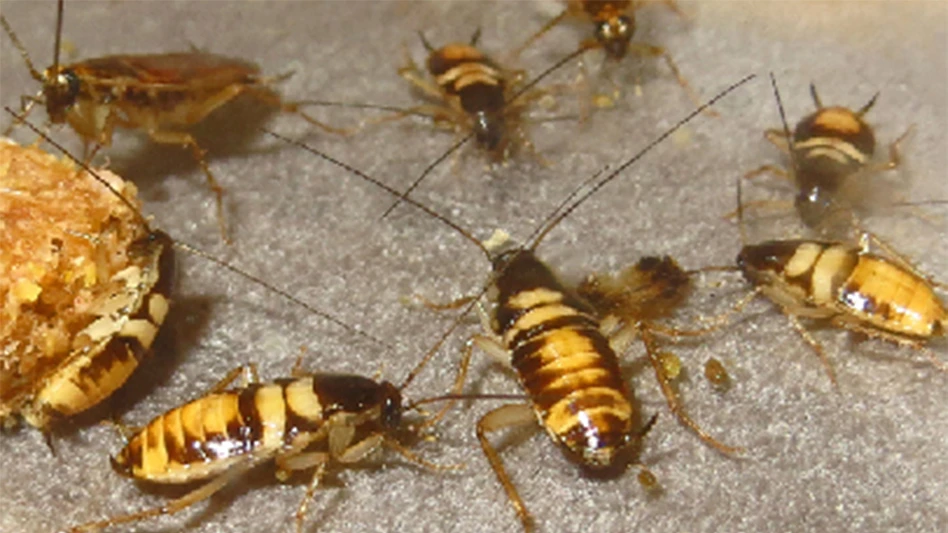
THE BROWN-BANDED COCKROACH. Other than its small size, the appearance of the brown-banded cockroach is not significantly similar to the other three mentioned so far. Brown-banded cockroaches are recognized by the light-colored bands that cross the bodies of the nymphs and the wings of the adults.
In 1979, Joe Barile had accepted a position with a global pest management firm and was assigned to a recently acquired company in upstate New York. The responsibilities of this position were to serve as a special service representative and provide outside sales efforts.
On one occasion, service was requested at a residential account in the town of Sodus, N.Y. The work description on the card read simply “cockroaches.” Such a nondescript service request was not unusual. Upon arriving, Barile was let in the door and proceeded directly to the kitchen, unpacked his equipment, pressurized his sprayer (this was before the development of cockroach baits) and opened the cabinet door under the sink. The homeowner seemed puzzled and asked, “What are you doing?” Barile explained that he was going to treat for cockroaches. “There are no cockroaches there,” she replied. After a confusing conversation, the homeowner directed him to the bedroom. Behind a set of window drapes were a number of brown-banded cockroaches. Barile had made the fundamental mistake of not making a positive identification, assuming the work order description of “cockroaches” was for German cockroaches. If he had proceeded with his planned service efforts for German cockroaches, the brown-banded infestation would have been minimally impacted.
With a corrected target identification, the right service was provided, which eradicated the brown-banded cockroach infestation. Since this service occurred before the development of cockroach baits and the use of vacuuming to remove these pests from the site, the efforts centered on careful application of residual liquid sprays and dusts. It did take multiple visits, but the cockroaches were eliminated.
Unlike Asian cockroaches, the brown-banded cockroach is an indoor species and dependent on humans for survival. Thus, control methods are similar to those implemented for the German cockroach. Best practices include vacuuming harborages, residual dust applications to gaps and voids, gel bait applications and reducing harborage by sealing cracks and crevices. But there are some noteworthy differences. Brown-banded cockroaches are much more tolerant of dry areas and are therefore more evenly distributed in a residence, as was the case in this instance. Additionally, they prefer warmer temperatures and are generally found in greater numbers higher up in rooms.
IDENTIFYING THE RIGHT CULPRIT. The two species in the accounts above are not the only small cockroaches that can be confused with the German cockroach. The field cockroach also bears a strong resemblance to both the German and Asian cockroach. It occurs in the southwestern U.S. from California to Texas. While it is slightly smaller and has a somewhat olive tone, its appearance can be easily confused with the German cockroach, and in the areas of Texas where they overlap, the Asian cockroach. The field cockroach is differentiated by the dark stripe found between the eyes, which is not present on either of the others.
The biology of the field cockroach shares much in common with that of the Asian cockroach. They can be found under stones, debris, in weedy vegetation, mulch and other similar areas that may provide shelter or retain moisture. They rarely enter buildings but may do so in search of moisture if it’s dry outside. They are capable of flight and are also attracted to lights.
The spotted Mediterranean cockroach (Ectobius pallidus) is about 3/8 inch long and is quite common in the northeastern U.S. Mediterranean cockroaches were first discovered and described on Cape Cod in 1948. They are smaller than German cockroaches but have similar base coloration. Mediterranean cockroaches are outdoor dwellers and have almost identical behavior as native wood cockroach species like the Pennsylvania wood cockroach (Parcoblatta pensylvanica). That species’ range has expanded into the Midwest.
Another species, the three-lined cockroach (Luridiblatta trivittata), has been found in parts of northern and central California. This small cockroach (adults are 1/3 inch long) has three black stripes across its back, which aid identification. It can sometimes be confused with German cockroaches, especially being mistaken for that species’ nymphs.
PEST IDENTIFICATION. Like the Asian cockroach, these other small cockroaches primarily live outdoors. They likely venture inside because they’re attracted to light or in search of moisture. Thus, IPM programs focused on exclusion and habitat modification should be the focus of reducing these creatures indoors. Remove or cut back heavy vegetation and clean up leaf litter. Seal entry points and be sure screens are properly fitted. Remove piles of clutter or debris. If the source is determined to be another property, consider changing or refraining from using exterior lighting.
Cases of mistaken identity such as these demonstrate why identification is such a key part of pest management. It’s essential to know the right pest to be able to provide the best recommendations and treatment.
The authors are urban entomologists with more than 90 collective years of experience in the pest management industry.
Latest from Pest Control Technology
- Earn CEUs from Your State at Next Week’s Mosquito Control Virtual Conference
- Preserving Culture, Providing Opportunities Key in Hoffman’s Decision
- Winter Weather Could Decide How Bad Mosquito Season Gets
- Trent Frazer Discusses How Mosquitoes Survive Winter
- Barnes Exterminating Acquires Tennessee Pest Solutions
- Pest Index Up 9% YOY in January
- Arrow Exterminators Acquires Hoffman's Exterminating
- PMPs Plan Mera Peak Summit for Parkinson's