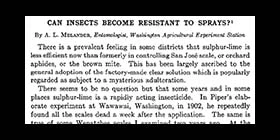
One hundred years ago this month, an entomologist at the Washington Agricultural Experiment Station named A. L. Melander published an article in the Journal of Economic Entomology called “Can Insects Become Resistant to Sprays?” It is widely regarded as the first ever published article on arthropod resistance to insecticides.
“Melander’s 1914 paper not only reported the first case of field-evolved insecticide resistance, it also foreshadowed the refuge concept for delaying resistance,” said Dr. Bruce Tabashnik, head of the Entomology Department at the University of Arizona. “It’s remarkable!”
Melander noticed that certain populations of insects — but not all of them — were becoming less susceptible to sulphur-lime than they had been in the past. While the chemical was documented to be very effective at killing scale insects in a previous experiment in Wawawai, WA, Melander found that 90% of the specimens that he had sprayed in Clarkston had survived. Even when he increased the amount of active ingredient by ten times, 74% of them still survived.
“That the San Jose scale should become acclimatized to a sulphur-lime environment is not altogether a strange thing,” he wrote, noting that a colleague had observed that moths in his lab could become resistant to arsenic.
Read more.
Source: ESA
Latest from Pest Control Technology
- Earn CEUs from Your State at Next Week’s Mosquito Control Virtual Conference
- Preserving Culture, Providing Opportunities Key in Hoffman’s Decision
- Winter Weather Could Decide How Bad Mosquito Season Gets
- Trent Frazer Discusses How Mosquitoes Survive Winter
- Barnes Exterminating Acquires Tennessee Pest Solutions
- Pest Index Up 9% YOY in January
- Arrow Exterminators Acquires Hoffman's Exterminating
- PMPs Plan Mera Peak Summit for Parkinson's





