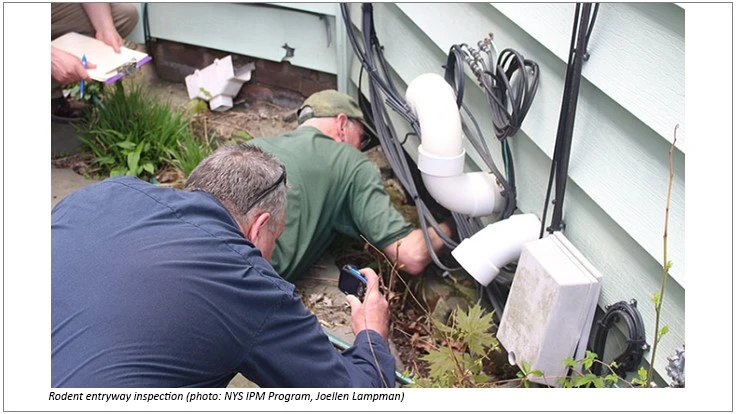
While pest control exclusion programs vary from company to company, they all begin with a thorough inspection to define what pest species are present, where they are located, and what resources they are using.
Dr. Matt Frye and Dr. Jody Gangloff-Kaufmann, from New York State IPM Program at Cornell University, explained to PestWorld 2017 attendees that the inspection is the critical first step for all pest management operations.
As Stoy Hedges noted in his PCT article “Situational Pest Management,” a thorough inspection helps to define the scope of the pest problems and identifies structural issues, entry points, and sanitation or water problems.
With this information, a PMP can then establish a treatment method and “in terms of exclusion, determine what products to use and where,” explains Frye. Knowing which treatment is best for the particular pests, the PMP can accurately quote a price for the work involved. Most importantly for the pest control industry, says Frye, “Without a thorough inspection, you may underprice that account and then lose money.”
Taking identification one step further, Frye indicates that simply “killing, removing, and cleaning does not help” with exclusion because there is more valuable information to be found. Knowing which rodent species is present, for instance, will provide more information about the pest’s nesting sites, seasonal activity, food sources, foraging habits, and lifecycle. And this information will lead to an exclusion plan because “accurate identification is the foundation of effective pest management,” shares Frye. For example, if the PMP finds an adult white-footed mouse inside a home, he or she would know that the pest is coming from outside, which would lead to knowing that exterior entry points need to be located. A mouse pup located indoors, in this example, would indicate breeding in the home and that a nest would need to be located nearby.
Additionally, evaluating pest evidence found in bait equipment over time will help indicate where to focus exclusion efforts. Per Frye, “Inspection is a way to refine our pest management efforts.” However, pest management professionals also need to monitor and record. Inspection is a moment of time, where monitoring with devices such as traps , are recordings of time to understand what might be occurring – or what pests are present – when PCOs are not onsite. With monitoring and tracking, the PCO will be able to determine more information about the pest population.
During inspections, structural issues and deficiencies may indicate where pests might be nesting and harboring. To identify pest entry points, any gap, crack, or crevice is practical information. A German cockroach, for instance, can fit into a 1.6mm opening, explains Frye. The size of rodent entry points will indicate the type of rodents present. The information is “based on the size of the skull,” explains Frye. Rodents can wiggle into spaces because their bodies are flexible, but their skulls are not as pliable. Mice, for example, can fit under gaps a quarter of an inch (or the size of a pencil width) and into openings of three eighths of an inch (or diameter of a dime). Rats, on the other hand, would not fit into entry points with these dimensions because their skulls are considerably larger.
Dr. Matt Frye and Dr. Jody Gangloff-Kaufmann, from New York State IPM Program at Cornell University, explained to PestWorld 2017 attendees that the inspection is the critical first step for all pest management operations.
As Stoy Hedges noted in his PCT article “Situational Pest Management,” a thorough inspection helps to define the scope of the pest problems and identifies structural issues, entry points, and sanitation or water problems.
With this information, a PMP can then establish a treatment method and “in terms of exclusion, determine what products to use and where,” explains Frye. Knowing which treatment is best for the particular pests, the PMP can accurately quote a price for the work involved. Most importantly for the pest control industry, says Frye, “Without a thorough inspection, you may underprice that account and then lose money.”
Taking identification one step further, Frye indicates that simply “killing, removing, and cleaning does not help” with exclusion because there is more valuable information to be found. Knowing which rodent species is present, for instance, will provide more information about the pest’s nesting sites, seasonal activity, food sources, foraging habits, and lifecycle. And this information will lead to an exclusion plan because “accurate identification is the foundation of effective pest management,” shares Frye. For example, if the PMP finds an adult white-footed mouse inside a home, he or she would know that the pest is coming from outside, which would lead to knowing that exterior entry points need to be located. A mouse pup located indoors, in this example, would indicate breeding in the home and that a nest would need to be located nearby.
Additionally, evaluating pest evidence found in bait equipment over time will help indicate where to focus exclusion efforts. Per Frye, “Inspection is a way to refine our pest management efforts.” However, pest management professionals also need to monitor and record. Inspection is a moment of time, where monitoring with devices such as traps , are recordings of time to understand what might be occurring – or what pests are present – when PCOs are not onsite. With monitoring and tracking, the PCO will be able to determine more information about the pest population.
During inspections, structural issues and deficiencies may indicate where pests might be nesting and harboring. To identify pest entry points, any gap, crack, or crevice is practical information. A German cockroach, for instance, can fit into a 1.6mm opening, explains Frye. The size of rodent entry points will indicate the type of rodents present. The information is “based on the size of the skull,” explains Frye. Rodents can wiggle into spaces because their bodies are flexible, but their skulls are not as pliable. Mice, for example, can fit under gaps a quarter of an inch (or the size of a pencil width) and into openings of three eighths of an inch (or diameter of a dime). Rats, on the other hand, would not fit into entry points with these dimensions because their skulls are considerably larger.
Latest from Pest Control Technology
- Earn CEUs from Your State at Next Week’s Mosquito Control Virtual Conference
- Preserving Culture, Providing Opportunities Key in Hoffman’s Decision
- Winter Weather Could Decide How Bad Mosquito Season Gets
- Trent Frazer Discusses How Mosquitoes Survive Winter
- Barnes Exterminating Acquires Tennessee Pest Solutions
- Pest Index Up 9% YOY in January
- Arrow Exterminators Acquires Hoffman's Exterminating
- PMPs Plan Mera Peak Summit for Parkinson's





