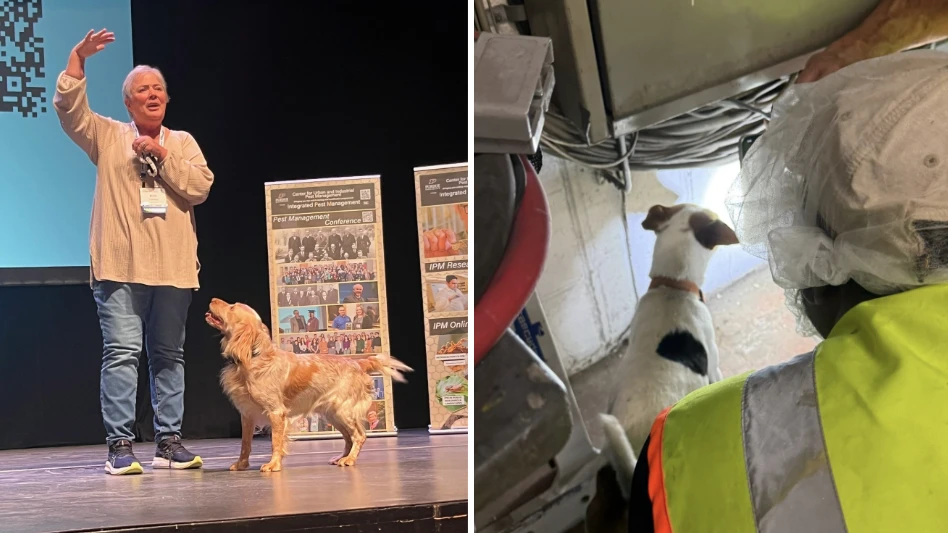
Left: Brad Harbison and right: Kimberly Camera
QUARETERO, Mexico – This past November, in Querétaro, Mexico, Kimberly Camera and her team gave a three-hour presentation about rodent exclusion and control at the 27th Regional Congress of the Asociación de Controladores de Plagas Urbanas del Bajío A.C. (ACPUB).
Camera, owner of Urban Canine Pest and Wildlife Solutions (UCPaWS), Windsor, S.C., said she assumed attendees would want to take breaks during her long presentation, but the opposite occurred — pest management professionals (PMPs) were thoroughly engaged in learning about advanced rodent exclusion practices
For Camera and her team at UCPaWS, successful rodent and wildlife control involves trained canine units. Before she started UCPaWS in 2020, Camera had retired from the Federal Emergency Management Agency (FEMA), where she worked with canines on relief efforts. Camera eventually grew bored of retirement and started contracting with pest control companies to have her dogs inspect for bed bugs.
Camera was also interested in rodent control and told her salesperson that she would be adding a rodent inspection program. Although Camera thought she had time to add those services to her operations, her salesperson had begun selling services and informed her that she would need the program up and running in three weeks.

To get the rodent control program operating in such a short time frame, Camera found a trained, but retired, dog named Leroy to test the waters. Camera said she found Leroy being inhumanely kept in a raccoon cage, which added to her decision to take him home.
On Leroy’s first mission, he was taken to a restaurant.
“That little dog found the one burrow that was in an azalea plant and those rats dug all the way in through the French drain into an old cast iron pipe that nobody knew existed,” Camera said. “This was a very old building. It was built in the 60s and we didn’t realize that’s what he found.”
After going into the restaurant building, Camera said Leroy was paying attention to the wall that housed the pipe. Three months later, the wall was torn into and the pipe was fumigated. “They did all their exclusion,” said Camera. “The restaurant didn’t have any trouble with rats after that.”
Camera comes from a wildlife biology background and said she approaches rodent control using that background. “If you treat the rodents as part of wildlife, as a part of that ecosystem, it just allows you to consider the factors like population ecology, habitat modification, ethical implications [and] non-targeted impacts — you get that whole picture,” said Camera.
UCPaWS uses detection and abatement canine teams for their rodent control services, Camera said. The detection dogs locate rodent activity, and the abatement canines apply controlled pressure to the activity. “It allows us to give our pest company partners more information for their mass trapping,” she said.
One of UCPaWS’ main goals, said Camera, is to paint a comprehensive picture of where rodent activity is happening for technicians to successfully remove the pests. UCPaWS is contracted by pest control companies and works their own contracts, too.
In Querétaro, Mexico, Camera and attendees at ACPUB’s regional congress traveled to a barn where she said rodent activity was immediately noticeable. However, Camera and her team taught attendees how to look for signs of rodent activity in untraditional areas. Camera said attendees were able to take what they learned from the lecture and apply it in real time. Dogs were released into the tunnels in hay and they chased rats out.
“Education has just got to be such a large part of rodent control,” said Camera. “We’ve got to educate our clients, we have to educate our staff, we have to find all the information. Then, of course, you’ve got to look at your observation, then your exclusion. And then from exclusion, we always [use] canines and then trapping.”
Camera said she aims for UCPaWS to support pest control companies and help them bring in specialized services. But the company can still stand and do the work alone. Camera said she also wants to provide free assistance to small farms and low-income housing complexes that are struggling with rodent infestations — all with the help of her canine team members.
“What dogs are really good at is finding what we can’t see,” Camera said. “That’s where dogs come in. A good pest technician can find all the obvious signs, the small signs that are in the open. But the dogs find what’s behind closed walls, what’s underneath, what’s in the pipe.”
Latest from Pest Control Technology
- Earn CEUs from Your State at Next Week’s Mosquito Control Virtual Conference
- Preserving Culture, Providing Opportunities Key in Hoffman’s Decision
- Winter Weather Could Decide How Bad Mosquito Season Gets
- Trent Frazer Discusses How Mosquitoes Survive Winter
- Barnes Exterminating Acquires Tennessee Pest Solutions
- Pest Index Up 9% YOY in January
- Arrow Exterminators Acquires Hoffman's Exterminating
- PMPs Plan Mera Peak Summit for Parkinson's





