Editor’s note: The following article on springtails was submitted by William A. Kolbe, B.C.E. and technical and training for New Jersey-based Viking Pest Control, and a PCT contributing writer. Kolbe has been involved in the pest control industry since he graduated from the University of Delaware in 1974.
This year, so far El Niño has brought us warmer than usual weather. Let’s hope La Niña brings us some cold weather and snow (and this weekend’s forecast may deliver just that!). We will get snow and when we do there is a chance we could encounter an insect that does occur in colder areas of the U.S. — the so-called “snow flea.”
In February, insects jumping on snow are the last thing you expect to see. You look down at what appears to be dirty snow and you see lots of little black specks. Suddenly, you remember something you read in PCT and you stoop down for a closer look. Just as the snow turns to cold water melting onto your knee, you notice some of the small black specks springing into the air! Yes, you’ve found ‘em — snow fleas!
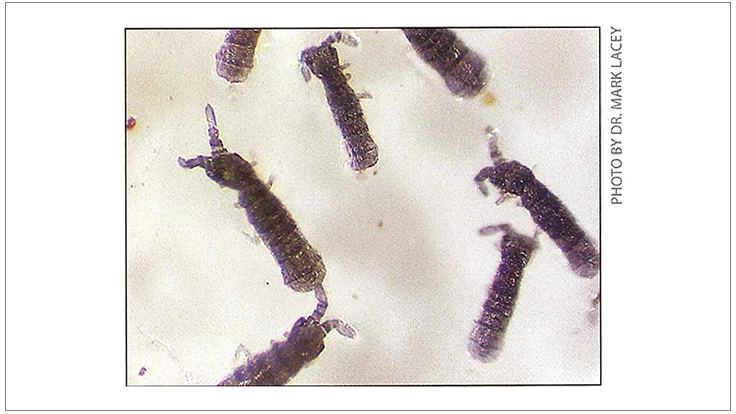
WHAT ARE THEY? Snow fleas are not fleas at all. They will not bite you, jump on your dog or really care about you at all. They are insects in the Order Collembola, commonly called springtails. In North America there are seven families and about 677 species of springtails. They are the most abundant of soil-dwelling arthropods. Living in a variety of habitats where they feed as scavengers on decaying vegetation and soil fungi, these insects are beneficial in that they help decompose organic matter. They are small in size, usually 6 mm or less in length.
WHY THE NAME 'SPRINGTAIL?' Springtails are named for a forked-like jumping organ called the furcula. Springtails are able to jump by positioning the furcula up underneath their body, releasing it and propelling into the air. Experts believe this mechanism was developed to avoid predation and escaping from other arthropods that may feed on them. The immature Collembola are similar in appearance to adults. They are dark-blue in color, making a nice contrast to snow. They usually molt 4 to 5 times before reaching sexual maturity. Unlike other arthropods, springtails have evolved in cooler climates. Snow fleas can tolerate cold temperatures down to 31°F. When the ground is covered with snow, they tend to emerge from leaf litter during warm sunny days. Keep in mind that decaying leaf litter can generate heat during the winter months and many times you can find insects and other arthropods warm and cozy even during the coldest of winter days.
ECONOMIC SIGNIFICANCE. The economic importance of springtails is that of decomposition. They break down and recycle organic waste. A few species feed on living plants and are sometimes regarded as pests. The garden springtail (Bourletiella hortensis) may damage seedlings in early spring. Other species will attack alfalfa and mushrooms.
BUG BYTES (courtesy of N.C. State University). Other fun facts about springtails include:
• They may be extremely abundant in certain habitats. Population densities exceeding 750 million individuals per hectare have been found in some grassland communities.
• Springtails "hop" by snapping their furcula against the substrate. In this manner, they may propel themselves up to 20 cm in the air — a distance 50 to 100 times their own body length!
• Unlike most other arthropods, springtails appear to have evolved in cooler climates. Their relative abundance in the soil tends to increase as the mean annual temperature decreases. Other cold-loving species are found on the surface of glacial ice in the far North. Females of some Sminthuridae cover their eggs with a glaze of freshly eaten soil and fecal material. This mixture evidently protects the eggs from dehydration and fungal attack.
• Like other non-insect hexapods, Collembola continue to molt after they reach sexual maturity. But unlike other taxa, reproductive activity occurs only during alternate instars: each reproductive stage is followed by a molt, a short period of feeding, and another molt.
• Some springtails live in caves or in the burrows of small mammals. A few species, including all members of the family Cyphoderidae, live in the nests of social insects.
• Springtails come in a wide variety of decorator colors, including white, pink, yellow, green, orange, red, blue, and indigo.
Latest from Pest Control Technology
- Earn CEUs from Your State at Next Week’s Mosquito Control Virtual Conference
- Preserving Culture, Providing Opportunities Key in Hoffman’s Decision
- Winter Weather Could Decide How Bad Mosquito Season Gets
- Trent Frazer Discusses How Mosquitoes Survive Winter
- Barnes Exterminating Acquires Tennessee Pest Solutions
- Pest Index Up 9% YOY in January
- Arrow Exterminators Acquires Hoffman's Exterminating
- PMPs Plan Mera Peak Summit for Parkinson's





