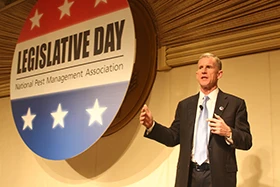


WASHINGTON, D.C. — Ongoing efforts to raise awareness and educate congressional representatives about pollinator health and the structural pest control industry took center stage at this year’s NPMA Legislative Day. More than 300 industry professionals traveled to Washington, D.C., to promote this cause and also make their reps aware of three other legislative/regulatory issues of importance to the pest control industry: America’s Small Business Tax Relief Act of 2015 (H.R. 636); the Pest Management Records Modernization Act; and the Fair and Transparent Stakeholder Involvement Fee Act (H.R. 1091).
The most significant recent development regarding the pollinator health issue was the March 4 introduction of the Saving America’s Pollinators Act of 2015 (H.R. 1284), which requires the EPA Administrator to suspend the use of neonicotinoids until the agency can review the registration and declare that such insecticides do not cause adverse effects upon honey bees and other pollinators. Legislative Day attendees were asked to urge their congressional representatives to: (1) withhold support for measures that unfairly blame pesticides for the decline in bee health; and (2) monitor EPA’s proposed label language, ensuring that PMPs are permitted to legally use pesticide in structural settings.
“It’s particularly problematic because obviously our industry uses a number of neonicitinoids, and there really is no evidence that pesticides are the most important cause, or even an important cause, in pollinator decline,” said Jim Fredericks, director of technical services for the National Pest Management Association. “There are a lot of groups real interested in pointing the finger at pesticides simply because pesticides are their issue. We really believe that by villainizing pesticides it actually does pollinators a disservice. We encourage lawmakers and regulators that as they address the pollinator health issue they consider all sources, especially things like varroa mites, disease and forage.”
An important business-related issue at Legislative Day was efforts to raise support for H.R. 636, America’s Small Business Tax Relief Act of 2015. H.R. 636 would amend the Internal Revenue Code to make permanent after 2014 the $500,000 allowance for the expensing of depreciable business property (section 179 property) and the $2 million threshold after which the amount of such allowance is reduced. Both the allowance and the threshold amount are indexed for inflation for taxable years beginning after 2015. Essentially, Section 179 of the IRS tax code allows businesses to deduct the full purchase price of qualifying equipment from gross income from the year the equipment was purchased, rather than writing off the depreciation of the equipment over several years. It's an incentive created by the U.S. government to encourage businesses to buy equipment and invest in themselves. In early 2015 the U.S. House of Representatives acted quickly to make the $500,000 deduction permanent and forego the yearly ambiguity concerning the deduction. The U.S. Senate has yet to pass a companion bill. Without further action, the 2015 section 179 business expense deduction will revert to $25,000.
A new issue that has arisen for PCOs involved in fumigation work is a recent rulemaking proposed by the U.S. Department of Agriculture’s Animal and Plant Health Inspection Service establishing a $375 fee for export fumigations. NPMA and others believe this is an exorbitant and costly fee and has been working with other groups — and with congressional members — in efforts to make the rulemaking more reasonable and workable. NPMA has joined with the U.S. Chamber of Commerce, National Association of Manufacturers, American Trucking Associations, American Association of Port Authorities, World Shipping Council, National Grain and Feed Association and many other organizations in calling for APHIS to withdraw the rulemaking and instead meet with affected stakeholders to develop a more reasonable AQI fee rulemaking. These groups have already gained support in Congress. On Feb. 25, 2015, Rep. Frederica Wilson (D-FL), introduced H.R. 1091, the Fair and Transparent Stakeholder Involvement Fee Act, which would require APHIS to use negotiated rule making concerning the AQI fees rule.
NPMA and its members once again asked Congress to pass the The Pest Management Records Modernization Act, which would permit pest management professionals to electronically convey information to consumers and state agencies. The legislation, which passed the House last year but failed to pass the Senate just prior to the session ending in December, addresses the problem of certain states mandating pest control operators provide a hard copy consumer information sheet (e.g., pesticide records, use reports, consumer info sheets, etc.) at the time of service, or after service. Legislative Day attendees were asked to thank House members for their support and urge Senate members to support and pass the Pest Management Records Modernization Act.
Other Legislative Day highlights included:
- The Monday luncheon keynote presentation given by General Stanley McChrystal, former Commander of U.S. and International Forces in Afghanistan. In his presentation, McChrystal noted that many of the tactics he used to command troops can be applied business management. His presentation was sponsored by FMC Professional Solutions.
- Noted television journalist Chris Wallace, host of FOX News Sunday, recapped the mid-term congressional and gubernatorial elections and provided insights and a historian’s perspective into the race for the White House in 2016. His presentation was sponsored by Dow AgroSciences.
- Reid Wilson, editor of The Washington Post’s Read In edition and former editor-in-chief of National Journal’s The Hotline, gave the Tuesday morning session, which was sponsored by Control Solutions, Inc. Wilson provided an overview of Capitol Hill and reviewed big trends that will affect the 2016 Presidential election, as well as future elections.
- PCT presented its 18th annual Technician of the Year Awards, sponsored by BASF, to our winners: Scott Lupo, Batzner Pest Management, New Berline, Wis. – residential category; Randy Jahnke, Beaver Dam, Wis. – commercial category; and Morris Myles, Terminix, Memphis, Tenn. – termite category.
- Darrell Ennes, who worked as director of government affairs for Terminix International, was posthumously recognized with the FMC Legislative Day Award, on Monday. Ennes, who passed away in February, was actively involved with regulatory/legislative issues with the National Pest Management Association (NPMA), Association of Structural Pest Control Regulatory Officials (ASPCRO), and the National Conference of State Legislators (NCSL). (Watch video coverage).
FMC was the primary sponsor of NPMA Legislative Day. Co-sponsors included: Bayer, Control Solutions and Dow AgroSciences.
Latest from Pest Control Technology
- Earn CEUs from Your State at Next Week’s Mosquito Control Virtual Conference
- Preserving Culture, Providing Opportunities Key in Hoffman’s Decision
- Winter Weather Could Decide How Bad Mosquito Season Gets
- Trent Frazer Discusses How Mosquitoes Survive Winter
- Barnes Exterminating Acquires Tennessee Pest Solutions
- Pest Index Up 9% YOY in January
- Arrow Exterminators Acquires Hoffman's Exterminating
- PMPs Plan Mera Peak Summit for Parkinson's





