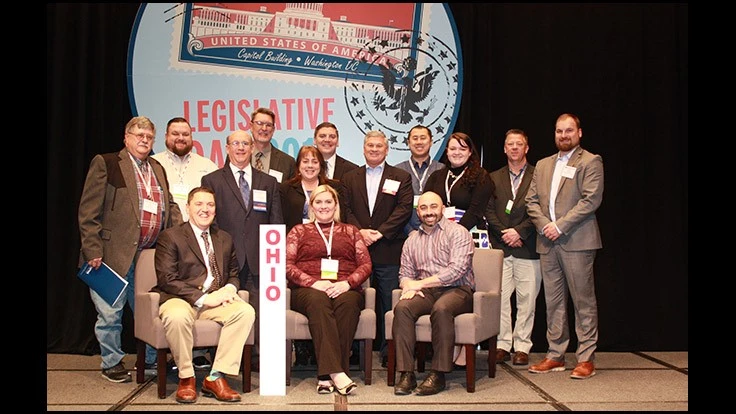
WASHINGTON, D.C. – While the current Congress remains deeply divided along party lines, PCOs who headed to Capitol Hill as part of NPMA Legislative Day left with optimism that their visits could influence current and policy. Part of the reason for this optimism is the pest control industry is backing legislation that may appeal to both sides of the aisle, particularly issues related to public health.
“There are great opportunities for you to build bridges and position yourself as a resource for whoever you are talking to,” said Jim Fredericks, vice president, technical and regulatory affairs, NPMA.
SMASH Act. One of the issues Legislative Day attendees advocated for at Legislative Day was support of HR 345, The Strengthening Mosquito Abatement for Safety and Health Act (SMASH Act).The SMASH Act passed the House in the 115th Congress and was included in a wider package on pandemic preparedness in the Senate. Unfortunately, despite broad bipartisan support, it did not pass in 2018, and was re-introduced in the 116th Congress as H.R. 345 (with a Senate companion bill expected to be introduced in by Sen. Angus King, D-Maine). The bill would extend CDC grants for mosquito control programs to include emerging mosquito-borne diseases and to improve existing control programs. The bill would also require a GAO report on the surveillance and control of emerging mosquito-borne infectious diseases in the United States and territories.
“Last year 2,544 cases of West Nile virus in the U.S., and 137 people died because of West Nile virus,” said Fredericks, who added that when Zika began making headlines NPMA was often called upon for its public health expertise.
REDTAPE ACT. A separate, but somewhat related issue is the pest control industry’s ongoing efforts to fight the requirement of National Pollutant Discharge and Elimination System (NPDES) permits, which the industry believes places an unnecessary burden on them. Despite the fact that pesticides applied in accordance with the Federal Insecticide, Fungicide and Rodenticide Act (FIFRA) have already undergone a thorough review during the EPA registration and reregistration processes, NPDES permits are required under the Clean Water Act any time chemical pesticides are used in, over or near Waters of the United States (WOTUS). The pest control industry, and other pesticide applicators, suffered a setback last year when legislation that would eliminate NPDES permits, H.R.953, the Reducing Regulatory Burdens Act, was not included in the final version of last year’s Farm Bill. However, this effort to eliminate NPDES permitting is still being actively pursued by various stakeholders, including NPMA, and legislation was recently introduced in the House, H.R. 890, The Reducing EPA Duplication to Advance Pesticide Enforcement Act (REDTAPE Act). Legislative Day attendees encouraged their representatives to support this legislation.
BED BUGS. Legislative Day attendees were seeking Congressional partners to help address the crisis of bed bugs, particularly when addressing infestations in affordable housing communities. Pest management professionals have positioned themselves as the best people to inspect, diagnose and craft an integrated approach to manage bed bugs, even in large multi-family dwellings, rather than depending on do it yourself efforts that often only perpetuate the problem and contribute to insecticide resistance. NPMA hopes that members of Congress will be willing to engage with affected industries and find a path forward to help manage bed bug infestations, particularly for those who are unable to afford treatment on their own. Ashley Amidon, vice president, public policy, NPMA, said Legislative Day attendees were to use their visits to gauge interest. “Whether it’s grants to do studies, or dealing with bed bugs in lower income housing we have some ideas, but we want to know what your boss thinks,” Amidon encouraged attendees to share with congressional aides. She added that once NPMA gets a feel for which legislators might be open to partnering, they will work on scheduling longer, targeted visits.
TAX ISSUES. Legislative Day attendees also used their Capitol Hill visits to encourage their reps to support a pair of tax issues that can have positive trickle-down effects: HR. 216 (The Main Street Tax Certainty Act) and the Tax Cuts and Jobs Act (TCJA). The Main Street Tax Certainty Act is bipartisan bill, sponsored by Reps. Jason Smith (MO-8) and Henry Cuellar (TX-28), that makes the Section 199A deduction permanent. The Section 199A deduction is popular fo for pass-through businesses – companies such as partnerships, S corporations, and sole proprietorships. Without H.R. 216, this deduction expires in 2026. Section 199A of the federal tax code allows small businesses to deduct up to 20% of qualified business income (QBI). QBI is the net amount of income, gain, deduction, and loss relative to the business. After the deduction, the remaining income would be subject to the appropriate individual rate. With H.R. 216 and a 20% deduction under a maximum individual tax rate of 37%, the effective tax rate for pass-through entities is cut to 29.6%. If H.R. 216 is not passed, small businesses will see their tax rates increase. Legislative Day attendees were tasked with asking their reps to support H.R. 216 to permanently secure a bipartisan tax deduction for small businesses.
NPMA also supports the Tax Cuts and Jobs Act (TCJA). The legislation, passed by Congress in December 2017, made significant progress in improving the cost recovery treatment of business investment by enacting 100 percent bonus depreciation for shortlived assets (Section 168(k)). This provision allows businesses to immediately deduct the full cost of short-lived investments, similar to the treatment of other business expenses, rather than stretching deductions over many years. However, it is only scheduled to be in full effect for five years, then phase down. It will begin to phase out in 2023 and will expire in its entirety at the end of 2026.
Latest from Pest Control Technology
- Earn CEUs from Your State at Next Week’s Mosquito Control Virtual Conference
- Preserving Culture, Providing Opportunities Key in Hoffman’s Decision
- Winter Weather Could Decide How Bad Mosquito Season Gets
- Trent Frazer Discusses How Mosquitoes Survive Winter
- Barnes Exterminating Acquires Tennessee Pest Solutions
- Pest Index Up 9% YOY in January
- Arrow Exterminators Acquires Hoffman's Exterminating
- PMPs Plan Mera Peak Summit for Parkinson's





