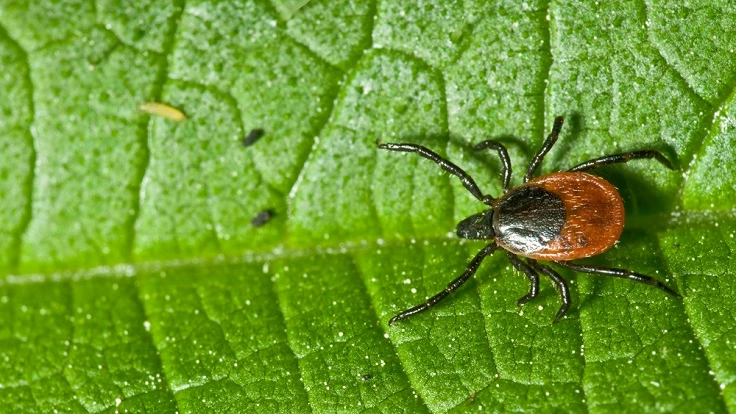
ANNAPOLIS, Md. — Since white-tailed deer serve as the primary host for the adult blacklegged tick (Ixodes scapularis) — the vector for Lyme disease — scientists have wondered whether reducing the number of deer in a given area would also mean fewer cases of Lyme disease. Now, after a 13-year study was conducted, researchers in Connecticut have found that reduced deer populations can indeed lead to a reduction in Lyme disease cases. The results of their study are published in the Journal of Medical Entomology.
The researchers surveyed 90–98% of all permanent residents in a Connecticut community from 1995 to 2008 to document their exposure to tick-related diseases and the frequency and abundance of deer observations. After hunts were initiated, the number and frequency of deer observations in the community were greatly reduced, as were resident-reported cases of Lyme disease.
The number of resident-reported cases of Lyme disease per 100 households was strongly correlated to deer density in the community, they found. Reducing deer density to 5.1 deer per square kilometer resulted in a 76% reduction in tick abundance, a 70% reduction in the entomological risk index, and an 80% reduction in resident-reported cases of Lyme disease.
Click here to read the entire story.
Source: ESA
Latest from Pest Control Technology
- Earn CEUs from Your State at Next Week’s Mosquito Control Virtual Conference
- Preserving Culture, Providing Opportunities Key in Hoffman’s Decision
- Winter Weather Could Decide How Bad Mosquito Season Gets
- Trent Frazer Discusses How Mosquitoes Survive Winter
- Barnes Exterminating Acquires Tennessee Pest Solutions
- Pest Index Up 9% YOY in January
- Arrow Exterminators Acquires Hoffman's Exterminating
- PMPs Plan Mera Peak Summit for Parkinson's