Modern Pest Services
BRUNSWICK, Maine – Pests are an unavoidable part of homeownership, but how prepared do Americans actually feel to deal with them? To understand how homeowners think about pest control and which myths still shape behavior, Modern Pest Services, an Anticimex company, surveyed 1,006 U.S. adults about their experiences, beliefs and misconceptions when it comes to pests in the home.
The results reveal a population that’s trying hard to stay ahead of pest problems, but often relies on DIY fixes, mixed information sources and long-held myths that don’t always hold up, Modern Pest Services said.
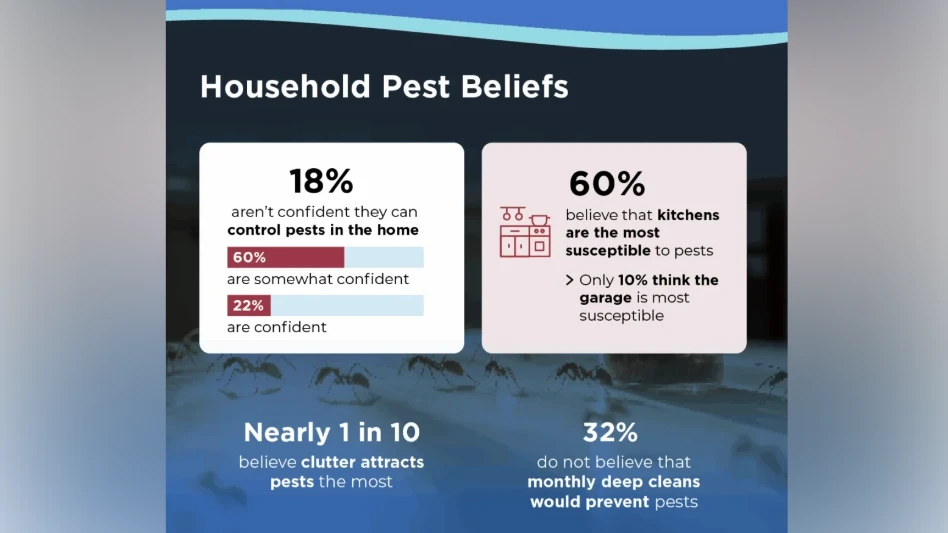
Most Americans Feel Somewhat Prepared — But Not Fully Confident. Most Americans feel they have some handle on pest control, but few feel fully confident. Just 22% say they’re confident in their ability to outsmart pests in their home, while the majority (60%) describe themselves as only somewhat confident. Nearly one in five (18%) admit they’re not confident at all, according to Modern Pest Services.
That uncertainty hasn’t stopped people from taking action, nearly everyone surveyed (97%) have tried at least one home remedy to deter pests. Store-bought pesticides are the most common solution by far, used by 72% of respondents. Half have relied on traps, and 44% have tried scent-based deterrents like peppermint oil, lavender or cinnamon. Many homeowners also experiment beyond traditional products, the company found. Sticky pads and bait stations have each been used by 41%, while vinegar (38%) remains a popular household fix. About one in five have poured bleach down drains or used borax. Less Americans report trying mothballs (14%), dryer sheets (14%), coffee grounds (12%), steel wool (12%), ultrasonic devices (14%), light-based devices (11%) or even cheese as mouse bait (13%). Only 3% say they haven’t tried any of these methods.
Kitchens are Ground Zero for Pest Anxiety. When asked where pests are most likely to invade, Americans overwhelmingly point to the kitchen, Modern Pest Services said. Six in ten (60%) believe it’s the most vulnerable area of the home. Far fewer cite basements (13%), garages (10%), or outdoor spaces and yards (11%) as the most vulnerable area.
That focus on kitchens makes sense given what people believe attracts pests most, the company said. Nearly three-quarters (73%) say food left out is the biggest draw. Standing water trails far behind at 11%, followed by clutter (9%) and dirt or dust (5%). Bright lights rank last, with just 2% believing they attract pests the most.
Cleaning, in particular, is seen as a powerful line of defense. An overwhelming 95% believe that keeping a clean home is a form of pest control, and more than two-thirds (68%) think monthly deep cleans would help prevent infestations. Still, nearly a third (32%) aren’t convinced that even regular deep cleaning is enough to keep pests away.
Professional Pest Control is Trusted for Good Reason. More than half of Americans (54%) understand that professional pest control is the most effective option, and only 8% say DIY methods work best, according to Modern Pest Services.
Among those who favor professional services, 77% point to better material applications, and nearly three in four (73%) believe professionals deliver longer-lasting results. Better pest identification (65%) and more innovative methods (59%) are also reasons why Americans turn to the pros, according to the company.
Still, many homeowners don’t realize the limits of DIY solutions until after the fact, Modern Pest Services said. More than half of Americans (55%) say they’ve discovered that something they once believed about pest control was incorrect. The most common realizations involve the effectiveness of DIY or store-bought products (28%) and how quickly pest problems can actually be resolved (24%). Others learned they were mistaken about how safe treatments are (15%), the causes of infestations (14%), how often pest control is needed (13%), and which pests are active in their area (12%).
Myths and Misconceptions About Pest Risks. Health concerns play a major role in how Americans think about pests, Modern Pest Services reported. More than half (53%) believe health risks from rodents are very serious, while another 43% consider them somewhat serious and 4% dismiss the risks altogether.
However, when asked which household pests are most dangerous for disease transmission, six in ten Americans (61%) said rats pose the greatest disease risk. Mosquitoes come in second at 17%, followed by roaches (10%). Bed bugs (7%), fleas (3%) and houseflies (2%) trail far behind. Only the 17% of homeowners who cited mosquitoes as the most dangerous in terms of disease were correct in their assumption, making mosquito control services especially beneficial — as the CDC identifies mosquitoes as the world’s deadliest animal due to the diseases they transmit, Modern Pest Services reported.
Perceptions of danger don’t always align with reality, especially when it comes to venom. The pest most often believed to have the most poisonous bite or sting is the brown recluse (or “lacrosse”) spider at 42%, closely followed by the black widow at 40%. Scorpions account for 10%, while wasps (4%), fire ants (3%) and bees (1%) receive minimal concern. The black widow is the pest that actually proves to be most poisonous in North America according to Smithsonian.
Longstanding pest myths continue to influence homeowner behavior, Modern Pest Services said. Nearly six in 10 Americans (59%) believe cats are usually a good mouse deterrent. Around 29% think essential oils repel pests and 27% still believe mice love cheese. One in five believe ultrasonic devices work, and 16% think pests only enter through cracks and holes. Just 21% reject all of these statements.
Ecofriendly pest control options also generate mixed opinions. While 79% believe ecofriendly options are safe for the environment, only 48% think they work as well as chemical treatments. When asked which ecofriendly methods are most effective, traps (24%) and diatomaceous earth (23%) lead the list, followed by plant-based oils (17%), baking soda (9%), and predator insects (7%). One in five remain unsure.
Where Americans Got it Right: Termite Damage. When it comes to threats to the home itself, Americans are far more unified, the company found. More than three-quarters (76%) identify termites as the most detrimental pest to a home’s structure, and they are correct— according to the University of Kentucky’s Entomology Department, termites cause billions of dollars in damage each year in America. Rodents rank a distant second at 15%, while carpenter ants (5%), wood-boring beetles (3%) and squirrels (1%) barely register.
While Americans seem confident about the damage termites can cause, there’s far more uncertainty when it comes to other pest concerns, which is where professional expertise could be most necessary, Modern Pest Services said. Solutions like termite treatments can help homeowners protect their home from pests that cause the most damage, according to the company.
DIY Knowledge Comes From Mixed Sources. Americans are eager to manage pests on their own; but, many aren’t turning to professionals for information, Modern Pest Services said. Only 10% say pest control companies are their primary source of guidance.
Instead, many rely on more informal sources. About 22% turn to YouTube or DIY videos, and an equal share (22%) consult online forums. Family and friends influence 15% of homeowners, while one in 10 turn to home improvement websites. Social media plays a smaller role at 9%, and 12% admit they don’t research pest control at all.
These mixed and sometimes unreliable sources of information may help explain why misconceptions remain common, Modern Pest Services said. It may also point to why many homeowners later realize they were incorrect about proper pest control methods.
Outsmarting Pests the Right Way. Americans are clearly motivated when it comes to pest control, the company said. Most understand the risks pests pose and are willing to try a wide range of solutions to protect their homes. But Modern Pest Services said the data shows that effort doesn’t always translate into effectiveness. Limited confidence, persistent myths and an overreliance on DIY approaches often leave homeowners dealing with recurring issues or problems that never fully get resolved, the company reported.
The most effective path forward, Modern Pest Services said, combines prevention, education and professional insight. Understanding which pests are common in your area, how they behave and what early warning signs to watch for can make a meaningful difference. Professional pest control helps close the gap by pairing that knowledge with accurate identification, proven treatment methods and longer-lasting results, the company said.
Source: Modern Pest Solutions
Methodology
This survey was conducted among 1,006 U.S. adults. Respondents included 50% men, 49% women, and 1% non-binary. Data reflects self-reported attitudes, behaviors and beliefs related to household pest control.
Latest from Pest Control Technology
- BOM Hosts Dinner at NPMA Legislative Day
- Rear Admiral Scott Moore Shares Five Essential Leadership Principles
- 2026 NPMA Legislative Day Photo Gallery
- Fleetio Launches AI Service Advisor
- Shannon Sked Discusses Preemption and Legislative Day Importance
- Routes to Riches with Kemp Anderson: Ep. 1 — 2026 Outlook
- NPMA Honors Industry Leaders At 2026 Legislative Day
- NPMA Legislative Day Highlights Farm Bill Momentum and Push for Pesticide Preemption