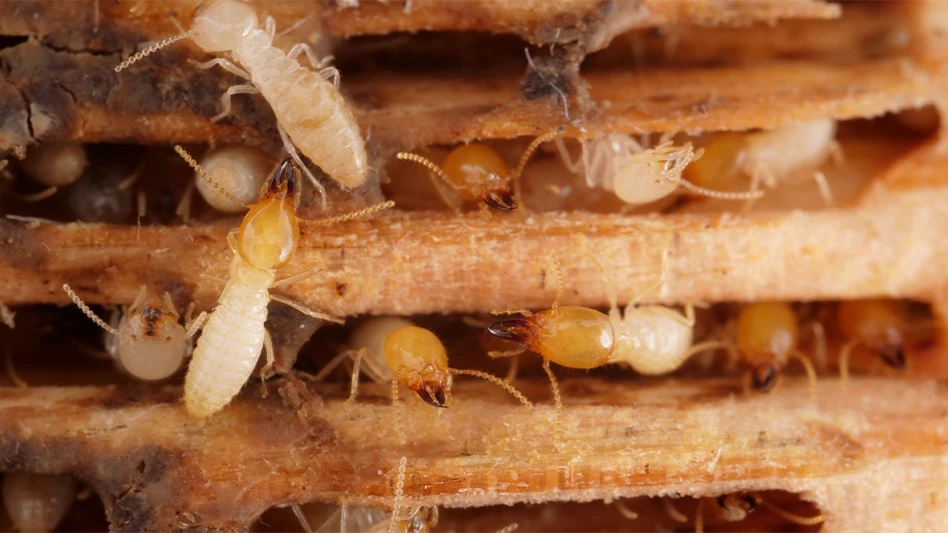
Photo: Thomas Chouvenc
DAVIE, Fla. — A new nationwide initiative is uniting scientists and industry professionals across the United States to stay ahead of destructive invasive termites.
Known as the North American Termite Survey (NATS), the effort is designed to help states track the spread of the Formosan subterranean termite, identify risk areas and detect infestations before structural damage becomes widespread.
As urban development and global trade continue to speed up termite spread, mass surveillance is becoming an essential defense. NATS researchers say the collaboration between science and industry operating at a national scale offers the opportunity to detect risk early and protect homes and infrastructure before costly damage occurs.
“NATS is a working group of Extension and research structural entomologists from academia, government and the pest management industry across 12 states who plan to accelerate national collaboration in termite surveillance and response,” said Thomas Chouvenc, associate professor of urban entomology with the University of Florida’s Institute of Food and Agricultural Sciences (UF/IFAS) at the Fort Lauderdale Research and Education Center.
Taking a nationwide approach was important to the working group for several reasons.
“Research shows that invasive species are introduced to the United States regularly and can spread long distances in a short period of time due to human activity,” said Aaron Ashbrook, a NATS team leader and assistant professor of urban/peri-urban entomology at Louisiana State University Ag Center. “Depending on the state, a survey may not have been conducted in 10 years or more. Additionally, by having NATS members promote the survey within their states, the message reaches the target audience more effectively and increases participation.”
The coordinated effort has resulted in over 300 survey participants for the alate trapping program, which focuses on the winged termites that leave their colonies in swarms to mate and establish news ones. Formosan subterranean termites were detected in 13 new counties across the Southern U.S. NATS launches just as two invasive species, the Formosan subterranean termite and the Asian subterranean termite, expand into new parts of Florida. The movement is reflected in Chouvenc’s latest study, charts existing infestations and models where they are likely to spread next.
“This new study provides a blueprint to all members of the recently established North American Termite Survey group so that all affected states can also properly determine areas at risk by the Formosan subterranean termite,” he said.
Termites cause billions of dollars in structural damage worldwide annually, and invasive species heighten the threat because they often go undetected until damages are seen.
“Subterranean species are especially difficult to identify early because they live largely underground or concealed within structures,” he said. “Not only are they hard to detect, but they are also rarely reported, making tracking their spread much more difficult.”
Historically, that underreporting led scientists to underestimate how far the species had advanced. To address the gap, the UF/IFAS termite research group built a long-standing partnership with hundreds of pest control providers across Florida. By submitting samples to the University of Florida Termite Collection service, these professionals have helped researchers confirm species. This growing dataset, publicly available through a UF/IFAS statewide termite distribution map, has become a model for NATS as participating states move toward standardized monitoring and reporting.
“With increasing sample participation, we have improved our understanding of where and when these invasive species are establishing in new places,” Chouvenc said. “Those samples give us the clarity we need to confirm species and guide effective treatment.”
With improved clarity, however, comes concerning trends. Researchers project that all Florida counties could be at risk for the spread of Formosan subterranean termites by 2050, with most large urban areas already at risk. The Asian subterranean termite is expected to be detected in all 24 southernmost Florida counties by 2040. An estimate first made in 2016, that by 2040 half of all structures in the urban South Florida metropolitan area could face infestation risk, has now been reaffirmed.
The data helps researchers, industry experts and policymakers visualize the spread and strengthen preparedness efforts. What began as a Florida-focused monitoring project is now shaping a nationwide strategy to anticipate termite expansion.
Latest from Pest Control Technology
- Terminix Strikes a Chord With Preventative Push in New ‘Ahhh’ Campaign
- Company Compassionately Solves a Severe Rodent Infestation
- Earn CEUs from Your State at This Week’s Mosquito Control Virtual Conference
- Jody Green Talks Ticks at Purdue Conference
- Truly Nolen Pest Control Promotes Freize, Hackett
- Preserving Culture, Providing Opportunities Key in Hoffman’s Decision
- Winter Weather Could Decide How Bad Mosquito Season Gets
- Trent Frazer Discusses How Mosquitoes Survive Winter