NPMA
FAIRFAX, Va. - According to the National Pest Management Association (NPMA)'s bi-annual Bug Barometer® forecast, milder-than-normal temperatures could extend pest activity well into the fall and even winter months across much of the United States.
The forecast, developed by NPMA's team of board-certified entomologists, analyzes long-term weather predictions and pest biology to provide region-specific insights for the coming months.
"Typically, pest activity tends to slow after the first official freeze," said Dr. Jim Fredericks, Senior Vice President of Public Affairs for NPMA. "But when colder temperatures are delayed, pests like ants, mosquitoes, and ticks continue to thrive, putting people and pets at risk for longer than expected."
This fall, NPMA is cautioning homeowners to stay vigilant as shifting weather conditions could lead to more pest encounters and a greater potential spread of West Nile virus and tick-borne illnesses like Lyme disease, babesiosis and alpha-gal syndrome. When colder weather does arrive, it'll likely push disease-carrying rodents indoors. Pests like mice and rats can carry over 35 diseases, including hantavirus, leptospirosis and the plague.
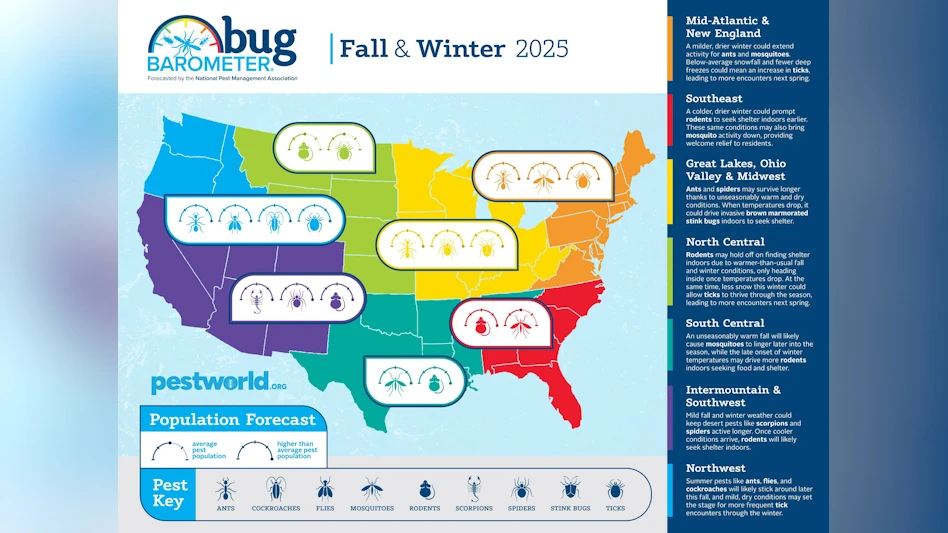
NPMA's Fall & Winter 2025 Bug Barometer® predictions include:
Mid-Atlantic & New England (Maine, New Hampshire, Vermont, Massachusetts, New York, Rhode Island, Connecticut, New Jersey, Pennsylvania, Delaware, Maryland, Washington, D.C., Virginia):
A milder, drier winter could extend activity for ants and mosquitoes. Below-average snowfall and fewer deep freezes could mean an increase in ticks, leading to more encounters next spring.
Intermountain & Southwest (New Mexico, Arizona, Utah, Colorado, Nevada, California):
Mild fall and winter weather could keep desert pests like scorpions and spiders active longer. Once cooler conditions arrive, rodents will likely seek shelter indoors.
South Central (Mississippi, Tennessee, Louisiana, Arkansas, Oklahoma, Texas):
An unseasonably warm fall will likely cause mosquitoes to linger later into the season, while the late onset of winter temperatures may drive more rodents indoors seeking food and shelter.
North Central (North Dakota, South Dakota, Nebraska, Kansas, Montana, Wyoming):
Rodents may hold off on finding shelter indoors due to warmer-than-usual fall and winter conditions, only heading inside once temperatures drop. At the same time, less snow this winter could allow ticks to thrive through the season, leading to more encounters next spring.
Great Lakes, Ohio Valley & Midwest
(West Virginia, Ohio, Kentucky, Indiana, Michigan, Wisconsin, Illinois, Iowa, Missouri, Minnesota):
Ants and spiders may survive longer thanks to unseasonably warm and dry conditions. When temperatures drop, it could drive invasive brown marmorated stink bugs indoors to seek shelter.
Southeast (North Carolina, South Carolina, Georgia, Alabama, Florida):
A colder, drier winter could prompt rodents to seek shelter indoors earlier. These same conditions may also bring mosquito activity down, providing welcome relief to residents.
Northwest (Idaho, Washington, Oregon):
Summer pests like ants, flies, and cockroaches will likely stick around later this fall, and mild, dry conditions may set the stage for more frequent tick encounters through the winter.
Latest from Pest Control Technology
- Arrow Exterminators Acquires Hoffman's Exterminating
- PMPs Plan Mera Peak Summit for Parkinson's
- NPMA Announces 2026 Impact Awards for Women in Pest Management Recipients
- Massey Services Promotes Farrell to GIS Director
- Earn CEUs at Next Week's Mosquito Control Virtual Conference
- NCPMA Graduates New Premier Technicians
- Pest Management Foundation Announces New Scholarships
- Coast Releases Report on Fuel Spend