Credit: Dennis Siebert
ST. PAUL, Minn. — Writer and philosopher Ralph Waldo Emerson coined the phrase “Build a better mousetrap, and the world will beat a path to your door,” which implies that if you invent or design something truly useful or superior people will take notice.
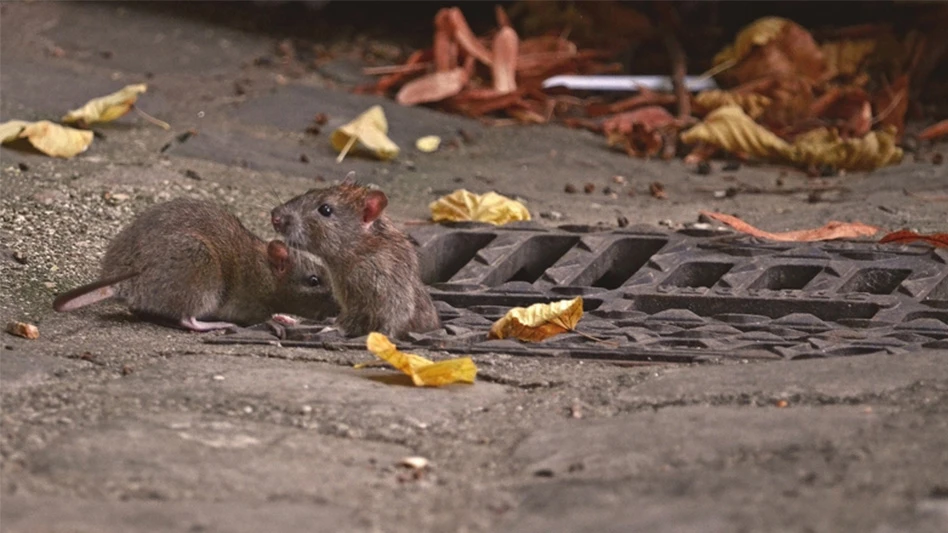
Attention was not the motivation for Dennis Siebert, owner of Arrow Pest Control, St. Paul, Minn., when he set out to build a better mousetrap. What drove him was a challenge every pest management professional knows all too well: capturing smart mice. “The problem really isn’t with traps and other devices/poisons we place — it’s more that certain house mice refuse to interact with our devices…and it seems to be getting worse,” Siebert said.
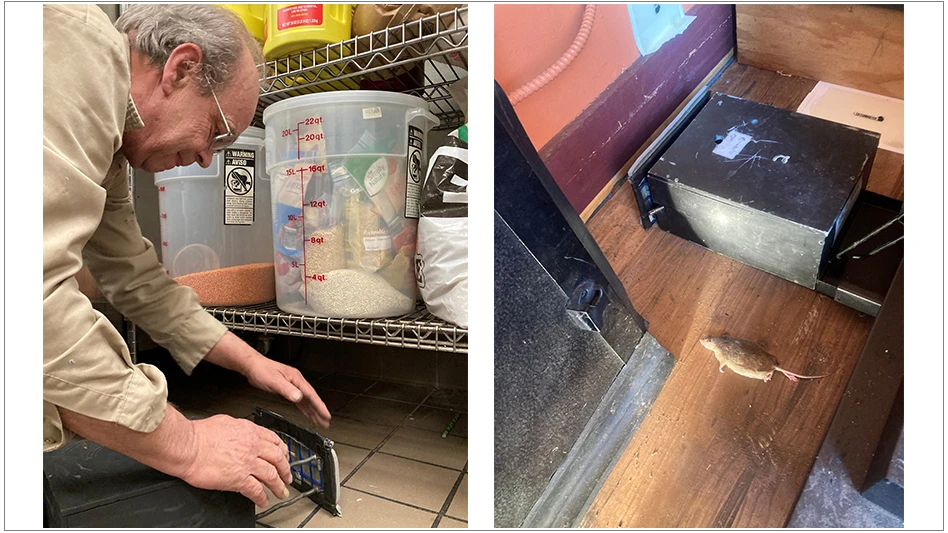
Siebert recalled a long battle with one particularly elusive mouse. “A residential customer had a mouse that avoided every type of trap – snap traps, glueboards, wind-up traps, even baits,” he said. “Despite at least eight visits to the home, the mouse never seemed to fall for any of the [conventional] methods.”
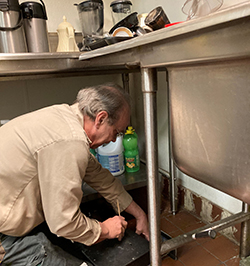
Then, after the customer saw the mouse scurry behind a box, she kicked the box against the wall — effectively smashing it — and the proverbial light bulb lit up for Siebert, a mechanically inclined PCO who once worked as a typewriter repairman. He went to work building a prototype, developing what he would later brand the Smasher Trap. About the size of a small shoe box, it is designed to be set about four inches from a wall. When the mouse walks between the trap and the wall, a spring-loaded paddle is triggered, gently striking the mouse with foam padding, leaving no blood or mess. “It’s simple, humane, and effective,” said Siebert, who patented the Smasher Trap in 2023.
Next up was testing the trap in real-world environments, including grocery stores and restaurants, where traditional methods often failed. In one grocery store, where a mouse infestation had caused the business to fail inspections, Siebert set just three of his traps. Over six weeks, his traps killed 54 mice, while the dozens of traditional traps used at the store by another pest control company caught nothing but baby mice. The Smasher Traps also have been used in other commercial settings with success, said Siebert, who noted that at one restaurant, his traps caught 18 adult mice and 7 young ones over 17 days.
Siebert has encountered barriers to bringing this technology to market. With the battery and sensor, each trap costs Siebert about $100 to manufacture. “But I’m only buying one or two sensors at a time. If you were to scale it up and purchase in larger quantities, the cost per unit could go down significantly. Plus, there are probably alternative sensors out there that are more affordable and could still get the job done.”
Due to these costs, Siebert said manufacturers have been hesitant to partner on production of the Smasher Trap, citing concerns about return on investment (ROI).
Regardless, Siebert sees a place in the pest control industry for the Smasher Trap, which he said is not intended to replace existing rodent control products, but rather to complement them. In other words, the trap is a targeted solution pest control companies can use when conventional methods fail to kill that elusive smart mouse. “For example, if a client repeatedly reports mouse sightings despite ongoing treatments with standard baits, a technician would then deploy the trap,” he said.
Siebert said his goal is not to become wealthy off his invention, but to provide a product that helps solve mice problems. "I get calls from people who’ve been trying everything, and nothing works," Siebert said. "I show up, set up my trap, and within hours, it starts catching mice."
Latest from Pest Control Technology
- Google Ads Mistakes That Cost PCOs Thousands
- Zach DeVries Details his Cockroach Research, Importance of UK Short Course
- Sprague Strengthens California Leadership Through New Appointments
- PestInsight Empowering Youth in Africa and Beyond Through Education
- Guest Editorial: Making Safety the Standard on Every Service Call
- Truly Nolen Pest Control Promotes Tuck, Stewart
- Little to No Hesitance When Asking for Customer Reviews, PCOs report
- Arrow Termite & Pest Control (La.) Acquires Ark-La-Tex Exterminators