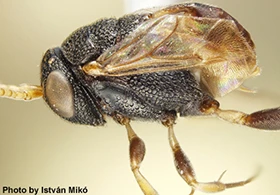
Researchers have discovered several new species of ensign wasps from Sub-Saharan Africa and have published their findings in the journal PLOS ONE.
“We didn’t know these new species existed until now, and at least two of them — Trissevania heatherae and T. mrimaensis — are found only in a small patch of forest in Kenya that is threatened by mining activity,” said Andy Deans, associate professor of entomology at Penn State University.
The researchers examined wasps belonging to the family Evaniidae and they named five new species. One of them, Trissevania slideri, is named after their colleague David “Slider” Love, coordinator of farm and greenhouse operations at Penn State University. The scientists also created an identification key for the a new tribe called Trissevaniini.
The new species are even more fascinating because they are the first known insects to exhibit transverse folding of the fore wing. The scientists made this discovery, in part, by using a technique they developed that provides broadly accessible anatomy descriptions.
Click here to access this journal article.
Latest from Pest Control Technology
- Earn CEUs from Your State at Next Week’s Mosquito Control Virtual Conference
- Preserving Culture, Providing Opportunities Key in Hoffman’s Decision
- Winter Weather Could Decide How Bad Mosquito Season Gets
- Trent Frazer Discusses How Mosquitoes Survive Winter
- Barnes Exterminating Acquires Tennessee Pest Solutions
- Pest Index Up 9% YOY in January
- Arrow Exterminators Acquires Hoffman's Exterminating
- PMPs Plan Mera Peak Summit for Parkinson's





