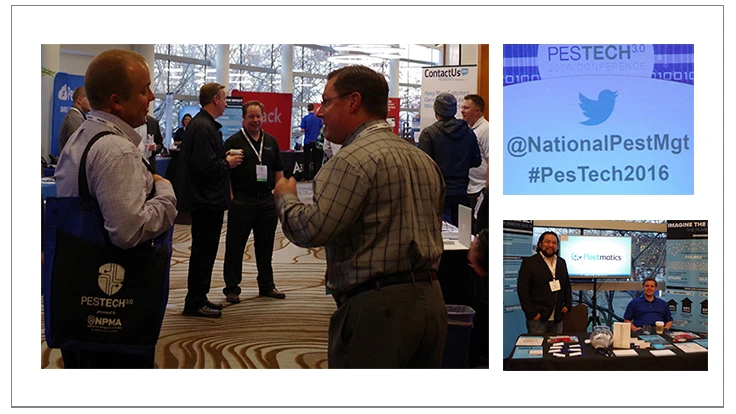
SAN JOSE, Calif. — PesTech 3.0 offered attendees a glimpse of the latest digital technologies that will shape not only how their businesses are run but dictate how customers will research, purchase and interact with them.
Digital pioneer and Microsoft co-founder Bill Gates was quoted saying, “We always overestimate the change that will occur in the next two years and underestimate the change that will occur in the next 10. Don't let yourself be lulled into inaction.”
Attendees at the National Pest Management Association’s PesTech 3.0 Conference in San Jose were challenged not to let their companies or industry fall behind the current digital revolution that is changing consumer and social behavior across the globe and neighborhoods around the corner.
More than a decade removed from NPMA’s initial PesTech events that ushered in the new millennium and introduced pest management professionals to the infinite possibilities of the worldwide web and wide scale adoption of tools such as email, PesTech 3.0 offered attendees a glimpse of the latest digital technologies that will shape not only how their businesses are run but dictate how customers will research, purchase and interact with them.
“This event is why NPMA is here – to protect and promote members’ businesses and to lead the way into the future,” said NPMA President Russ Ives of Rose Pest Solutions in Troy, Mich.
Keynote speaker Peter Leyden, founder and CEO of Reinvent, a new media startup focused on connecting top innovators in video conversations and former managing editor of the original Wired magazine, and a frequent speaker on new paradigms in technology, told attendees one of the challenges for 21st century business owners is embracing the rapid growth and adoption of technology.
Leyden referred to Moore’s Law (named after Intel co-founder Gordon Moore) whose observation of the history of computing hardware found the number of transistors in a dense integrated circuit has doubled approximately every two years.
Translated into a business definition Moore’s Law says that every two years the capacity for storing and using data – which is the driving force of technological and social change, business productivity and economic growth – doubles.
“Seventy-five percent of the world has a mobile phone and nearly half are connected to the web and there is still substantial room for growth,” said Leyden.
Recognizing how fast consumers are adopting new technologies, when the tipping point will arrive in the market and how to organize their company’s operational and marketing efforts to keep up and take advantage of these new paradigms is a challenge PMPs face.
Leyden also pointed to the growing impact video is having on consumers and marketers trying to reach audiences that are turning in ever-growing numbers to watch videos to be informed, entertained and connected.
“By 2018, 90 percent of web traffic will be video and the challenge is figuring out how to leverage video to benefit for your business,” said Leyden.
The pest management industry could benefit from video since many aspects of the industry have visual appeal. A video of a home inspection that provides tips for homeowners on how to prevent pests from gaining access or shows damage from termites can be impactful.
Another aspect of the digital era impacting how pest services are sold and serviced is understanding the future customer base – millennials. Defined as those age 17 to 35 years old, millennials are the largest segment of the U.S. population (84 million) and workforce (35 percent). Their adoption and use of technology is forcing service providers to adjust their approach to marketing and customer service.
In addition to being tech savvy the millennial generation is recognized for being collaborative, ethnically diverse, global, very green and more civic-minded than most observers think. Their influence is being felt not only in the business arena but in politics, social attitudes and the environment, said Leyden.
When asked how the technology revolution will impact service industries like pest management in the years ahead, Leyden pointed to opportunistic areas that can attract new customers and expand service offerings.
Building Construction Practices – New construction and retrofitting of existing structures will place a heavy emphasis on sustainable building and maintenance practices such as LEED where credits can be earned by incorporating IPM-based pest solutions.
Population Shift – With more people returning to urban centers to live and work, communal living in apartments and condominiums will become more popular and that brings with it a need for professional pest management services to control bed bugs, rodents and cockroaches.
More Regulation – The focus on sustainability will likely add pressure to enact additional regulations and requirements to use products that leave the smallest environmental footprint possible.
Another topic that was discussed was the impact disruptive technology such as data/identity theft, social media and marketing pest services through Uber-like on-demand model.
Responding to customer reviews on Yelp!, protecting customers’ credit card and account information, and determining what apps to develop to facilitate customer interaction, leaves pest management companies to face challenges or opportunities depending on where you stand, that previous generations of PMPs never had to tackle.
Garrett Thrasher of Thrasher Termite & Pest Control in San Diego encouraged fellow pest professionals to embrace disruptive social media technology like Yelp! and look at it as an opportunity to position your company in a positive light with consumers.
“Use negative reviews as a chance to connect with customers and strengthen or rebuild the relationship you have with them,” said Thrasher. “Responding in a timely, professional fashion to posts, especially negative ones isn’t easy but it is a must if you are going to successfully participate in social media.”
The wide array of software systems and digital products designed to assist pest management professionals route more efficiently, connect with customers on mobile platforms and dice and splice data to help identify new customers can leave a company at wits end when trying to determine what system works best for them.
Cautionary tales were shared from PMPs who have invested significant time and resources trying to find the right technology and attendees were encouraged to do their homework before buying, do the necessary prep work to make sure your current infrastructure will support the new technology, secure buy-in from staff, and select technology that fits your business objectives.
Second-generation PMP Justin McCauley of Arkansas-based McCauley Services and chairman of the NPMA’s Technology Committee that helped develop the PesTech 3.0 program, said the conference’s goal was to not only introduce pest professionals to new ideas and ways of incorporating technology in their businesses but to reaffirm the advances that have already been made.
“Using technology to improve operating efficiencies as well make communicating with customers easier and faster lets consumers know our industry is adopting and embracing technology to make our services easier to buy and use,” said McCauley.
(Photos courtesy of Allie Taisey, NPMA)
Latest from Pest Control Technology
- Earn CEUs from Your State at Next Week’s Mosquito Control Virtual Conference
- Preserving Culture, Providing Opportunities Key in Hoffman’s Decision
- Winter Weather Could Decide How Bad Mosquito Season Gets
- Trent Frazer Discusses How Mosquitoes Survive Winter
- Barnes Exterminating Acquires Tennessee Pest Solutions
- Pest Index Up 9% YOY in January
- Arrow Exterminators Acquires Hoffman's Exterminating
- PMPs Plan Mera Peak Summit for Parkinson's





