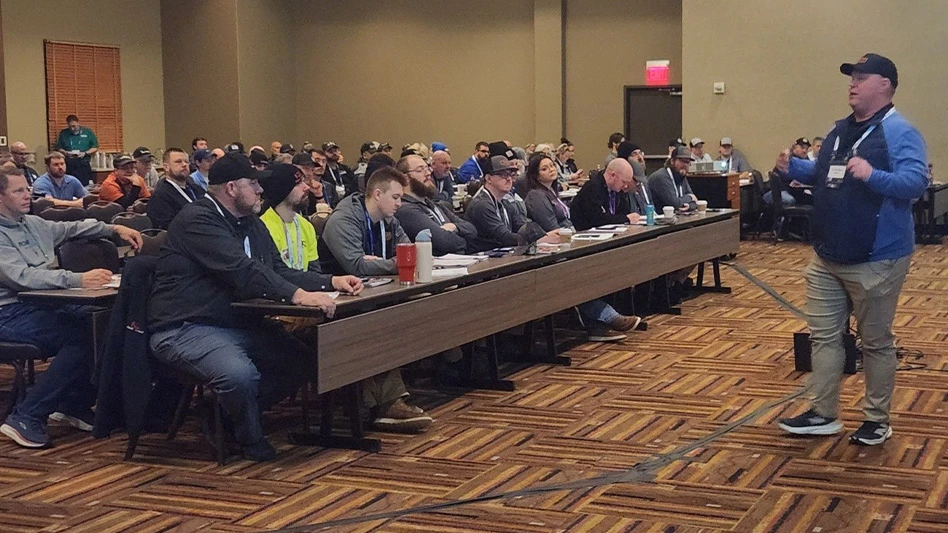
WEST LAFAYETTE, Ind. — The pest control industry is rooted in education and innovation, and an important goal of the 80th Annual Purdue Pest Management, held last week at Purdue University in West Lafayette, Ind., was to build on that foundation. With that goal in mind, attendees learned from industry experts on a variety of cutting-edge pest management topics.
In kicking off this year’s event on Monday, Gary Bennett, coordinator for the Purdue Center for Urban and Industrial Pest Management, noted that the 2016 Industry Planning Committee developed a wide-reaching program that meets the needs of today’s and tomorrow's pest management professional.
In keeping with the theme of progressive pest management, Jay Bruesch, technical director, Plunkett’s Pest Control, addressed the importance of pest control as a “thinking man’s game” during his presentation, “Pest Vulnerability Points – Use in Prevention.” Bruesch said he gets frustrated when PMPs search for and rely on “silver bullet” solutions when all of the answers for controlling pests can be found by having a thorough understanding of your target pest; knowing each pests’ weaknesses and how to exploit those weaknesses; and being able to quickly and easily spot pests.
Bruesch said one of the most important tools a PMP can have in his arsenal is a reference manual such as the Mallis Handbook of Pest Control, NPMA Field Guide to Structural Pests and Truman’s Scientific Guide to Pest Management Operations. He said it’s not enough to learn pest behavior and biology once; it must be constantly re-learned. He cited that his copy of the NPMA Field Guide to Structural Pests has smudge marks on every page from being referenced so frequently. “Some of today’s products work so well that we’ve gotten away from the basics,” Bruesch said. “All of the answers needed to solve pest problems are in these books.”
Bruesch then reviewed a variety of pests and how their weaknesses can be exploited, including:
Stored product pests — Time is your biggest ally. These pests take several weeks to complete their life cycle (from egg stage to several larval stages to a pupal stage, and finally an adult stage). Using the first-in first-out food rotation method, for example, can ensure that stored product pests don’t have enough time to develop in raw materials.
Mice — They need a place to hide. “At some primitive, cognitive level they know they are near the bottom of the food chain, so their ability to find food, shelter and water is largely governed by predator avoidance.” As a result, place your traps in dark places where mice hide and feel safe, Bruesch said.
Ants – Trophallaxis is their Achilles heel. Ants use trophollaxis to share food with one another. This feeding tendency allows baits to be shared throughout the colony.
Birds – They invest a tremendous amount of energy building their nests. Bruesch said you can use this trait against them by knocking down their nest after it gets half or three-quarters built. Do this several times and a bird will get frustrated and move to a different location.
Bed bugs – Their love-hate relationship with heat. Bed bugs will initially be drawn to heat, but by the time they realize it is too hot, they will be baked to death.
Spiders – Their Achilles heel is their webs, which are big and visible and give away their location.
Carpenter ants – They require persistent moisture to lay eggs. Seeking out moisture sources can help you identify where they are nesting.
While Bruesch said that pests are “wily” and "persistent," it’s a fallacy to say they are “smart,” because unlike humans, they don’t have the ability to consider options outside of their current situation. In other words, humans really do have the upper hand because of their ability to: plan ahead; anticipate problems; use their knowledge to guide decisions; evaluate and adapt; and see the world through the eyes of others.
- Bed bugs remain a hot topic at Purdue. In his presentation “The Science and Practical Importance of Bed Bug Movement” Mark “Shep” Sheperdigian of Rose Pest Solutions reviewed when and how bed bugs move and how this can be used against these pests. While Shep noted that there is much more research needed to find out why bed bugs’ movement is akin to “musical chairs,” he reviewed some tendencies. For example, items such as beds, recliners and movie theater seats are more likely to have large bed bug populations (compared to a location like a car seat) because once bed bugs find a meal source they stop scavenging and “dig in.” “Bed bugs don’t do ‘Bun on a Run.’ They prefer a long, filling feast. They eat like Italian families.”
- Dini Miller, Virginia Tech University, shared some of her bed bug predictions in coming years. Miller has done a lot of work in multi-family facilities and she has a great understanding of the challenges in these facilities. She said that pest management professionals are needed to train facility personnel on how to inspect and monitor. Miller also said that the pest control industry needs to move away from giving customers extensive room prep sheets and focus more on treatments that include: vacuuming; chemical applications (especially with products that have good residual); use of steam and heat chambers; chamber fumigations; and encasements.
- This year’s conference also included presentations on ants, spiders, cockroaches, rodents, termites, wildlife pests and others. In addition, a separate set of food pest IPM sessions included presentations from Linda Mason (IPM in Food Pest Management); Judy Black (Impact and Implications of Global Food Safety); and Dan Collins (Food Pest Management in Unusual Situations).
PCT will have additional coverage of this year's Purdue conference throughout 2016.
(Pictured is Purdue's Gary Bannett and Dale Hodgson of Rose Pest Solutions).
Latest from Pest Control Technology
- Earn CEUs from Your State at Next Week’s Mosquito Control Virtual Conference
- Preserving Culture, Providing Opportunities Key in Hoffman’s Decision
- Winter Weather Could Decide How Bad Mosquito Season Gets
- Trent Frazer Discusses How Mosquitoes Survive Winter
- Barnes Exterminating Acquires Tennessee Pest Solutions
- Pest Index Up 9% YOY in January
- Arrow Exterminators Acquires Hoffman's Exterminating
- PMPs Plan Mera Peak Summit for Parkinson's